 Fluxx Tech
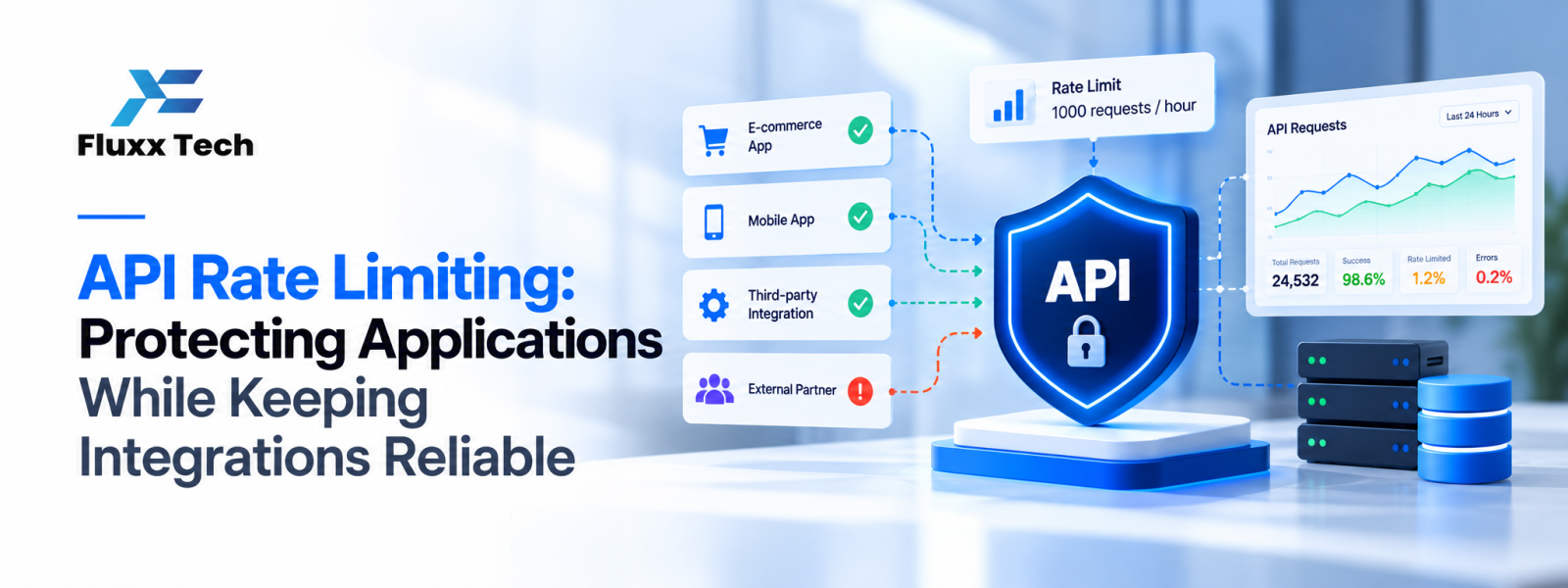
APIs need safeguards against accidental overload, abusive traffic and poorly behaved integrations. Rate limiting controls how frequently a client can make requests within a defined period. A well-designed policy protects shared resources while giving legitimate users predictable behaviour. Poorly designed limits can block valid traffic, create confusing errors or let one client consume too much capacity.
Set limits according to operation cost
Not all endpoints cost the same. A status check may be inexpensive, while a report-generation request may consume substantial resources. Define thresholds using expected usage and capacity. Consider separate policies for authenticated users, service accounts and anonymous traffic.
Choose a suitable strategy
Fixed-window counters are simple but can allow bursts around window boundaries. Sliding windows smooth usage; token-bucket approaches can permit controlled bursts. Select based on consistency needs and complexity. Document whether limits apply per user, API key, tenant, IP or a combination.
Return recoverable errors
When a client exceeds a limit, return an appropriate status such as 429 Too Many Requests and provide retry guidance where supported. Clients should respect Retry-After and use bounded exponential backoff with jitter. Immediate repeated retries can worsen overload.
Coordinate across instances
In a distributed deployment, independent in-memory counters may produce inconsistent results. A shared store or gateway-level control may be needed. Decide deliberately what happens if the limiting service fails, considering the endpoint's risk and business impact.
Observe the real effect
Track rejected requests, request volume, latency, endpoint costs and limit utilisation. Alerts should reveal whether a limit blocks normal customer activity. Avoid logging secrets and review policies after launches or changes in usage.
Common Mistakes to Avoid
Avoid one global limit for every endpoint, undocumented errors and immediate retry loops. Rate limits should be explained to developers and covered by integration tests.
Frequently Asked Questions
Is rate limiting the same as authentication?
No. Authentication identifies a client; rate limiting controls request frequency. They solve different but complementary problems.
Should API users know the limits?
Document the policy and communicate useful retry guidance so developers can build resilient integrations.
Conclusion
Rate limiting is both a reliability and developer-experience decision. Set limits according to resource cost, communicate them clearly and monitor the effect on legitimate customers.