Fluxx Tech
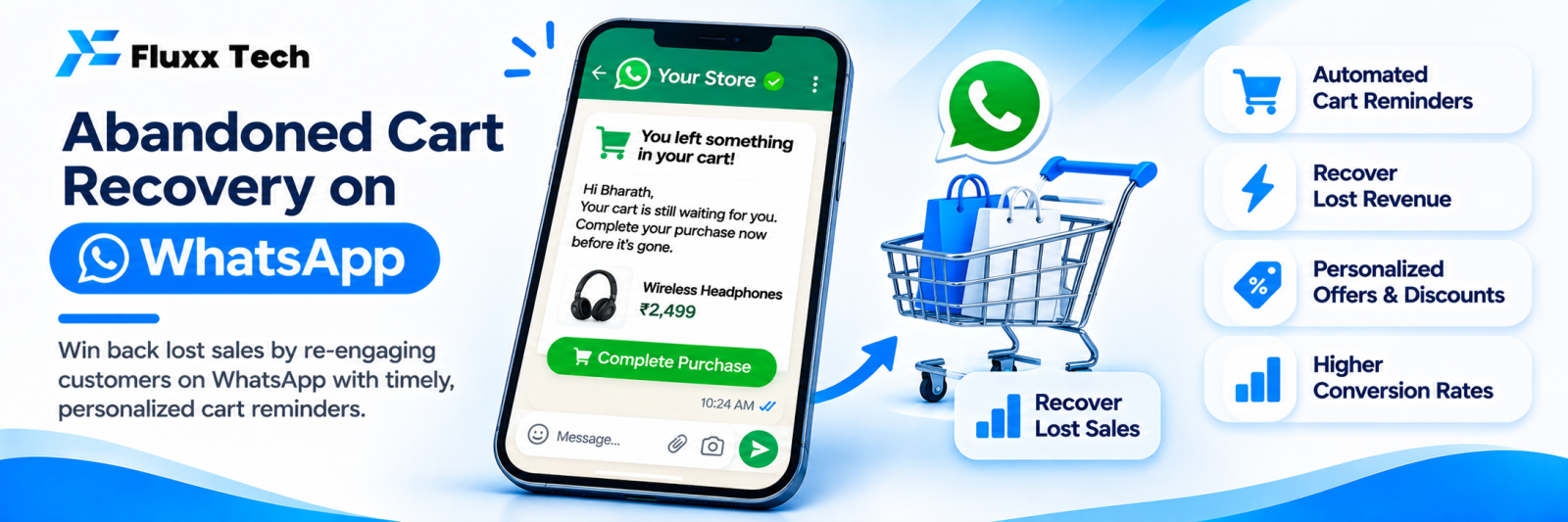
Most people who add something to a cart do not buy it. That is normal everywhere, and in India the rate tends to be high because of payment friction, delivery uncertainty and the habit of using the cart as a wishlist.
A recovery message brings back a meaningful share of them, and on WhatsApp it works considerably better than on email, because people actually read it.
Why carts are abandoned
Reason | What fixes it |
Delivery charge revealed at checkout | Show charges earlier, or offer a threshold for free delivery |
Payment failed | Retry link, alternative payment method |
No COD option | Offer it, or explain why not |
Comparing prices elsewhere | A reason to choose you now |
Not ready, just saving | Reminder later, not pressure |
Checkout too long | Fewer fields, guest checkout |
Delivery time too slow or unclear | State it before the cart |
Doubt about size, fit or quality | Answer it in the recovery message |
Trust: unfamiliar brand | Reviews, return policy, a real contact number |
Recovery messages work on reasons 1 through 6. The rest are fixed on the website, and that fix is usually worth more than any recovery sequence.
WhatsApp versus email
| WhatsApp recovery | Email recovery |
Read rate | Very high | Low |
Reply possible | Yes, and they do | Rarely |
Cost | Per message | Near zero |
Requires | Phone number and opt-in | Email address |
Best for | India, higher-value carts | Large lists, low-value carts |
The decisive advantage is the reply. A customer who writes back “is this available in L?” can be sold to immediately. An email cannot do that.
You need the number and the consent
Recovery only works if you captured the phone number before the cart was abandoned, and have the right to message it.
• Ask for the phone number early in checkout, not on the last step
• Offer WhatsApp login or a “get updates on WhatsApp” option
• Include a clear opt-in checkbox, not pre-ticked
• For users who arrived from a click-to-WhatsApp ad, the conversation already exists; use it
Business-initiated messages need opt-in and approved templates, and category rules affect cost. Check Meta’s current requirements before building this. Cart recovery is usually treated as marketing, not utility, so budget accordingly.
A three-message sequence
Message 1 — after about an hour
Helpful, not salesy. Assume something interrupted them.
Hi [Name], you left [item] in your cart 🛒 It’s still available. Complete your order here: [link] Any questions about size or delivery? Just reply.
Message 2 — after about 24 hours
Address the likely objection.
Hi [Name], still thinking about the [item]? Delivery to [city] takes [X] days, and returns are accepted within [Y] days. [link] Happy to send more photos if that helps.
Message 3 — after about 48–72 hours
Last touch. Use an incentive only if your margins allow and you have decided to.
Hi [Name], your cart expires soon. Here’s [X]% off if you complete it today: [code] [link] If you’ve changed your mind, no problem — reply STOP and we won’t message again.
Three messages maximum. A fourth produces blocks, not sales.
The discount question
Discounting in cart recovery is a trade-off most businesses get wrong in one direction or the other.
Risk: customers learn that abandoning the cart produces a discount, and start doing it deliberately.
Sensible approach:
• No discount in message 1
• Free delivery rather than a price cut in message 2, where possible
• A modest discount in message 3 only, and not for every customer
• Never discount for repeat abandoners
• Consider a different incentive: a small gift, priority delivery, an extended return window
For high-margin categories a discount is cheap recovery. For thin-margin ones it can turn a recovered sale into a loss. Calculate before you set the rule.
Related sequences worth building
Trigger | Message |
Payment failed | Immediate retry link and an alternative method. This one recovers the most, because the customer intended to buy |
Browse abandonment | Viewed an item repeatedly and left; a gentler nudge |
Back in stock | For items they asked about |
Price drop | For items they viewed |
Wishlist reminder | Occasional, low pressure |
Payment failure recovery is the highest-return of these and the one most Indian stores do not build. A customer whose UPI timed out is not an abandoner; they are a buyer with a technical problem.
Measure it honestly
Metric | Why |
Abandonment rate | Your baseline |
Messages sent | Cost |
Click rate | Message quality |
Reply rate | WhatsApp’s real advantage |
Recovery rate | Share of abandoned carts completed |
Revenue recovered | The result |
Cost per recovered order | Messages plus discounts |
Opt-out and block rate | Whether you are over-doing it |
Be honest about attribution. Some of those customers would have returned anyway. If you want a real number, hold back a small control group that receives no messages, and compare.
Mistakes
• Sending before you have consent
• More than three messages
• Discounting on the first message
• A link that does not restore the cart
• Messaging at 11 pm
• Continuing after the customer bought, which happens when the systems are not connected
• No reply handling, so the customer’s question goes unanswered
That second-last one is embarrassing and common. Make sure a completed order stops the sequence immediately.
Frequently asked questions
What is a good recovery rate? It varies widely by category and price point. Measure your own, then improve it.
Is WhatsApp recovery expensive? Marketing messages are charged. Compare the cost against the recovered margin, not the recovered revenue.
Can I message anyone who abandoned a cart? Only with opt-in and approved templates. Check current WhatsApp Business Platform rules.