Fluxx Tech
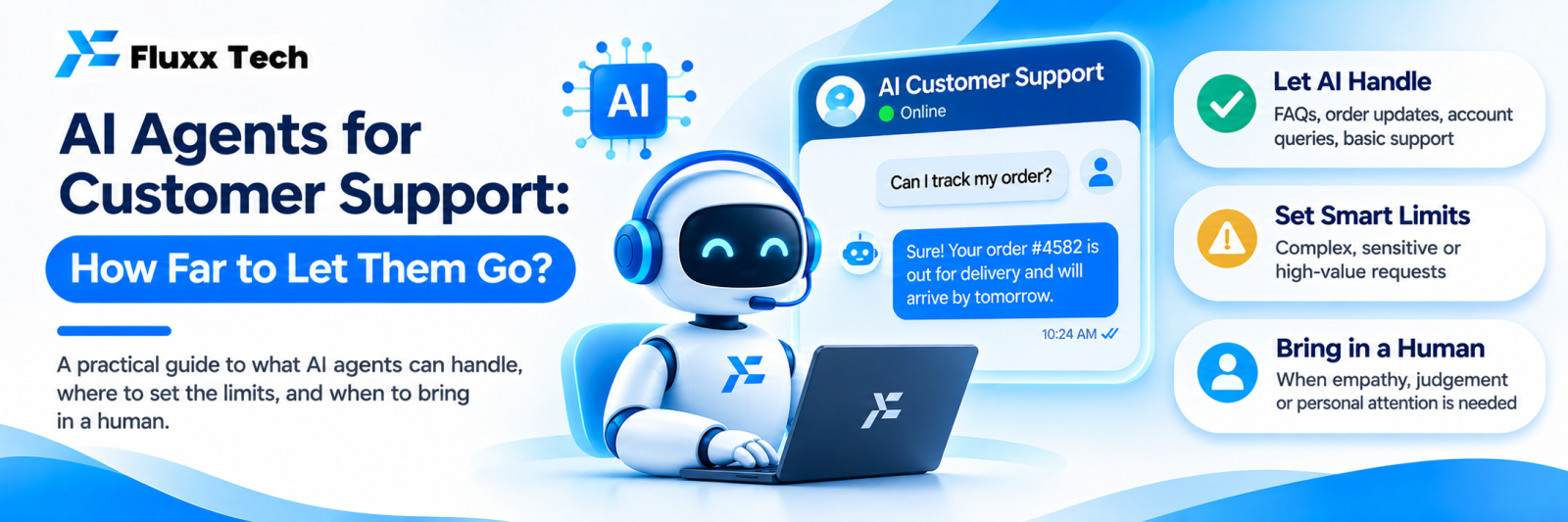
An AI agent can read a customer’s message, understand it and reply in natural language, in English, Tamil or a mix. That is genuinely useful. It can also confidently state a price that does not exist, which is genuinely expensive.
The question is not whether to use AI. It is where to draw the line.
Three levels of autonomy
Level | What the AI does | Risk |
1. Suggest | Drafts a reply; a human sends it | Very low |
2. Answer | Replies directly to informational questions | Medium: wrong information |
3. Act | Books, cancels, refunds, changes orders | High: real-world consequences |
Most businesses should run at level 2 for information and level 1 for anything else, moving selected actions to level 3 only after the data and the guardrails are proven.
What AI handles well
• Questions phrased in ways no keyword rule anticipated
• Long or multi-part messages
• Mixed Tamil and English
• Product comparisons: “which one suits a small shop?”
• Summarising a long conversation for a human taking over
• Drafting a reply for an agent to edit
• Classifying and routing incoming messages
• Extracting details: order number, address, issue type
That last pair is underrated. Using AI purely to classify and route is low risk and saves real time.
What AI should not do without a human
• Confirm a price for custom or negotiated work
• Approve a discount
• Promise a delivery date
• Process a refund or cancellation
• Give medical, legal or financial advice
• Handle an angry customer
• Make any commitment the business must honour
If a wrong answer costs money or creates an obligation, a human confirms it.
Guardrails that matter
Ground it in your own information. The AI should answer from your product data, prices and policies, not from general knowledge. Keep that source current; an outdated price list produces confidently wrong answers.
Tell it to refuse rather than guess. “If you are not certain, say you will check and hand over to the team” is the single most valuable instruction you can give it.
Restrict scope. It answers about your business, not about anything else.
Never let it invent. Prices, dates, stock, offers, policies: if it is not in the source data, it does not exist.
Log everything. Every AI reply reviewable, with the conversation.
Hard handover triggers. Angry language, the words agent or human, a complaint, a refund request, two failed attempts, or any mention of a legal or safety issue.
Disclose it. Do not let a customer believe they are speaking to a person. “I’m the [Business] assistant — I can answer most questions, and I’ll bring in the team when needed.”
Keyword rules first, AI second
The cheapest and most reliable architecture:
Message arrives
↓
Matches a keyword rule? → send the exact, approved reply (free, always correct)
↓
No match → AI answers from your information
↓
AI unsure, or sensitive topic → human handover
This keeps your highest-volume questions, address, timing, price, delivery, on fixed answers, and uses AI only where it adds value. It also controls cost, because you are not paying a model to answer “what time do you close”.
See our keyword bot vs AI bot comparison.
Controlling cost
• Keyword rules handle the common questions
• Set a monthly spend cap
• Limit conversation length before handover
• Monitor cost per conversation, and per resolved conversation
• Review which question types consume the most, and convert the frequent ones into keyword rules
Test it before customers do
1. Write 50 real questions from your actual inbox history
2. Run them past the AI
3. Score each: correct, incomplete, wrong, should have handed over
4. Fix the source information for the wrong ones
5. Add keyword rules for anything that must be exact
6. Re-test
7. Launch to a small share of conversations first
8. Review every AI conversation daily for the first two weeks
Test specifically for the dangerous failures: does it invent a price if asked about a product you do not sell? Does it agree to a discount if a customer pushes? Does it hand over when someone is upset?
Monitor continuously
Metric | Watch for |
Handover rate | Too high means AI adds little; too low may mean it is over-reaching |
Customer satisfaction on AI conversations | Compare with human-handled ones |
Repeat questions in the same conversation | The answer was not understood |
Corrections made by agents after handover | AI errors |
Cost per conversation | Budget control |
Complaints referencing the bot | Immediate review |
Privacy
AI processing involves sending customer messages to a model provider. Know where that processing happens, what is retained, and what your obligations are under the DPDP framework and your agreements with customers. Avoid sending more personal data than the task requires. Take legal advice on your specific setup.
Frequently asked questions
Will customers accept an AI? Most accept it for quick answers when it is honest about being an assistant and hands over quickly. They object to being trapped with one.
Can AI handle Tamil? Modern models handle Tamil and Tanglish reasonably well. Test with your own customers’ actual phrasing before relying on it.
Should AI reply to complaints? No. Acknowledge and hand over to a person immediately.