Fluxx Tech
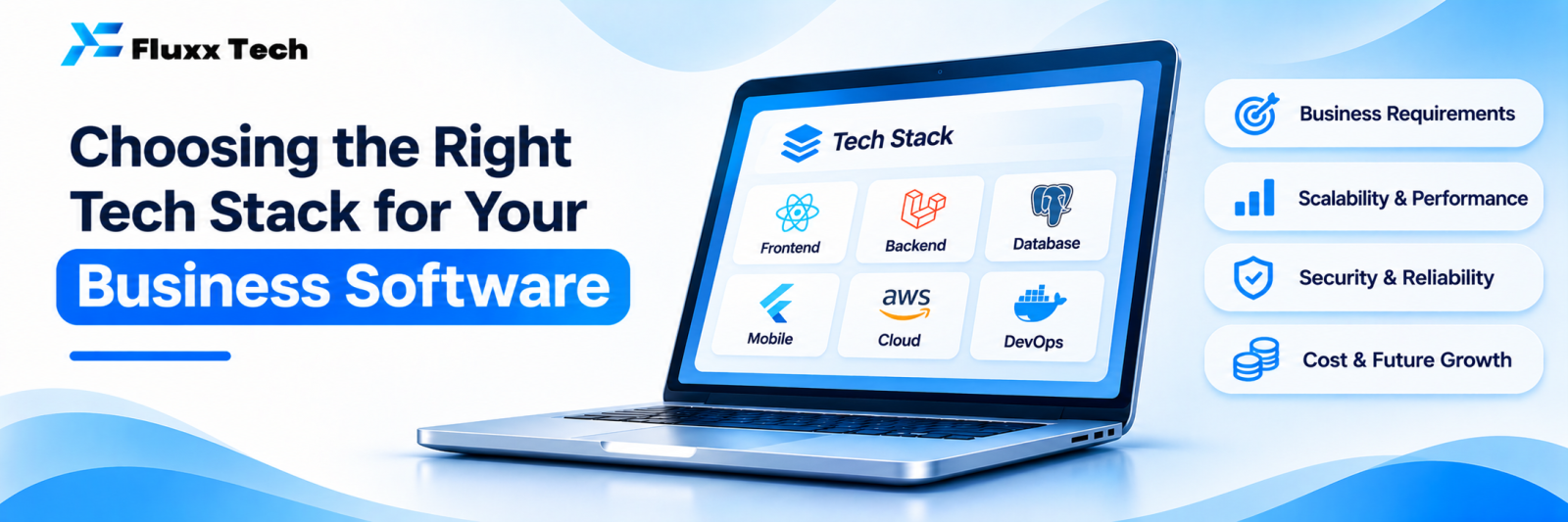
When you ask a developer how they will build your software, you will hear words like React, Next.js, Laravel, Node, Flutter, PostgreSQL and AWS. Together these are the “tech stack”. You do not need to code to ask good questions about it.
What a tech stack includes
Layer | What it does | Common choices |
Frontend | What users see in the browser | React, Next.js, Vue, Angular |
Backend | Business logic and APIs | Node.js, Laravel (PHP), Django (Python), .NET |
Database | Where data is stored | PostgreSQL, MySQL, MongoDB |
Mobile | Phone apps | Flutter, React Native, native Kotlin/Swift |
Hosting | Where it runs | AWS, Google Cloud, Azure, managed hosting |
Supporting | Email, storage, queues, search | Varies |
What actually matters for your business
1. Fit for the problem
A content website, an internal dashboard and a real-time delivery platform have different needs. A stack that is excellent for one can be wrong for another.
2. Your team’s skills
The best stack is one your developers know well. An unfamiliar stack means slower work and more bugs.
3. Availability of developers
If you may change partners or hire in-house later, choose technologies with a large talent pool in India. A rare framework can leave you stuck.
4. Long-term support
Is the technology actively maintained, with a strong community and regular security updates? Avoid frameworks that look abandoned.
5. Hosting and running cost
Some stacks need more server resources. Ask for an estimated monthly hosting cost at your expected usage.
6. Scalability
Will it handle ten times your current users without a rewrite? Most business software never needs extreme scale, so beware of over-engineering too.
7. Integration needs
If you must connect to Tally, a payment gateway, WhatsApp or an ERP, check that libraries and examples exist.
Questions to ask your developer
1. Why this stack for my project, rather than alternatives?
2. How many developers in the market know it?
3. What will monthly hosting cost at our expected usage?
4. What happens if we need to double capacity?
5. Who owns the code and the infrastructure accounts?
6. How are security updates handled?
7. Can another team take this over if needed?
A good partner answers these in plain language. Vague answers or “it’s just better” are warning signs.
Over-engineering: a real risk
Small businesses sometimes get complex architectures (microservices, Kubernetes, multiple databases) when a well-built single application would do. That adds cost, complexity and maintenance for no benefit. Match the architecture to the actual need.
Frequently asked questions
Is one stack better than another? Rarely in absolute terms. Fit, team skills and support matter more.
Can I change the stack later? Changing the frontend or mobile app is possible. Changing the backend or database usually means a rebuild.
Should I choose the newest technology? Proven, well-supported technology is usually the safer choice for business software.