 Fluxx Tech
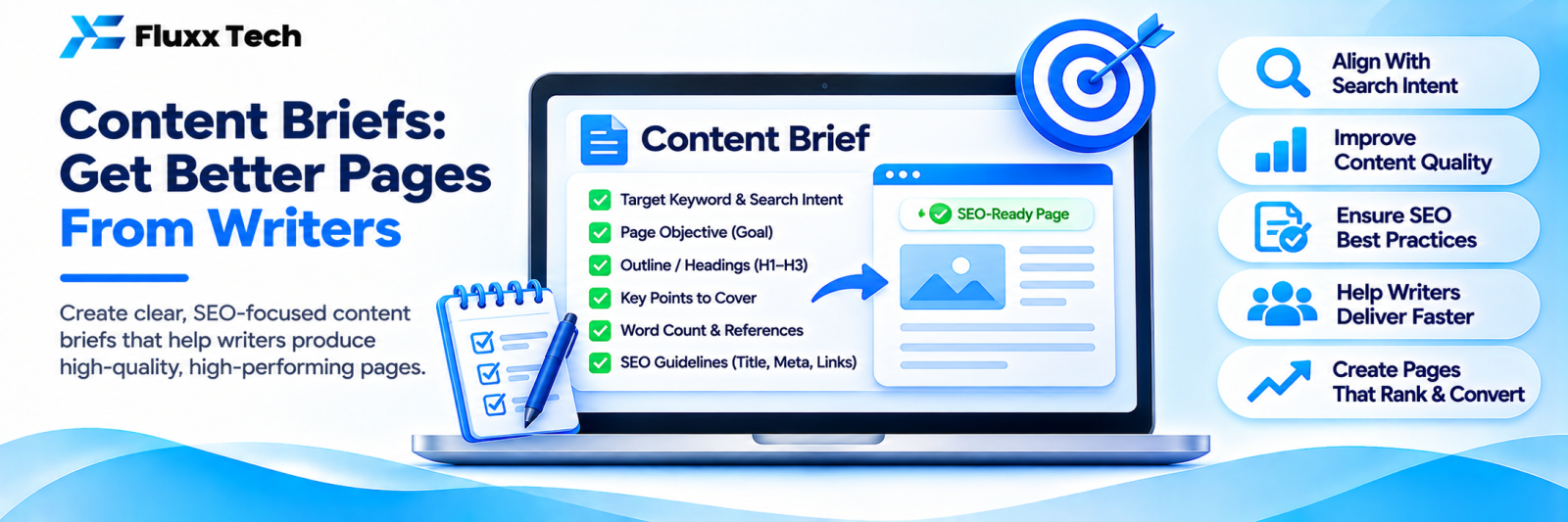
Most disappointing content is a briefing failure, not a writing failure. The writer was told “write 1,000 words on payment gateways”, so they wrote 1,000 generic words on payment gateways, and the page ranks nowhere.
A proper brief takes thirty minutes to prepare and changes the output entirely. It is also what makes AI-assisted drafting useful rather than generic.
What a brief must contain
1. The target query and its variations
• Primary keyword
• Search volume and difficulty
• Three to eight secondary phrases that belong naturally
• Questions from People Also Ask
2. Search intent, stated explicitly
Not “informational” as a label, but: what does the person want when they type this?
“Someone comparing payment gateways for a small Indian ecommerce site. They want to know which to pick and why, and they are worried about charges and settlement time. They are not a developer.”
Everything else in the brief follows from this sentence.
3. What the current top results look like
Search the term and record:
• The format of the top five: guide, listicle, service page, comparison
• Their rough length
• What they all cover
• What none of them cover, which is your opportunity
• Whether a featured snippet, AI overview or People Also Ask box is present
• Which sites they are: if all five are national publishers, say so
This single section prevents the most common failure: writing the wrong type of page.
4. The outline
Give the H2s and H3s. Not suggestions, the actual structure.
H1: Razorpay vs PhonePe vs Cashfree: How to Choose
H2: The quick answer
H2: Transaction charges compared
H2: Settlement cycles
H2: Developer experience
H2: Which suits which business
H2: How to decide: a checklist
H2: FAQs
5. Must-include facts
This is the section that makes the page unique, and it must come from you, not the writer:
• Our price range: [X]
• Our process: [steps]
• Our real example: [with permission]
• Local requirement: [specific to Tamil Nadu or India]
• The thing clients always ask: [question]
• The mistake we see most: [observation]
Without this, you get a competent summary of other people’s pages.
6. Tone and audience
• Who is reading: business owner, technical buyer, parent, patient
• Reading level: plain language, or technical
• Voice: direct, warm, formal
• Language: English, Tamil, or mixed
• What to avoid: jargon, hype, specific claims you cannot support
7. Internal links
Name them. Three to six existing pages this article should link to, with the anchor text, plus the service page it must point to.
Also name which existing pages should link to this new one once published, so the writer or editor can add them.
8. Metadata
• Target URL slug
• Title tag, drafted
• Meta description, drafted
• H1
• Image requirements: how many, what of, alt text guidance
9. Length and deadline
Give a range, not a number, and tie it to covering the outline properly. “1,200–1,600 words” with a complete outline beats “1,500 words” with no structure.
10. What success looks like
“This page should rank in the top five for [keyword] within six months and generate enquiries for [service].”
Writers produce better work when they know what the page is for.
A reusable template
PAGE: [working title]
URL: /blog/[slug]
OWNER: [who signs off]
DEADLINE: [date]
PRIMARY KEYWORD: [term] — [volume] / KD [n]
SECONDARY: [list]
QUESTIONS TO ANSWER: [from PAA]
INTENT: [one paragraph in plain language]
CURRENT TOP 5: [format, length, what they cover, the gap]
OUTLINE:
H1:
H2: ...
MUST INCLUDE:
- [our price / process / example / local detail]
TONE: [audience, voice, language, what to avoid]
INTERNAL LINKS OUT: [page → anchor text]
LINKS IN (add after publishing): [pages]
METADATA:
Title tag:
Meta description:
Slug:
Images: [number, subject, alt text]
LENGTH: [range]
SUCCESS: [what this page should achieve]
Review checklist before publishing
• ☐ Answers the search intent in the first 100 words
• ☐ Covers every H2 in the brief
• ☐ Includes the must-include facts
• ☐ No invented statistics or unsourced claims
• ☐ Prices and facts verified
• ☐ Internal links added, with sensible anchor text
• ☐ Title tag and meta description written, not auto-generated
• ☐ Images added with alt text
• ☐ Reads naturally when read aloud
• ☐ A named author who can stand behind it
• ☐ Links added from existing pages to this one
Who should write the brief
Not the writer. The brief comes from whoever understands the business and the search data: usually the SEO person with input from the owner or the service lead. Fifteen minutes of the owner’s time on the “must include” section is what makes the page better than the competition’s.
Frequently asked questions
Is a brief worth it for every page? For anything intended to rank, yes. For a short announcement, no.
How long does a brief take? Thirty to forty-five minutes once you have a template, less with practice.
Can AI write the brief? It can draft the outline and pull questions. The intent statement and the must-include facts have to come from you, and those are the parts that matter.