Fluxx Tech
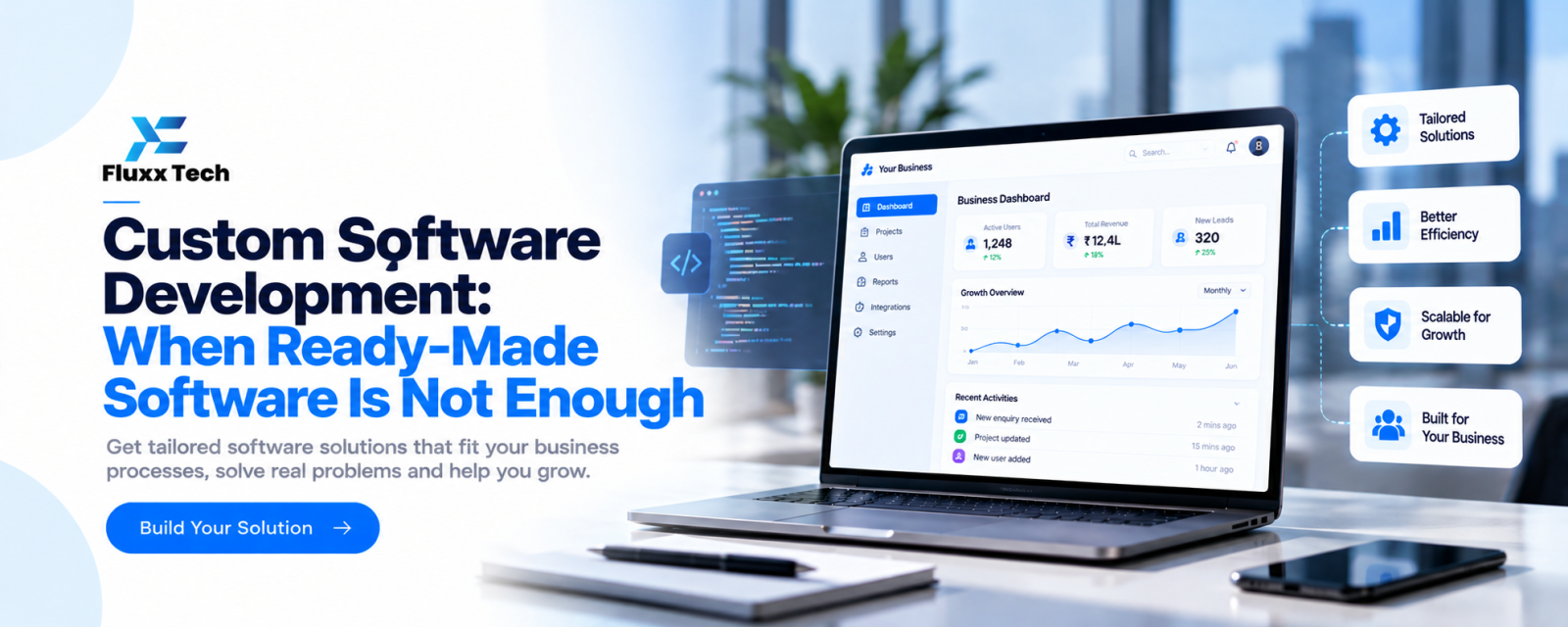
Most businesses start with ready-made software: Tally for accounts, a billing app, Google Sheets, a CRM. That is usually the right choice. But at some point, many growing companies hit limits: staff re-enter the same data in three tools, reports take days, and the software does not match how the business actually works.
That is when custom software is worth considering. This guide helps you decide.
Ready-made vs custom: a quick comparison
| Ready-made (SaaS) | Custom software |
Upfront cost | Low | Higher |
Ongoing cost | Subscription per user | Hosting and maintenance |
Time to start | Days | Weeks to months |
Fit to your process | You adapt to the software | Software adapts to you |
Integrations | Limited to what the vendor offers | Built for your systems |
Ownership | Vendor owns the product | You own the software |
Competitive advantage | Same tools as competitors | Can become a real advantage |
Signs you need custom software
• Staff spend hours copying data between spreadsheets and apps
• You pay for several tools that each do part of the job
• Ready-made tools force workarounds for your core process
• You need a customer, dealer or vendor portal
• Reports need manual compilation every week or month
• Per-user subscription costs are growing fast as you hire
• Your process is a genuine competitive advantage you want to protect
Common custom software projects
• Operations and ERP-lite systems for manufacturers: orders, production, inventory and dispatch
• Dealer and distributor portals with order placement and outstanding tracking
• Field service apps for technicians with job cards, photos and signatures
• Booking and scheduling systems for clinics, labs, salons and rentals
• Dashboards that pull data from Tally, spreadsheets and other tools
• Workflow automation with approvals, notifications and WhatsApp alerts
What does custom software cost?
Cost depends on the number of users and roles, screens, workflows and integrations. As a rough guide for India in 2026:
Project size | Example | Approximate cost |
Small | A single-workflow tool or dashboard | ₹1,50,000 – ₹4,00,000 |
Medium | A portal with several roles and integrations | ₹4,00,000 – ₹12,00,000 |
Large | A multi-module system with mobile apps | ₹12,00,000+ |
Fluxx Tech pricing: [add your price or “after a free scoping call”].
Yearly maintenance and hosting are usually 15–20% of the build cost.
How a good project runs
1. Discovery: map your current process, pain points and goals with the people who do the work
2. Scope and prototype: clickable wireframes so everyone agrees before code is written
3. Phased development: build the most valuable module first and release it early
4. Testing with real users: catch problems before full rollout
5. Training and rollout: short training, user guides and support during the first weeks
6. Iteration: add modules based on real usage
Why custom projects fail, and how to avoid it
• Vague requirements: fix with a written scope and prototype
• Trying to build everything at once: start with one module
• No internal owner: assign one person to make decisions quickly
• Ignoring end users: involve staff who will use the system daily
• No ownership terms: make sure you own the code and data
Frequently asked questions
Is custom software only for big companies? No. Many small and mid-sized businesses build focused tools that save hours every week.
How long does custom software take? A small tool takes four to eight weeks; larger systems are built in phases over several months.
Can custom software work with Tally or my existing tools? Often yes, through integrations or data imports. Confirm this during scoping.
Who owns the code? You should. Put it in the contract.