Fluxx Tech
Most feedback systems collect numbers nobody acts on. A form goes out, a few people respond, a score appears in a report, and nothing changes. The customers who were unhappy do not fill forms; they simply stop coming.
A feedback system is worth building only if it leads to an action. Design it backwards from that.
Three common measures
Measure | Question | Tells you |
NPS | “How likely are you to recommend us, 0–10?” | Overall loyalty |
CSAT | “How satisfied were you with [this interaction]?” | Quality of one transaction |
CES | “How easy was it to get this done?” | Friction in your process |
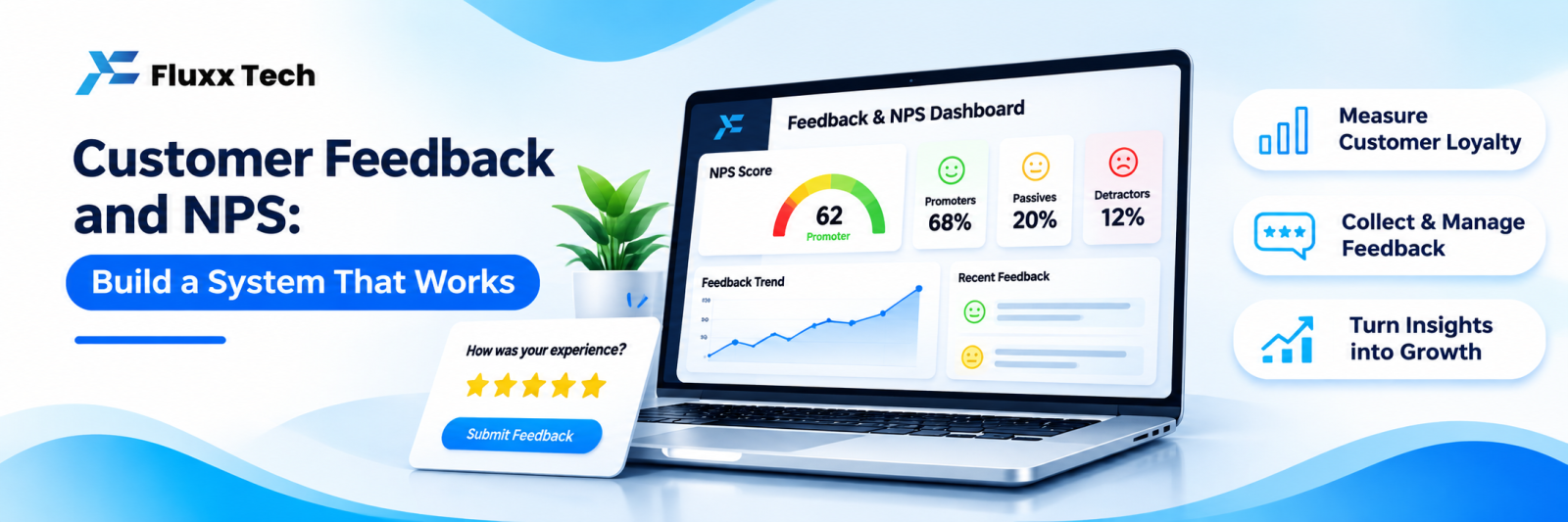
NPS groups respondents: 9–10 promoters, 7–8 passives, 0–6 detractors. Score = % promoters − % detractors. It ranges from −100 to +100.
Use NPS for the relationship, CSAT right after a specific interaction, and CES after a process you suspect is painful. Most small businesses need one, not all three.
The score is not the point
Businesses obsess over the number and ignore the free-text answer, which is where everything useful is.
Always ask a second question: “What is the main reason for your score?”
That sentence tells you what to fix. The number only tells you whether it is getting better.
When to ask
Business | Ask after |
Retail | Purchase, same day |
Restaurant | Meal, before they leave or that evening |
Service centre | Vehicle or appliance delivered |
Clinic | Appointment completed |
Software or project work | Go-live, then every quarter |
Ecommerce | A few days after delivery, when they have used it |
Hotel | Checkout |
Subscription | Periodically, and after support interactions |
Ask once per interaction. Asking the same customer every week destroys response rates and goodwill.
Channels and response rates
Channel | Typical outcome |
Highest response in India; one-tap rating works well | |
SMS with a link | Moderate |
Low, but fine for B2B | |
QR at the counter or on the bill | Good for walk-in businesses |
In-app | Good if you have an app |
Verbal, recorded by staff | Biased; people are polite in person |
WhatsApp with a simple number reply beats a form every time. Keep it to one tap, then one optional sentence.
Keep it short
• One rating question
• One open question
• Optional: one specific question that changes with the campaign
Three questions maximum. Every extra question costs you responses, and the long surveys get answered only by people with extreme opinions.
Closing the loop: the part that matters
A feedback system without follow-up is a complaint box.
Detractors (0–6): contact within 24 hours. Not to argue, but to understand and fix. A recovered detractor often becomes a loyal customer; an ignored one tells others.
Passives (7–8): ask what would have made it a 9 or 10. This is where your most actionable product feedback sits.
Promoters (9–10): thank them, and ask for a public review or a referral. This is the right moment, and most businesses let it pass.
Set a rule: every detractor gets a response, with an owner and a deadline. Measure how many were actually contacted.
Turn feedback into action
1. Tag every response by theme: price, speed, staff behaviour, quality, communication
2. Count themes monthly
3. Pick the top one and fix it
4. Tell customers what you changed
5. Watch whether that theme falls next month
The fifth step is what makes the system credible internally. Without it, feedback becomes a report nobody reads.
Connect it to Google reviews
Public reviews matter for local search. A simple flow:
• Ask for feedback privately first
• Promoters are invited to leave a Google review, with a direct link
• Detractors go to your team instead
Do not pay for or incentivise reviews, and do not suppress negative ones: both breach platform policies and can backfire badly. Asking happy customers at the right moment is legitimate and effective.
Watch for bias
• Responses skew towards very happy and very unhappy customers
• Staff asking in person get inflated scores
• Low response rates make month-to-month comparison noisy
• Customers who left silently never respond at all
Treat the trend and the themes as the signal, not a single month’s number.
Frequently asked questions
What is a good NPS? It varies hugely by industry. Compare with your own previous score, not with other companies’ published numbers.
How often should we survey? After interactions, plus a relationship survey once or twice a year. Not more.
What if we get very few responses? Shorten the survey, move it to WhatsApp, and ask closer to the interaction. Those three changes fix most response-rate problems.