Fluxx Tech
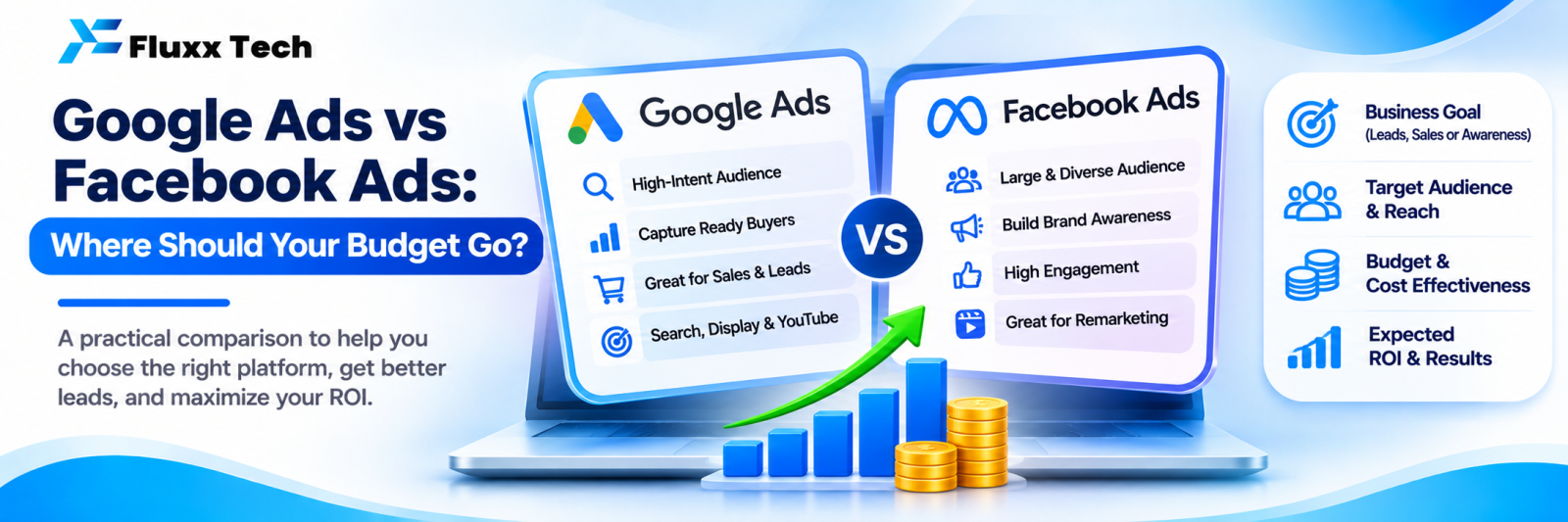
Google Ads and Meta Ads (Facebook and Instagram) both bring customers, but they work in opposite ways. Google reaches people who are already searching for what you sell. Meta reaches people who are not looking, but who match your customer profile.
Neither is universally better. The right split depends on what you sell.
The core difference
| Google Ads | Meta Ads |
Demand | Existing: people search | Created: people discover |
Targeting | Keywords and location | Interests, behaviour, lookalikes, location |
Intent | High | Lower, varies |
Creative | Text and basic visuals | Video and image led |
Typical cost per click | Often higher | Often lower |
Lead quality | Usually higher intent | More volume, needs qualification |
Works for | Urgent needs and known services | Visual products, discovery, offers |
When Google Ads wins
• Urgent services: AC repair, plumber, emergency clinic, towing
• Known purchases: “website design company”, “CA for GST filing”
• High-value B2B: specific products and specifications
• When people search a problem you solve
When Meta Ads wins
• Visual products: fashion, jewellery, food, interiors, fitness
• New products people don’t search for yet
• Local offers and events
• Building awareness in a city
• Retargeting people who visited your site
Lead quality
Meta often delivers cheaper leads. Google often delivers leads that convert at a higher rate because the person was actively searching. Measure cost per customer, not cost per lead. A ₹100 Meta lead that converts at 5% is more expensive than a ₹400 Google lead that converts at 30%.
A simple split for a small budget
If you are starting with a limited budget:
Business type | Suggested starting split |
Urgent local services | Google 70% / Meta 30% |
Clinics and professional services | Google 60% / Meta 40% |
Restaurants and cafes | Meta 70% / Google 30% (plus Google Business Profile) |
Fashion, jewellery, D2C | Meta 70% / Google 30% |
B2B and manufacturing | Google 70% / LinkedIn or Meta 30% |
Education and coaching | Meta 50% / Google 50% |
Run both for four to six weeks, measure cost per customer, then shift budget to the winner.
Use them together
• Meta builds awareness; Google captures the search that follows
• Retarget Google visitors on Meta
• Use Google search terms data to find words for Meta ad copy
• Use Meta to promote content that later brings organic traffic
Common mistakes on both
• No conversion tracking
• Sending all clicks to the homepage
• Judging after one week
• Ignoring the landing page
• Not following up leads within minutes
Frequently asked questions
Which is cheaper? Meta usually has lower cost per click; Google often has better conversion rates. Compare cost per customer.
Can I run both on a small budget? Yes, but give each enough budget to collect data. Splitting a very small budget too thin teaches you nothing.
What about Google Business Profile? It is free and often outperforms both for local searches. Set it up before spending on ads.