Fluxx Tech
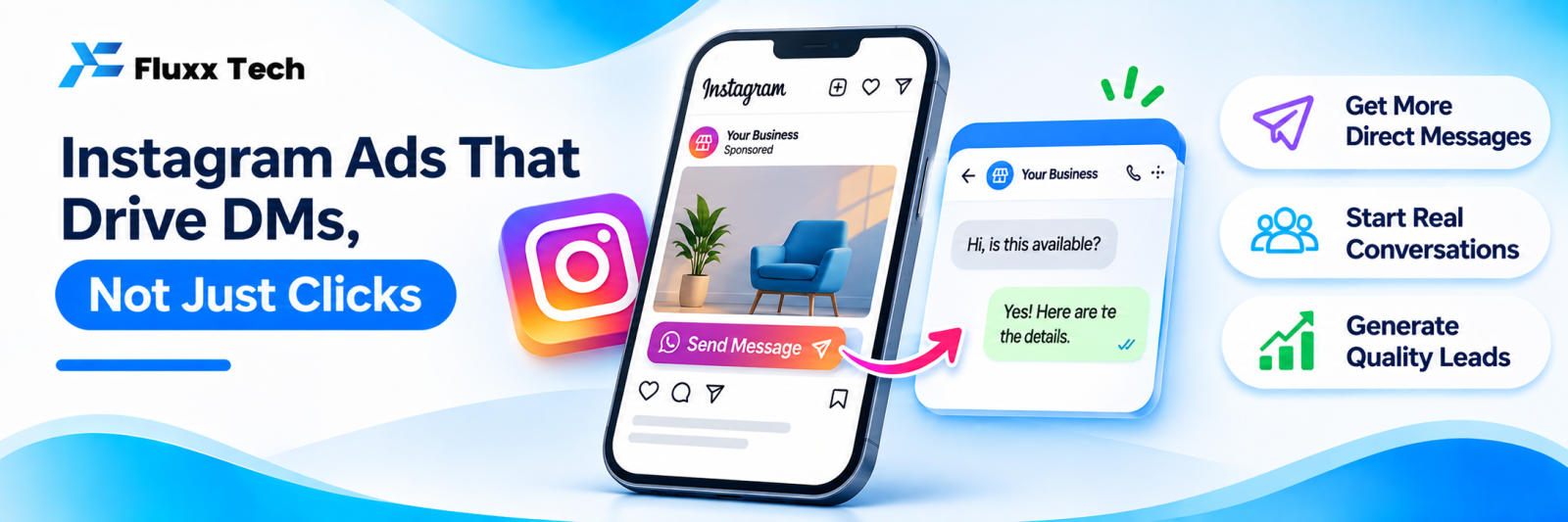
Most Instagram ad budgets are spent sending people to a website where they do nothing. For businesses that close deals in conversation, an ad that produces a DM is worth several that produce clicks.
This is how to build those ads, and what to put behind them.
Pick the right objective
Meta’s objective names change, so go by what you want:
You want | Choose |
Conversations in your inbox | A messaging objective, with Instagram as the destination |
Conversations on WhatsApp | A messaging objective with WhatsApp as the destination. See our click-to-WhatsApp guide |
Website enquiries | Traffic or conversions, with proper tracking |
Awareness in your city | Reach, used sparingly |
App installs | App promotion |
Choosing “engagement” and hoping for messages is the common error. The platform optimises for exactly what you asked for; ask for conversations.
Creative rules for conversation ads
Lead with the thing they want. The product, the result, the price.
Show the price or range where you can. It reduces volume and raises quality, which lowers your cost per customer even if cost per message rises.
Make the action explicit. “Message us for the rate list.” “DM SIZE to check availability.”
Keep video short and captioned. Most viewing is muted.
Use real photos, not stock. Especially for local businesses; your actual shop, team and work outperform polished generic imagery.
Test three creatives, one audience. Changing everything at once teaches you nothing.
Audiences worth testing
Audience | Use |
Location radius around your business | Local services and retail |
Interest-based | Starting point for a new category |
Website visitors (retargeting) | Warmest, usually cheapest per customer |
People who engaged with your Instagram | Very warm |
Customer list (uploaded with consent) | Re-engagement and lookalike seed |
Lookalike from your best customers | Scaling, once you have enough customers |
Retargeting people who already engaged almost always outperforms cold audiences. Build those audiences before you need them.
Upload customer lists only where you have the right to do so, and follow Meta’s data use terms.
Behind the ad: this is the part people skip
An ad that generates 200 DMs and no replies is worse than no ad.
Before launching:
• ☐ Automated greeting that answers the ad’s promise immediately
• ☐ Keyword rules for the obvious follow-up questions
• ☐ A qualifying question built into the flow
• ☐ Lead capture with the campaign as source
• ☐ A named person responsible for replies during ad hours
• ☐ Away message if the ad runs outside working hours
• ☐ Handover rule to a human
If the ad promises a rate list, the first automated message should contain the rate list. Not “hi, how can I help”.
See our Instagram automation guide.
Budget approach
1. Start with a modest daily budget on one audience and three creatives
2. Run a week; do not change things daily
3. Kill creatives with poor results, keep the winner
4. Test a second audience against the winning creative
5. Scale gradually: increase budget in steps, not jumps
6. Refresh creative when performance decays, which it will
Measure properly
Metric | Use |
Cost per conversation started | Early efficiency signal |
Reply rate | Whether the ad attracted real interest |
Qualified enquiry rate | Audience and creative quality |
Cost per qualified enquiry | Better than cost per message |
Conversion to customer | The real test |
Cost per customer | The number that decides your budget |
Revenue and ROAS | Whether to scale |
Tag every conversation with its campaign so these can be calculated. Without that tag, you are back to guessing.
Organic and paid together
• Promote posts that already generate enquiries organically; they are proven
• Use your best-performing organic reel as an ad creative
• Keep the comment-to-DM keyword active on promoted posts, so the comments the ad generates also convert
• Retarget people who engaged with the organic post
Promoting weak content simply buys weak reach faster.
Mistakes
• Sending ad traffic to a profile with no highlights, no prices and an unclear bio
• Running ads with no automation behind them
• Optimising for cheap messages instead of customers
• Changing budget and creative daily
• Ignoring the comments on the ad itself, where real questions get asked publicly
• No follow-up on conversations that stalled
Frequently asked questions
Should ads go to Instagram DM or WhatsApp? WhatsApp if you need to send catalogues, payment links and order updates. Instagram DM if the conversation is exploratory and visual.
How much should I spend to test? Enough to produce a meaningful number of conversations over at least a week. Below that you are reading noise.
Why do I get messages that go nowhere? Usually the creative over-promises or under-specifies. Adding price guidance to the creative fixes most of it.