Fluxx Tech
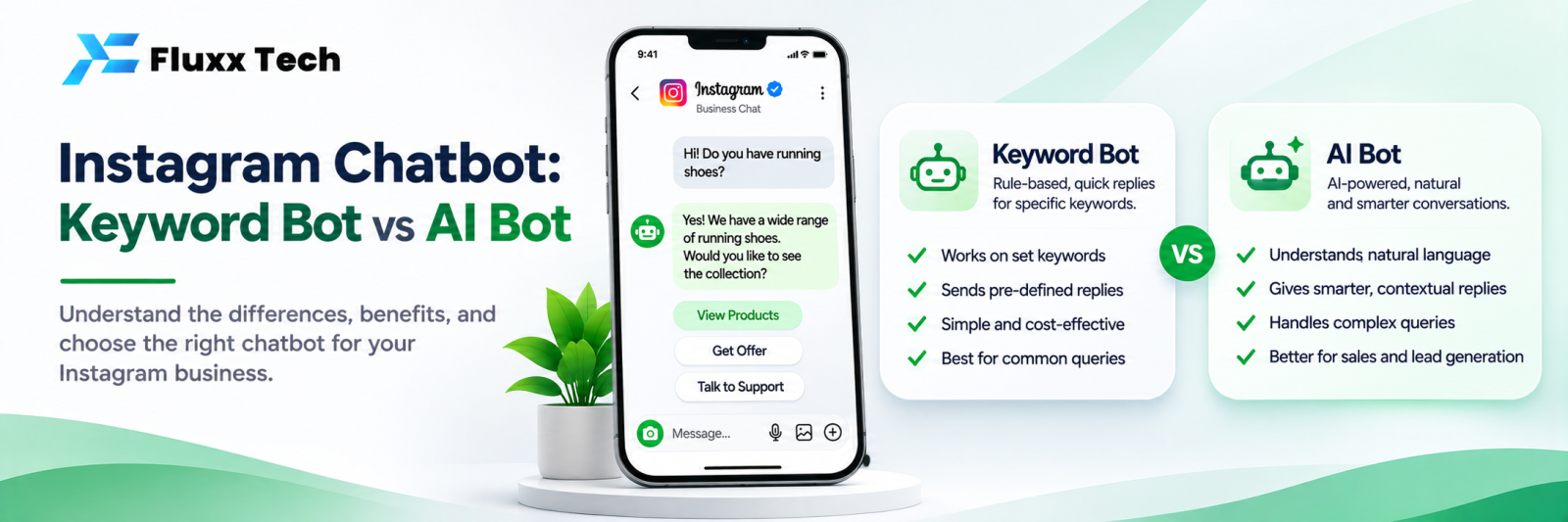
There are two ways to build an Instagram chatbot, and the choice affects cost, accuracy and how much control you have over what your business says.
How each works
Keyword bot. You write rules: if the message contains “price”, send this reply. Deterministic. It says exactly what you wrote, every time. It fails when the customer words something unexpectedly.
AI bot. A language model reads the message and generates a reply, usually guided by your product information. It handles phrasing you never anticipated. It can also be wrong, and it costs money per message.
Side by side
| Keyword bot | AI bot |
Setup | Write rules and replies | Provide product and policy information |
Cost | Usually included, no per-message cost | Per message or per token |
Accuracy on known questions | Exact | Usually right, occasionally wrong |
Unexpected phrasing | Fails to the fallback | Handles well |
Control over wording | Total | Partial |
Risk of wrong information | Low | Real, needs guardrails |
Languages | As many as you write rules for | Handles mixed language naturally |
Maintenance | Add rules as questions change | Update the source information |
Speed | Instant | Near-instant |
What belongs in a keyword bot
The questions whose answers must be exactly right and never change unexpectedly:
• Address and directions
• Working hours
• Phone number
• Price list or price range
• Delivery areas and charges
• Booking link
• Payment methods
• Return policy summary
If a wrong answer would cost you money or a customer, make it a rule.
What belongs with AI
• Questions phrased in ways you never anticipated
• Long or multi-part questions
• Product comparisons: “which one is better for X?”
• Customers mixing Tamil and English freely
• Conversations where the person is exploring rather than asking
What should always be human
• Price negotiation
• Complaints and refunds
• Custom requirements and quotes
• Anything medical, legal or financial
• An unhappy customer, immediately
The hybrid setup most businesses should run
Customer message
│
├─ Matches a keyword rule? → send the exact reply
│
├─ No match, AI enabled? → AI answers from your information
│ │
│ └─ Unsure, or sensitive topic? → handover
│
└─ No match, no AI? → fallback message + menu + handover
This order matters commercially. Keyword rules handle the high-volume, predictable questions for free. AI handles the remainder. You pay for AI only on the messages that need it.
For most businesses, that means 60–80% of messages answered by rules, and AI used on the rest.
Guardrails if you use AI
• Give it only your real information: prices, policies, product details
• Tell it explicitly not to invent prices, dates or availability
• Instruct it to hand over rather than guess
• Never let it confirm an order, discount or appointment on its own
• Review AI conversations weekly for the first month
• Set a monthly spend cap
A FAQ bot: the free middle ground
Between keyword rules and AI sits a menu-driven FAQ bot: the customer picks from numbered options, each leading to a prepared answer or a sub-menu. No AI cost, better coverage than keywords alone, and it teaches customers what you can help with.
Many businesses never need more than this plus a dozen keyword rules.
Frequently asked questions
Is an AI bot better? Better at unexpected questions, worse at guaranteed accuracy, and it costs per message. Use both, in the right order.
Will AI give wrong prices? It can, if your information is incomplete or out of date. Keep prices in keyword rules.
Can one bot handle Tamil and English? Keyword bots need rules in both. AI handles mixed language more naturally.