Fluxx Tech
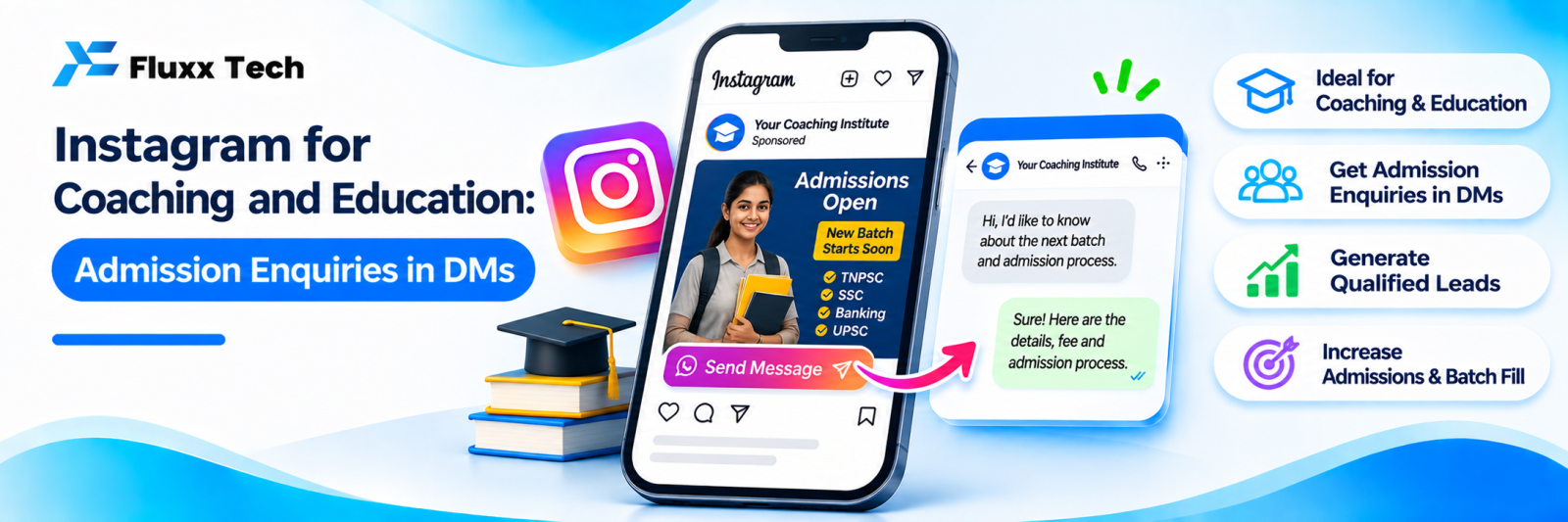
Education is sold on trust. A parent choosing a coaching centre for their child is not comparing features; they are deciding whether to believe you. Instagram is good at this, because teaching content demonstrates competence directly.
The practical challenge is different from retail: the enquirer is often a parent, the decision takes weeks, and the whole year’s revenue concentrates into an admission season.
Content that builds trust
Format | Why it works |
Teach something in 60 seconds | Demonstrates ability better than any claim |
A concept explained simply | Shows how you teach, which is what parents want to know |
Common mistakes in [subject] | Useful, saveable, positions expertise |
Exam strategy and time management | High-value for the audience |
Student results, with permission | Proof, handled carefully |
Faculty introductions | Parents choose teachers, not institutes |
Inside the classroom | Reassurance about environment and discipline |
Parent testimonials, with consent | Speaks to the actual decision-maker |
Syllabus and schedule explainers | Practical information |
Doubt sessions and Q&A | Interaction |
Results content needs care. Get written consent before posting any student’s name, photo or marks, especially for minors. Be accurate: do not imply a result is typical when it is exceptional, and do not use another institute’s students or stock imagery as your own. Follow any advertising rules applicable to your category.
Who you are talking to
Two audiences, often in the same conversation:
| Student | Parent |
Cares about | Teaching quality, batch timing, friends, whether it is boring | Results, fees, safety, discipline, faculty, distance |
Channel | WhatsApp, and phone calls | |
Language | Casual, English or Tanglish | More formal, often Tamil |
Decides | Influences | Usually decides and pays |
Design your content for students and your conversation for parents. The reel brings the student; the WhatsApp conversation convinces the parent.
The enquiry flow
Reel → "Comment BATCH"
↓
Automated DM: courses, batch timings, starting dates, fee range
↓
Qualifying: which class/exam, which batch, student or parent?
↓
Offer a demo class or a counselling call
↓
Move to WhatsApp with the parent, with consent
↓
Brochure, fee structure, faculty details
↓
Demo attended → follow-up → admission
↓
Onboarding: schedule, materials, group, first class
Qualify with three questions
1. Which class or exam? NEET, JEE, CA, class 10, spoken English
2. Which batch suits? Weekday, weekend, morning, evening
3. Student or parent? Changes your tone and what you send next
Then offer the demo. The demo class is this category’s equivalent of a site visit, and demo attendance rate is the metric that predicts admissions.
Be clear about fees
Coaching enquiries stall on fees more than anything else. Hiding the number produces a long conversation that ends in surprise.
Give a range early:
Our NEET repeater batch is ₹[X] for the full year, with instalment options. Would you like the detailed fee structure and syllabus?
Honest filtering costs you nothing. The parent who cannot afford it was never going to enrol, and the one who can now trusts you.
The demo class
• Confirm with date, time, location or link
• Reminder the day before and two hours before
• Tell them what to bring and how long it takes
• Follow up the same evening, while the impression is fresh
• Ask the student and the parent separately what they thought
• If they did not attend, offer another slot once
Admission season
Most of the year’s revenue arrives in a few weeks. Prepare like a retail business prepares for a festival:
When | Action |
6 weeks before | Content plan ready, automation set up, fee structure finalised |
4 weeks before | Teaser and result content, build the enquiry list |
3 weeks before | Open enquiries, batch details published, demo slots live |
2 weeks before | Demo classes running, daily follow-up |
1 week before | Last-date messaging, seat availability updates |
Season | Fast replies, extra hands on the inbox |
After | Onboard admitted students, nurture the ones who did not join |
Enquiries that do not convert this season are next season’s list. Tag them and keep in touch, usefully, not with monthly “join us” messages.
Follow-up over weeks
• Tag by exam, class, batch interest and decision timeline
• Every enquiry gets a next-contact date
• Between contacts, send something useful: a study tip, a schedule, an exam notification, a free resource
• Involve the parent explicitly: “Shall I share the details with your father on WhatsApp?”
• Stop when they say no, and record why
Safeguarding and minors
You are often communicating with or about children.
• Prefer the parent’s number as the primary contact for school-age students
• Do not conduct extended private conversations with minors on personal accounts
• Get written parental consent before posting any identifiable student content
• Restrict staff access to student data
• Have a clear policy on staff communicating with students outside official channels
Take advice on your obligations; this article does not cover them.
Measure
Metric | Why |
DMs per reel | Which teaching content works |
Enquiry-to-demo rate | Quality of your conversation |
Demo attendance rate | Reminder effectiveness |
Demo-to-admission rate | Teaching and counselling quality |
Cost per admission, for paid campaigns | Budget decisions |
Enquiries carried to next season | Pipeline |
Source content per admission | What to make more of |
Frequently asked questions
Should we post student results? Only with written consent, accurately, and without implying exceptional results are typical.
Parents are not on Instagram. Does it still work? Yes. Students discover you on Instagram; the conversation then moves to WhatsApp where the parent joins in.
How do we handle the admission season rush? Automate the first reply with batches, timings and fees, and add people to the inbox for the peak weeks