Fluxx Tech
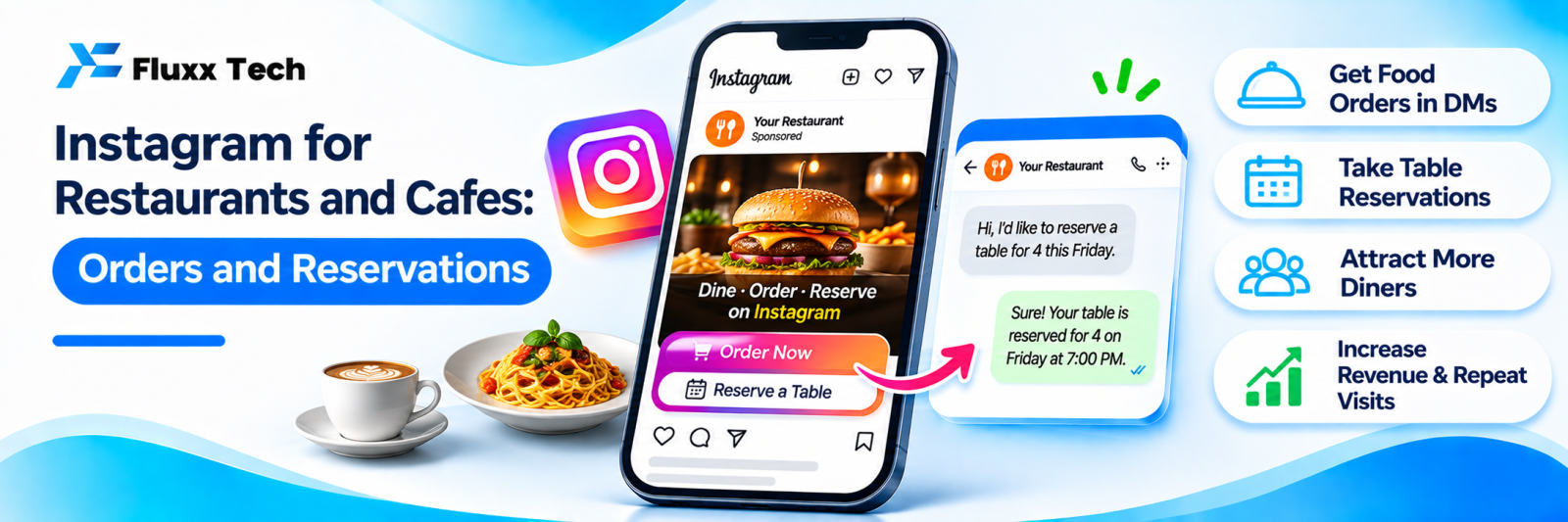
People choose where to eat on Instagram. They see a dish, check your profile, look at the location, and decide. The whole journey takes forty seconds, and most restaurants lose it somewhere in the middle, usually because the profile does not say where they are or whether they deliver.
Fix the profile first
More than any other category, restaurants lose customers at the profile.
• Name field: “Café Nila | Coimbatore Café” — the city and category are searchable
• Bio: cuisine, area, timings, and the one thing that makes you different
• Address and map: set the location properly, and tag it on every post
• Action buttons: directions, call, WhatsApp, and a reserve or order link
• Highlights: Menu, Today’s specials, Timings, Delivery, Reviews, Events
• Menu in a highlight, readable on a phone, with prices and updated
A hungry person deciding at 8 pm will not scroll your feed to find out whether you are open. Put it where they look.
Content that fills tables
Format | Why |
Close-up food reels | Steam, cheese pull, pouring, cutting; this is the category’s superpower |
The dish being made | Process is compelling and builds trust |
Today’s special | Urgency, and a reason to post daily |
Interior and ambience | People choose cafés for the space as much as the food |
Staff and chef | A face makes a place memorable |
Customer reactions, with consent | Proof |
Offers and combos | Direct, used sparingly |
New item launches | Creates a reason to visit |
Events: live music, screenings, festivals | Brings groups |
Shoot in good light, shoot close, keep clips short. Food content does not need production value; it needs the food to look like the food.
Reservations in DMs
Most customers will not use a reservation app for a casual café, but they will send a message.
Automate the first reply:
Hi! 👋 Thanks for messaging [Restaurant] 1 — Book a table 2 — See the menu 3 — Delivery and timings 4 — Private party or event
For a booking, collect in one message:
Happy to book! Please share: • Date and time • Number of people • Name and phone number
Then confirm in writing with the address, and send a reminder a few hours before. No-shows fall significantly with a reminder, and the table can be released if they cancel.
Direct orders versus aggregators
Aggregators bring volume and charge commission. Direct orders through WhatsApp keep the margin and the customer relationship.
| Aggregator | Direct via WhatsApp |
Reach | Their audience | Yours |
Commission | Significant | None, beyond payment charges |
Customer data | Theirs | Yours |
Delivery | Handled | Your own, or a partner |
Effort | Low | Higher |
A sensible position for most restaurants: stay on aggregators for discovery, and encourage repeat customers to order direct.
How to shift repeat orders direct, without breaching your aggregator agreements (check them first):
• A WhatsApp ordering link in your bio and highlights
• A QR at the table and on the bill
• Mention direct ordering in your Instagram content
• Give a genuine reason: slightly better value, a free add-on, faster service, a loyalty benefit
Set up direct ordering properly: menu accessible in chat, clear delivery area and charge, payment link or UPI, and an order confirmation. See our WhatsApp commerce guide.
Handling the busy hours
Your DMs peak exactly when your kitchen does. Automation is not optional:
• Instant reply with menu, timings and delivery information
• An away message during peak: “We’re in the rush right now, we’ll reply by [time]. For orders: [link]”
• Keyword replies for the common questions: MENU, TIMINGS, DELIVERY, BOOK
• One person assigned to the inbox during the shift, not “whoever is free”
An unanswered 8 pm DM is a table that went somewhere else.
Reviews and complaints
Food complaints are public, emotional and fast.
• Reply publicly within hours, acknowledge, and move to DM
• Never argue about taste; offer to make it right
• For hygiene or illness claims, respond immediately and take it seriously offline; do not debate it in comments
• Thank positive reviewers specifically
• Ask happy customers for a Google review; for restaurants it drives walk-ins more than anything else
Delete spam and abuse. Do not delete genuine criticism.
A weekly routine
Day | Action |
Daily | One story: today’s special, kitchen, or the space |
Mon | Plan the week’s content, shoot in one session |
Wed | Reel: a dish being made |
Fri | Weekend offer or event post, with a booking CTA |
Sun | Reshare customer posts, with permission |
Weekly | Reply to all reviews, update the menu highlight |
One shooting session a week produces enough content for seven days. Shooting daily is what makes restaurants give up on Instagram.
Measure
Metric | Why |
Profile visits and direction taps | Real-world intent |
DMs per week | Interest |
Bookings from DMs | Conversion |
Direct orders versus aggregator orders | Margin shift |
No-show rate | Whether reminders work |
Best-performing dish content | What to shoot next |
New versus repeat customers | Loyalty |
Direction taps is the most underrated metric here: it means someone decided to come.
Frequently asked questions
How often should a restaurant post? Stories daily, feed or reels three to four times a week. Consistency matters more than volume.
Should we leave the aggregators? Most should not. Use them for discovery, and build direct ordering for repeat customers.
Do we need a photographer? Not at first. Good natural light, a clean plate and a steady phone cover most of it.