Fluxx Tech
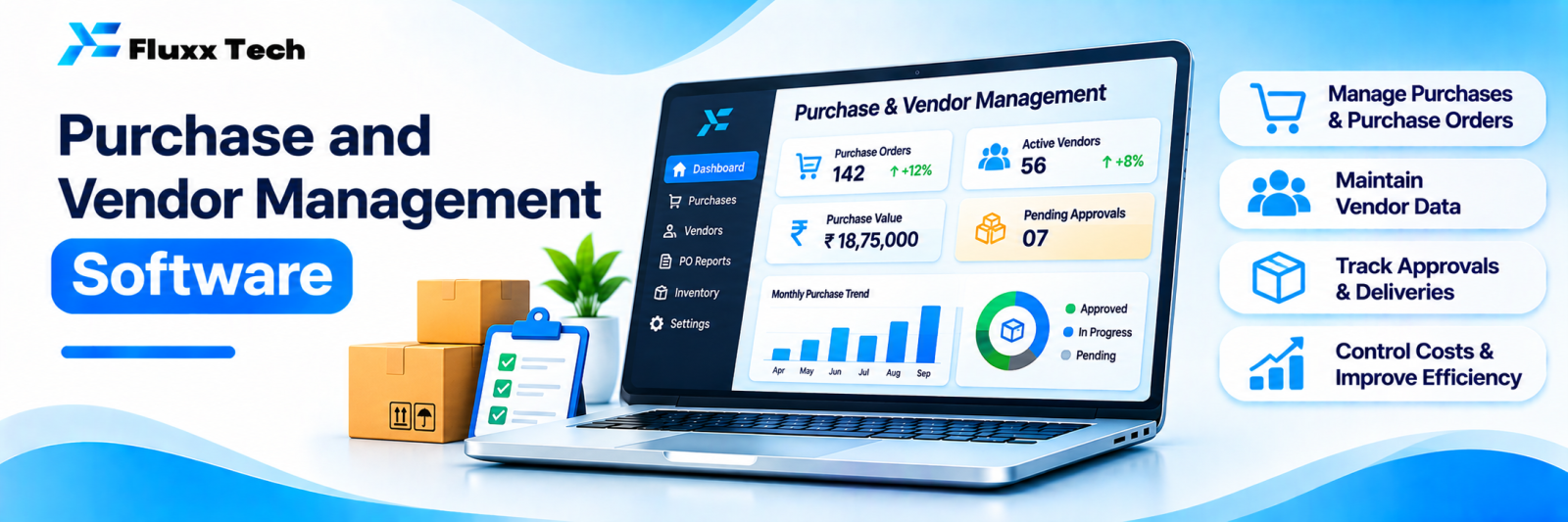
Purchasing is where money leaves the business, and in most small companies it leaves with the least documentation. A supervisor calls a supplier, material arrives, a bill follows weeks later, and nobody can confirm what was ordered, at what rate, or whether the full quantity arrived.
Purchase management software creates a paper trail that pays for itself in discipline alone.
The standard flow
Indent (someone requests material)
↓
Approval
↓
Quotation comparison (for larger values)
↓
Purchase order issued to vendor
↓
Material received → GRN with quantity and quality check
↓
Vendor invoice received
↓
Three-way match: PO vs GRN vs invoice
↓
Payment approved and scheduled
The three-way match is the control that prevents overpayment, and it is almost impossible to do reliably on paper.
What each stage needs
Indent
• Who requested, for which department or job
• Item, quantity, required-by date
• Justification for non-routine items
• Stock in hand shown at the time of request, to prevent duplicate buying
Approval
• Value-based limits: who can approve up to how much
• Department-wise budgets, if you run them
• Escalation when the approver is unavailable
• A record of who approved and when
Quotation comparison
• Multiple vendor quotes against one indent
• Side-by-side comparison on rate, delivery, terms
• Reason recorded if the lowest quote is not chosen
That last line is a small field that changes behaviour.
Purchase order
• Clear specification, quantity, rate, taxes
• Delivery date and location
• Payment terms
• Sent to the vendor and acknowledged
• Amendments tracked as versions
Goods receipt (GRN)
• Quantity received against ordered
• Short receipt, excess, rejection
• Quality check result
• Photo of damaged material
• Partial deliveries handled properly
Invoice and payment
• Match against PO and GRN
• Flag differences in rate or quantity
• Debit notes for rejections
• Payment scheduling by due date and terms
Controls that stop leakage
• No payment without a matching PO and GRN
• Rate variance from the rate contract flagged automatically
• Duplicate invoice detection, by vendor and invoice number
• Approval limits enforced by the system, not by habit
• Segregation: the person who approves is not the person who receives
• An audit log of who changed what
Each of these is dull. Together they are usually the difference between a purchase function that leaks and one that does not.
Vendor management
Feature | Use |
Vendor master with documents | GST, PAN, bank details, agreements |
Rate contracts | Agreed rates with validity, applied automatically |
Performance rating | On-time delivery, quality rejection rate, price competitiveness |
Payment history | What you owe, and ageing |
Approved vendor list | Only approved vendors can be used above a value |
Communication log | Quotes, negotiations, disputes |
A simple quarterly vendor scorecard, delivery on time and rejection rate, gives you real negotiating leverage at renewal.
Integration
• Accounting or Tally, so purchase entries do not get retyped
• Inventory, so GRN updates stock
• Production or job costing, so material costs attach to jobs
• E-way bills and e-invoicing where applicable
• WhatsApp for sending POs and chasing deliveries
Reports worth having
• Pending indents and POs
• Deliveries overdue
• Purchase value by category and vendor
• Rate trend for key items
• Rejection rate by vendor
• Payables ageing
• Savings achieved against the last purchase rate
Rollout
1. Clean the item master and vendor master first
2. Set approval limits with the owner
3. Start with PO and GRN only
4. Add indents and approvals once people are used to the system
5. Add three-way matching with accounts
6. Add vendor rating and rate contracts last
Trying to start with full three-way matching usually fails, because the master data is not clean enough to match anything.
Frequently asked questions
Is this only for manufacturing? No. Any business buying regularly, retail, hospitality, construction, services, benefits from the same controls.
Will it slow down urgent purchases? Build an emergency route with a higher-value approval and mandatory documentation afterwards. Without one, people bypass the system entirely.