Fluxx Tech
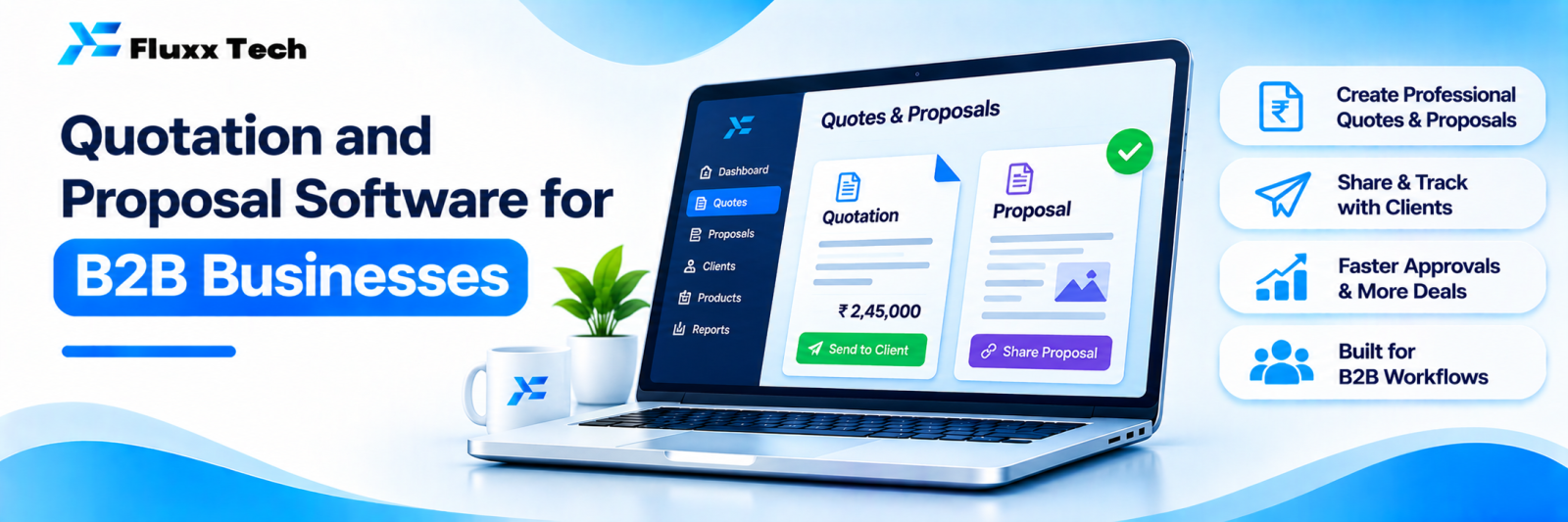
In most B2B businesses the quotation is the sales process. Someone opens last month’s Excel file, changes the customer name, edits the rates, exports a PDF, and emails it. Three weeks later nobody remembers what was quoted, at what rate, or whether anyone followed up.
Quotation software fixes four things: speed, consistency, follow-up and the ability to answer “what did we quote them last time?”
Who it suits
• Manufacturers and fabricators
• Distributors and dealers
• Service and AMC providers
• Interior designers and contractors
• IT and equipment suppliers
• Anyone whose price depends on specifications
What it should do
Feature | Why |
Item and rate master | Consistent pricing, no typing errors |
Customer-specific rates | Dealer and contract pricing applied automatically |
Templates | Professional, branded, identical every time |
Multiple options in one quote | Good / better / best, which lifts average value |
Taxes and terms | GST, freight, packing, validity, payment terms |
Discount rules with approval | Discounts above a limit need a manager |
Versioning | Revision 1, 2, 3, with what changed and when |
Validity and expiry | Quotes expire; the system should say so |
Send and track | Email or WhatsApp, with a record of when it was sent |
Follow-up reminders | The single biggest source of lost revenue |
Status | Draft, sent, negotiating, won, lost, expired |
Convert to order | Accepted quote becomes an order or invoice without retyping |
Reporting | Conversion rate, value, reasons for loss |
Approval rules worth defining
• Maximum discount a salesperson can give without approval
• Who approves beyond that, and within how long
• Whether credit-blocked customers can be quoted at all
• Minimum margin per item or per quote
• Who can change master rates
Software enforces these quietly. A rule that exists only in your head is a rule that gets broken on a Friday evening.
Version control matters more than it sounds
A customer negotiates three times. Each revision changes quantities and rates. Without versioning you end up delivering against revision 1 while the customer expects revision 3.
The system should keep every version, show the differences, and make the current one obvious to everyone.
Follow-up is where quotes are won
Most quotations are not lost on price. They are lost because nobody followed up.
• Automatic reminder to the salesperson after [3] days with no response
• A record of every follow-up: when, how, what the customer said
• Status change required; a quote cannot sit as “sent” forever
• A weekly list of open quotations by value, reviewed by the owner
• Expiry handling: a short message before a quote lapses often restarts the conversation
Send the quote on WhatsApp as well as email. In most Indian B2B relationships, the WhatsApp copy is the one that gets read.
Reporting that changes decisions
Report | Decision it drives |
Quotes sent vs won, by value | Realistic pipeline |
Conversion rate by salesperson | Coaching |
Conversion rate by product | Pricing and positioning |
Average discount given | Margin control |
Average time from quote to decision | Follow-up cadence |
Loss reasons | Price, delivery time, specification, competitor |
Recording loss reasons is the most valuable habit here and the one most businesses skip. After fifty quotes you will see a pattern worth acting on.
Make the document good
The quotation is often the only thing a buyer compares. Get the basics right:
• Your letterhead, GSTIN, contact details
• Clear line items with specifications, not just “as discussed”
• Taxes shown separately
• Delivery timeline
• Payment terms
• Validity date
• Warranty and support terms
• Exclusions, stated explicitly
• A named contact person
Exclusions prevent most post-order disputes.
Build or buy
Ready quotation tools exist and suit standard needs. A custom build is worth it when:
• Pricing is calculated, not looked up: by weight, area, dimensions, grade or configuration
• The quote must pull live stock or cost data from your other systems
• Approval chains are complex
• It needs to convert directly into your production or order system
Configurator-style pricing, where selecting options recalculates the price, is usually the point at which ready tools stop fitting.
Frequently asked questions
Can quotation software handle GST properly? It should, including item-level rates and separate display. Confirm with the vendor, and check current rules with your CA.
Can we keep using our existing format? Yes. Good software reproduces your existing layout; you should not have to change how your quotes look.
What is a realistic conversion rate? It varies by industry. Track your own and work on improving it, rather than comparing to a benchmark.