Fluxx Tech
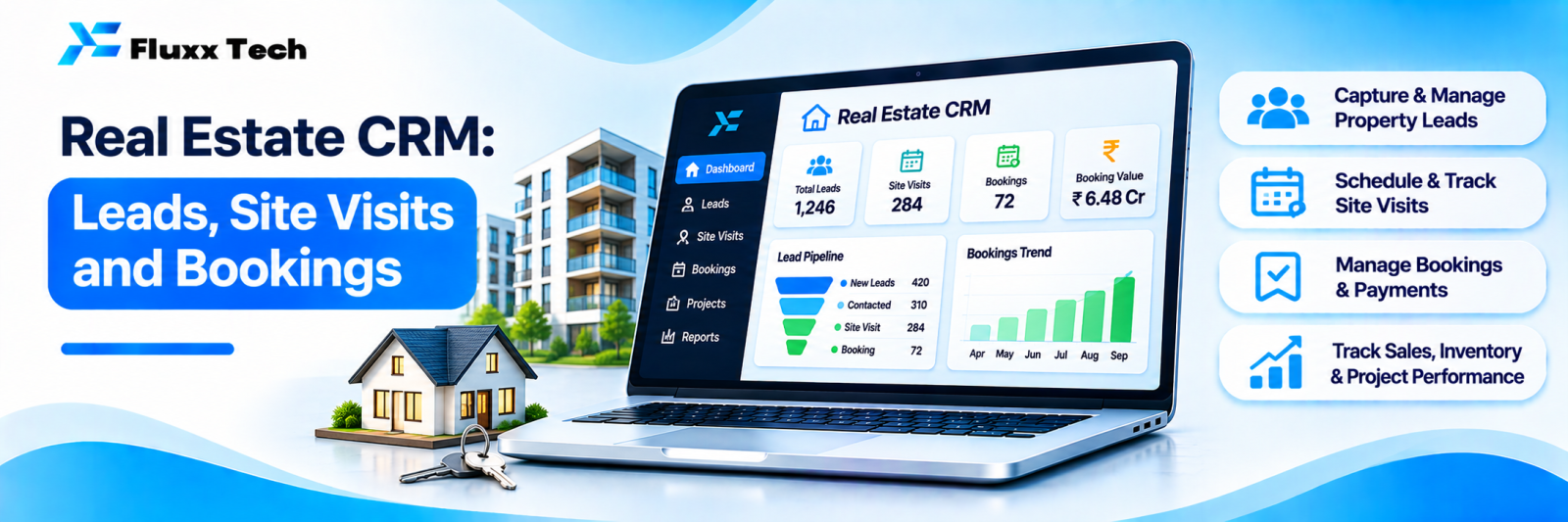
Real estate has a long sales cycle, a high value per deal and many people touching each lead. A buyer enquires on a portal, visits the site three weeks later, negotiates for a month and books a unit after two more visits. Without a system, that journey lives in one salesperson’s phone.
A real estate CRM is mostly about two things: never losing a lead, and knowing exactly which unit is available right now.
Lead capture from everywhere
Source | How it should arrive |
Property portals | Automatically, via integration or email parsing |
Website enquiry forms | Direct into the CRM |
Meta and Google ads | Lead forms connected directly |
Instagram and WhatsApp | Through your messaging tool |
Walk-ins at the site office | Entered on a tablet |
Channel partners and brokers | Through a partner portal, with the partner tagged |
Referrals | Tagged to the referrer |
Speed to first response decides conversion in this industry. A lead that sits for two hours has usually already spoken to three competitors. Auto-assignment plus an instant WhatsApp acknowledgement is the single highest-return feature.
Lead routing and ownership
• Round robin, by project, by location or by budget band
• A named owner for every lead, always
• Reassignment rules when a lead goes untouched for [X] hours
• Duplicate detection by phone number, with the original owner retained
• A clear rule for duplicate leads from a channel partner, which is where most commission disputes start
Write the duplicate rule into both the software and the partner agreement.
The lead stages
New → Contacted → Qualified → Site visit scheduled → Site visit done
→ Negotiation → Booked → Agreement → Registered → Handover
Each stage needs a next action with a date. A lead with no next action is a lost lead that has not been admitted yet.
Site visits
This is the stage that predicts closure, so manage it properly:
• Schedule with date, time, project and assigned person
• Automatic WhatsApp confirmation and reminder
• Pickup arrangement, if offered
• Attendance recorded: visited, no-show, rescheduled
• Feedback captured straight after: what they liked, objections, budget fit
• Follow-up task created automatically
Track site visit to booking rate by salesperson and by project. It tells you more about performance than lead counts do.
Inventory and unit blocking
The operational core:
• Project, tower, floor, unit, type, area, facing, price
• Live status: available, blocked, booked, agreement done, registered
• Temporary blocking with an expiry, so units do not stay blocked indefinitely
• Price list with floor rise, PLC and other charges
• Who blocked what, when, and for which customer
Two salespeople selling the same unit is the classic failure. The CRM must make status visible to everyone, instantly.
Booking and payment schedule
• Booking form with customer and co-applicant details
• Payment plan: construction-linked, down payment, flexi
• Milestone-wise demand generation
• Receipts and outstanding
• Automatic payment reminders by WhatsApp
• Home loan status tracking, with bank and sanctioned amount
• Document checklist per customer
For a buyer, the most common complaint is poor communication about dues and construction progress. Automated milestone updates fix most of it.
Channel partners
• Partner registration and verification
• Lead submission with tagging
• Duplicate and ownership rules visible to both sides
• Commission structure, calculation and payout status
• Partner-wise performance reporting
Transparency here is a commercial advantage. Partners route more leads to developers whose commission tracking they trust.
Reports
Report | Decision |
Leads by source and cost per lead | Marketing spend allocation |
Lead-to-visit rate | Quality of leads and of calling |
Visit-to-booking rate | Sales effectiveness |
Inventory status by project | What to push |
Collection vs demand raised | Cash flow |
Salesperson pipeline and ageing | Coaching and forecasting |
Loss reasons | Pricing, location, competitor, loan rejection |
Compliance and data
Real estate is regulated, and the rules for registration, advertising and disclosures vary by state and project.
• Confirm RERA and advertising requirements with your legal adviser; the CRM should store the disclosures you are required to make
• Customer documents include identity and financial records; restrict access and keep an audit trail
• Under the DPDP framework, personal data carries obligations; discuss your position with a legal adviser
• Decide what happens to a salesperson’s leads when they leave, before it happens
Frequently asked questions
Can a general CRM work for real estate? Up to lead management, yes. Unit inventory, blocking and construction-linked payment plans usually need a real-estate-specific or custom system.
How fast should we respond to a lead? Minutes, not hours. Automate an instant acknowledgement and get a human on it quickly.
Can it integrate with property portals? Many do. Confirm which portals, and whether the integration is official.