Fluxx Tech
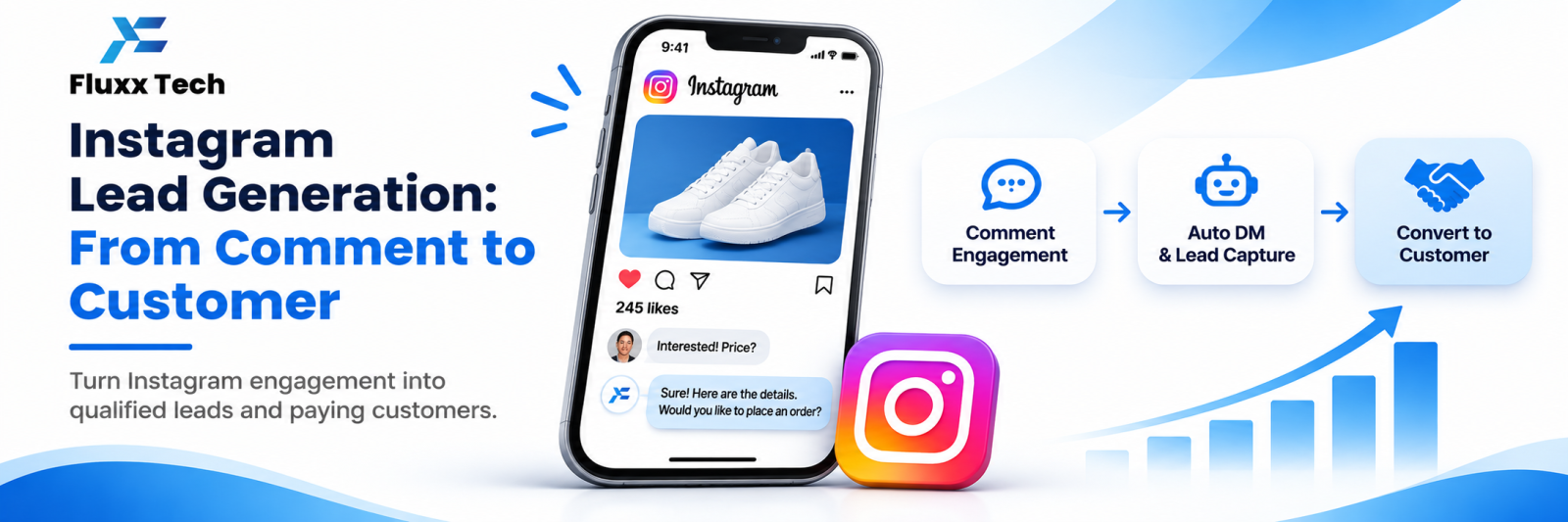
“Is Instagram working?” is usually answered with followers, reach and likes. None of those answer the question. The answer is revenue: how much money came from customers who found you on Instagram.
For businesses that sell through DMs rather than a checkout, standard analytics cannot tell you this. You have to record it. Here is how.
Why this is hard for DM-based selling
A website sale can be traced: ad click → landing page → checkout. A DM sale cannot. The customer comments on a reel, moves to DM, switches to WhatsApp, calls you, visits the shop, and pays in cash. No analytics tool sees that chain unless you record it.
Attribution methods, weakest to strongest
1. Ask the customer
“How did you find us?” at the point of sale. Cheap, easy, and surprisingly effective, but people misremember and staff forget to ask.
2. Keyword and source tracking
Each comment-to-DM keyword and each campaign gets its own keyword. When a lead arrives, the source is recorded automatically. This tells you which post generated which conversation.
3. UTM-tagged links
Any link you send from Instagram carries campaign parameters, so website visits and form fills are attributed. Works only for the part of the journey that goes through your site.
4. Conversation-level records
Every DM conversation is a contact record with a source, a tag and a status. When that contact buys, you mark the value against it. This is the method that works for DM-based selling, because it follows the person rather than the click.
5. Revenue linked to the contact
The strongest version: your messaging tool records what each Instagram-sourced contact has paid you. You can then see revenue per post, per keyword, per campaign and per agent.
What to record for every lead
Field | Example |
Source channel | |
Source detail | Reel 14 Nov / keyword PRICE |
First contact date |
|
Product or service interest |
|
Status | New, quoted, won, lost |
Order value | ₹ |
Payment date |
|
Repeat orders | ₹ and count |
Without order value, everything above is activity reporting, not revenue reporting.
The calculations
Instagram revenue = total value of orders from contacts whose source is Instagram.
Cost = ad spend + content production + tool subscriptions + a fair share of staff time.
ROI = (revenue − cost) ÷ cost
Cost per lead = cost ÷ leads from Instagram
Cost per customer = cost ÷ customers from Instagram
Conversion rate = customers ÷ leads
Average order value from Instagram, compared with your other channels.
Two refinements worth making:
• Use gross margin, not revenue, if your margins vary by product. A ₹1,00,000 month at 8% margin is not the same as at 40%.
• Include repeat purchases. A channel that brings customers who order monthly is worth more than its first-order value suggests.
Report these monthly
Metric | This month | Last month |
Leads from Instagram |
|
|
Customers from Instagram |
|
|
Conversion rate |
|
|
Revenue |
|
|
Average order value |
|
|
Cost (ads + tools + content) |
|
|
Cost per customer |
|
|
ROI |
|
|
Top post by revenue |
|
|
The last line is the one that changes what you post next month.
Make it practical
• Record source at first contact, automatically, not from memory later
• Use one keyword per campaign so attribution is unambiguous
• Mark won and lost; incomplete data makes the whole report useless
• Review monthly, not daily; small numbers are noisy
• Accept that some sales will be unattributable, and report that share honestly
Watch for the content that earns, not the content that performs
Posts with the highest reach are often not the ones that bring revenue. A reel with 50,000 views and no enquiries is worth less than a plain carousel with 2,000 views and eleven DMs. Revenue tracking is how you find out which is which, and most businesses are surprised by the answer.
Frequently asked questions
Can I track Instagram revenue without a tool? Yes, in a spreadsheet, if you record source and order value for every lead. A tool removes the manual step and the forgetting.
What if a customer finds us on Instagram but buys in the shop? Ask at billing, and record it. Unattributable sales always exist; your aim is to reduce the share.
Should I count followers in ROI? No. Followers are not revenue. Track them separately as a reach indicator.