Fluxx Tech
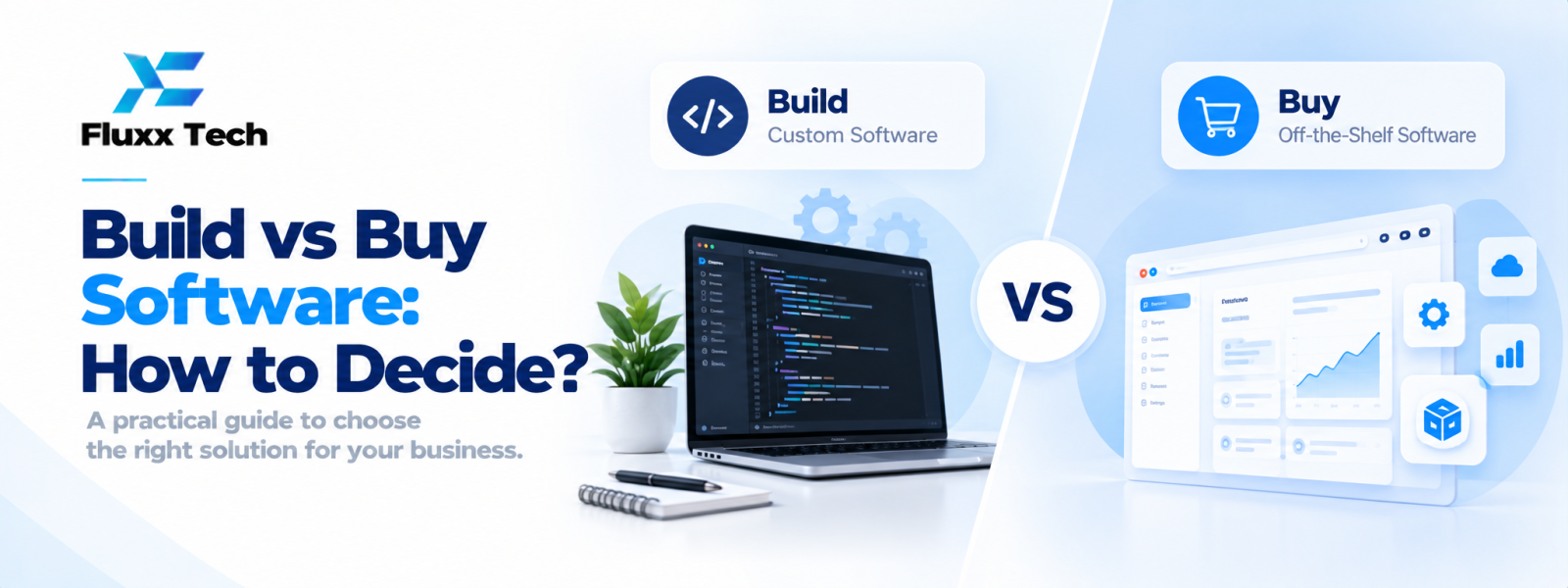
The build vs buy software decision affects more than the initial budget. It influences how quickly a business can start, how well the system fits its processes, who maintains it and how easily it can adapt later. Buying a ready-made product is often the sensible choice for common needs. Building custom software can be valuable when a process creates competitive advantage or existing products cannot support essential requirements. The best choice comes from comparing both options against the same criteria.
Understand the two options
Ready-made software is developed for a broad market and usually offers standard features, configuration and subscription or licence pricing. It can reduce implementation time when its workflow fits your business. However, it may require process changes or add-ons to cover gaps.
Custom software is designed around a specific organisation's requirements. It can support distinctive workflows and integrations, but the business takes on greater responsibility for specification, testing, maintenance and future changes. Custom does not automatically mean better; it means the system can be shaped more closely around defined needs.
Start with requirements and business value
Write down the essential tasks the system must support, the people who will use it, the information it will handle and the systems it must connect to. Separate mandatory requirements from preferences. This prevents a feature-rich product from winning simply because it looks impressive in a demonstration.
Identify what makes the process strategically important. If the workflow is common across many businesses, a standard product may be enough. If it represents a unique service model, complex pricing rule or operational advantage, a tailored solution may provide greater value.
Compare total cost of ownership
Buying costs may include subscriptions, licences, onboarding, configuration, data migration, integrations, training, support tiers and extra charges as usage grows. Review renewal terms, user limits, storage allowances and the cost of exporting data if you leave the vendor.
Building costs include discovery, UX design, development, testing, hosting, security reviews, deployment, documentation, support and ongoing improvements. Changes in scope can increase cost, so the estimate should state assumptions and exclusions. Also account for the internal time needed to make decisions and review deliverables.
Compare costs across a realistic period, such as three to five years where appropriate. Avoid treating the initial development quote as the complete lifetime cost.
Evaluate speed and flexibility
Ready-made products may launch faster when requirements match the product's existing capabilities. However, complicated configuration, data migration or workarounds can reduce the time advantage. Custom development usually requires more discovery and build time, but it can deliver a more direct workflow when the requirements are well understood.
Consider how frequently your process changes. A configurable product may handle ordinary changes through settings. If every important change depends on a vendor's roadmap or expensive add-ons, that limitation should be part of the decision.
Check integration, security and data ownership
List the systems that must exchange information, such as accounting, CRM, payment, inventory or messaging platforms. Confirm that the available APIs and integration options support the required flows. A product that does not integrate reliably can create duplicate records and manual work.
Assess authentication, permissions, audit logs, encryption, backup practices, incident communication and data residency or retention requirements relevant to your business. Ask who owns the data, how it can be exported and what happens at contract termination. For custom software, define security responsibilities and maintenance arrangements in the project agreement.
Consider a hybrid approach
Build vs buy is not always an all-or-nothing decision. A business may purchase standard accounting or HR software and build a small integration layer or customer portal around it. It may also start with a ready-made platform and replace only the parts that become a real constraint.
A hybrid approach can preserve the benefits of proven tools while giving the business control over a distinctive workflow. Keep the architecture simple and avoid customising so heavily that upgrades become difficult.
Use a decision matrix
Score each option against agreed criteria: functional fit, total cost, time to launch, integration, security, usability, vendor dependence, scalability and maintainability. Weight criteria according to business priorities rather than giving every factor equal importance by default.
Test the leading option with a realistic workflow or proof of concept. Include end users, not only decision-makers. Record the reasons for the final choice and the conditions that would justify reviewing it in the future.
Common warning signs
Buying without checking data export, integration or renewal costs can create future lock-in. Building without a product owner, clear requirements or a maintenance budget can create an expensive system that nobody can confidently improve. Choosing based on a single demonstration or the lowest quote ignores operational risk.
The decision should be documented, based on evidence and revisited when the business or market changes materially.
Conclusion
In conclusion, successful technology decisions begin with a clear understanding of business goals, current challenges and the outcomes you need to achieve. Assess the available options, define priorities and plan implementation in manageable stages. Review risks, costs and results regularly so the solution continues to support the business as it grows. A practical roadmap and the right technical guidance can help teams make informed decisions instead of investing in technology without a clear purpose.
Frequently Asked Questions
Is custom software always more expensive?
It often requires a larger upfront investment, but lifetime cost depends on licences, integrations, workarounds, support and the value delivered. Compare total ownership costs for both options.
When should a business buy ready-made software?
Buying is usually a strong option when requirements are standard, a reliable product fits the workflow and the vendor's support, integration and pricing terms are acceptable.
Can we start with ready-made software and build later?
Yes. Plan data export and integration boundaries early so a later transition is possible without unnecessary disruption.