Fluxx Tech
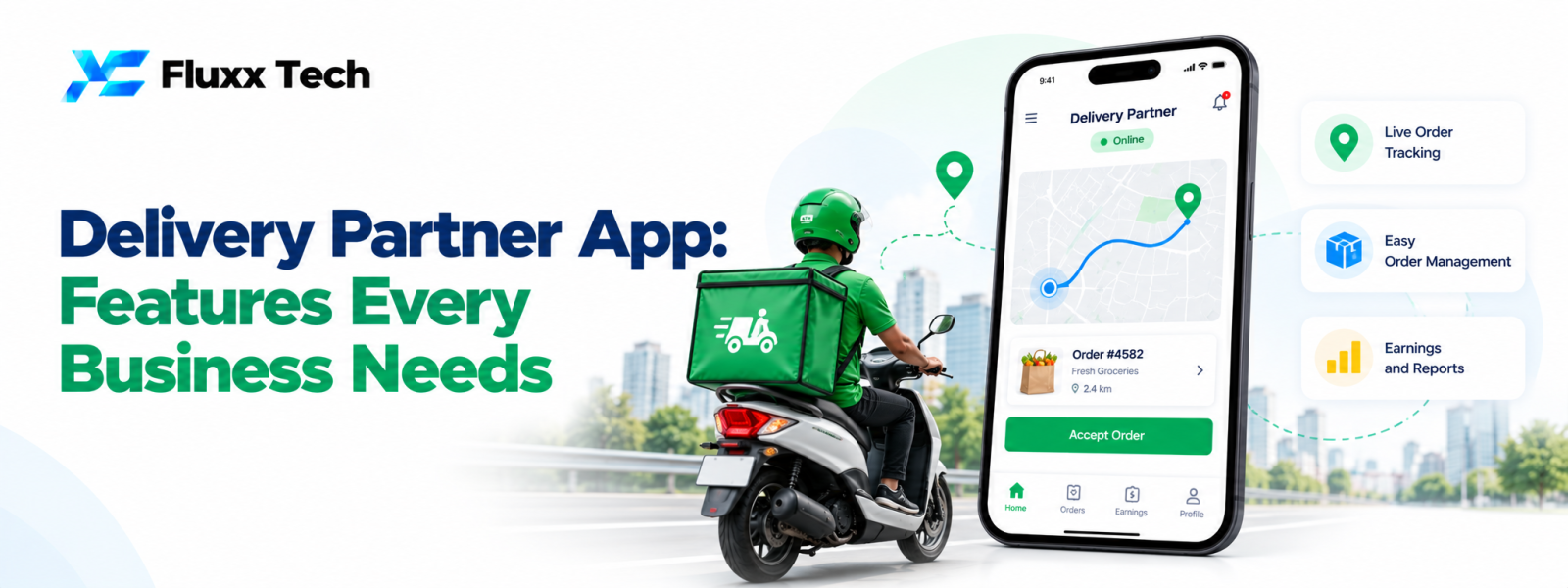
A delivery partner app helps a business coordinate riders, orders and delivery updates without relying entirely on calls and manual messages. A useful delivery partner app should make each task clear: which order to collect, where to go, what status to update and how to report a problem. The feature set should match the delivery model and the size of the operation.
1. Secure login and delivery partner profiles
Each delivery partner should have an identifiable account with the information required for assignment and support. The business may need profile status, service area, availability and vehicle details, depending on its operating model.
Use secure authentication and appropriate access controls. Staff should be able to disable access when a partner leaves or no longer meets operational requirements.
2. Order assignment and task queue
The app should show assigned deliveries with order reference, pickup location, destination, delivery instructions and expected timing. Partners need to know which task is active and what action is required next.
Assignment rules can begin manually and become more automated as order volume grows. Avoid assigning orders before the store confirms that they are ready for pickup.
3. Pickup and delivery status updates
Provide simple status actions such as accepted, arrived at pickup, collected, on the way and delivered. Each status should have a clear meaning so the customer, store and support team see consistent information.
Handle exceptions such as customer unavailable, wrong address, damaged package or store delay. The app should guide partners to report the issue instead of silently leaving an order stuck.
4. Navigation and delivery instructions
Opening a trusted map or navigation app can reduce the effort required to find addresses. Show the destination clearly and provide delivery notes that are relevant to the order.
Navigation estimates should not be treated as guaranteed delivery promises. Traffic, weather, access restrictions and customer availability can affect the actual result.
5. Customer communication and privacy
Partners may need a controlled way to contact customers about arrival or access. Use business-approved communication methods and avoid exposing personal information beyond what is necessary to complete the delivery.
Where notifications are sent automatically, keep the message content accurate and avoid sending updates before the underlying order status has changed.
6. Proof of delivery and cash handling
Depending on the business, proof of delivery may include a delivery confirmation, recipient acknowledgement or another appropriate record. Choose a process that is proportionate to the goods and service.
If cash on delivery is supported, record the amount due, amount collected and reconciliation status clearly. Limit access to financial records and create a process for discrepancies.
7. Offline handling, battery and reliability
Delivery partners may experience weak connectivity. The app should communicate when an update has not synced and avoid showing a status as completed when the server has not received it.
Keep screens readable outdoors, actions simple and data entry minimal. Test on the devices and network conditions the delivery team actually uses.
8. Admin monitoring and performance reports
Dispatchers need visibility into pending orders, partner availability, delayed tasks and delivery exceptions. Useful metrics include acceptance time, pickup delay, delivery duration, completion rate and customer-reported issues.
Use performance data to improve routes, staffing and store preparation. Metrics should be interpreted fairly and in context rather than used as a substitute for investigating operational causes.
9. Security and integration
Protect customer addresses, phone numbers and order details with secure APIs, role-based permissions and sensible retention practices. Record important actions for troubleshooting and accountability.
Integrate with the order-management system so that store, admin and customer views stay aligned. Prevent duplicate updates and define how cancellations or reassigned orders are handled.
Conclusion
Building a successful solution around delivery partner app requires a clear customer need, reliable operations and a buying experience people can trust. Start with the core workflow, test it with real users and improve it using customer feedback and measurable results. Avoid adding complexity before the essentials work consistently. With a practical roadmap and the right technology partner, your business can expand its digital channel at a pace its team can support.
Frequently Asked Questions
Does every business need a separate delivery boy app?
Not always. A small operation may begin with a simpler workflow, but a dedicated app becomes more useful when deliveries are frequent and multiple partners need coordinated assignments.
Can customers track orders in real time?
Yes, if the system is designed to share appropriate status or location information. Explain tracking accuracy and protect delivery partners' privacy.
What is the most important feature?
Reliable order assignment and status updates are foundational. Advanced routing is less useful if order readiness and delivery statuses are inaccurate.