Fluxx Tech
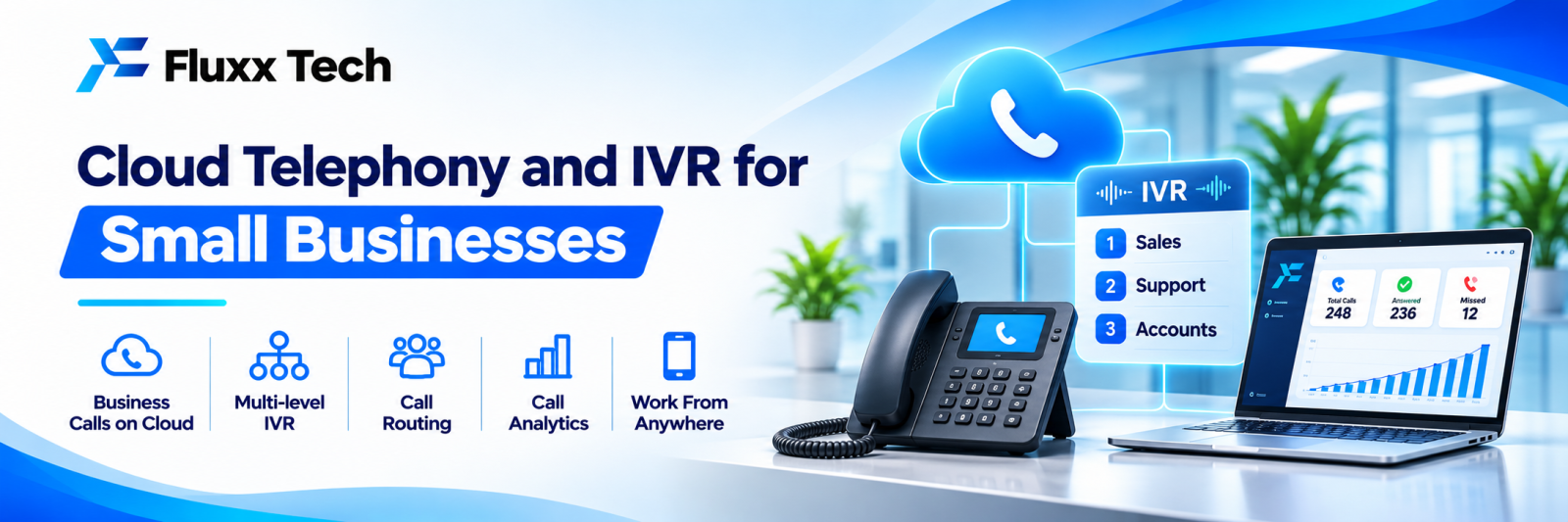
A missed call is a lost customer, and most small businesses have no idea how many they miss. The phone rings at the shop, someone is busy, it stops. No record, no callback, no number.
Cloud telephony puts your phone system in software: one business number, calls routed to multiple staff on their own mobiles, every call logged, recorded and reportable.
What it gives you
Feature | What it solves |
One business number | Customers remember one number, not five staff mobiles |
Call routing | Rings the right person, or several in sequence or together |
IVR menu | “Press 1 for sales, 2 for service” |
Missed call capture | Every unanswered call logged with the number |
Call recording | Quality, training and dispute resolution |
Call reports | Volume by hour, answered rate, duration, per agent |
Voicemail and callback | Captures after-hours enquiries |
Sticky agent | A repeat caller reaches the person who handled them last |
CRM integration | Call history against the customer record |
Click to call | Dial from your software |
Virtual numbers | Separate numbers per campaign to measure ad sources |
Missed calls are the real finding
Switch it on and the first month’s report usually surprises the owner. Businesses commonly discover a meaningful share of calls go unanswered, concentrated at lunchtime, after hours and during peak.
Once you can see it, you can fix it: add a person at peak, enable callback, set an after-hours message, or route overflow to a second number. You cannot fix what you cannot count.
Design an IVR people do not hate
Badly built IVRs lose customers. Rules that work:
1. Three options maximum at the first level. More and people forget the first one.
2. Say the options in the order of demand. Most callers want one thing; put it first.
3. Keep the greeting short. No one wants your mission statement.
4. Offer language choice early, where your customers need it: Tamil and English.
5. Always offer a human. “Press 0 to speak to someone” or a timeout that transfers automatically.
6. Never more than two levels deep.
7. Tell people the wait, if there is one.
8. Record the audio properly. A clear human voice, not a muffled phone recording.
For many small businesses, the right answer is no IVR at all: route straight to a hunt group and answer the phone. Add an IVR when the volume or the departmental split genuinely needs it.
Routing patterns
Pattern | Use |
Sequential | Rings person A, then B, then C |
Simultaneous | Rings everyone; first to answer takes it |
Round robin | Distributes evenly across the team |
Skill or department based | Via IVR selection |
Time based | Different routing after hours and on holidays |
Sticky agent | Repeat caller reaches the same person |
Overflow | Unanswered calls go to a backup number |
Sticky agent matters more than people expect, especially for service businesses: the customer does not want to explain the problem again.
Call recording: the rules
Call recording is widely used in India, but there are legal and practical obligations around notification and consent, and rules differ by context and can change.
• Announce recording at the start of the call
• State the purpose, usually quality and training
• Restrict who can listen to recordings
• Set a retention period and delete after it
• Never record payment card details being read out
• Protect recordings as personal data under the DPDP framework
Take legal advice on your specific use. This article is not legal advice.
Track ad sources with virtual numbers
Give each campaign its own number: one on the Google Ads landing page, one on the hoarding, one on the Justdial listing, one printed on the vehicle.
Now you know which channel produced which calls, and your cost per call per channel becomes a real number instead of a guess. This is the single most useful trick in cloud telephony for businesses that get most enquiries by phone.
See our conversion tracking guide.
Integration with your systems
• CRM: the caller’s record opens as the phone rings; call logged automatically
• Helpdesk: a ticket created from a call. See our helpdesk guide
• WhatsApp: send a follow-up message after the call, with details or a payment link
• Billing or job cards: link calls to service history
A call that leaves no trace in your systems is a call you cannot follow up.
Costs
Typically a monthly platform fee plus per-minute or per-call charges, with extra for numbers, recording storage and integrations. Ask for pricing at your expected call volume, and check:
• Per-minute rates for incoming and outgoing
• Number rental
• Recording storage and retention limits
• Charges for additional agents
• Contract length
Fluxx Tech can set up and integrate this: [add your pricing approach].
Compliance for outbound calling
If you make outbound sales calls, telemarketing regulations apply, including registration and do-not-disturb obligations under TRAI’s framework. These rules are enforced and have changed over time. Confirm your obligations before running an outbound calling operation.
Measure
Metric | Why |
Total calls, by hour and day | Staffing |
Answered rate | The core number |
Missed calls, and when | Where you are losing business |
Average response and talk time | Efficiency |
Calls per source number | Channel attribution |
Repeat callers | Unresolved issues |
Call-to-customer rate | Commercial outcome |
Frequently asked questions
Do we need special phones? No. Cloud telephony routes to ordinary mobiles or an app.
Can we keep our existing number? Often yes, through porting or forwarding. Confirm with the provider.
Is an IVR always a good idea? No. For a small team, answering directly converts better. Add an IVR when volume or departments require it.