Fluxx Tech
Contracts decide what your business is legally obliged to do and entitled to receive. In most small and mid-sized companies they sit as PDFs in email, in a folder nobody maintains, or in a drawer. Renewal dates pass unnoticed, and nobody can find the signed copy when a dispute arises.
Contract management is mostly about three things: knowing what you have agreed, being reminded before dates pass, and being able to produce the signed document.
What goes wrong without a system
• An AMC or lease renews automatically because nobody saw the notice period
• A supplier contract expires and work continues with no agreement in place
• Two versions exist and nobody knows which was signed
• The signed copy cannot be found during a dispute
• Payment terms agreed in the contract are not what accounts is following
• A clause commits you to something nobody tracked
Core functions
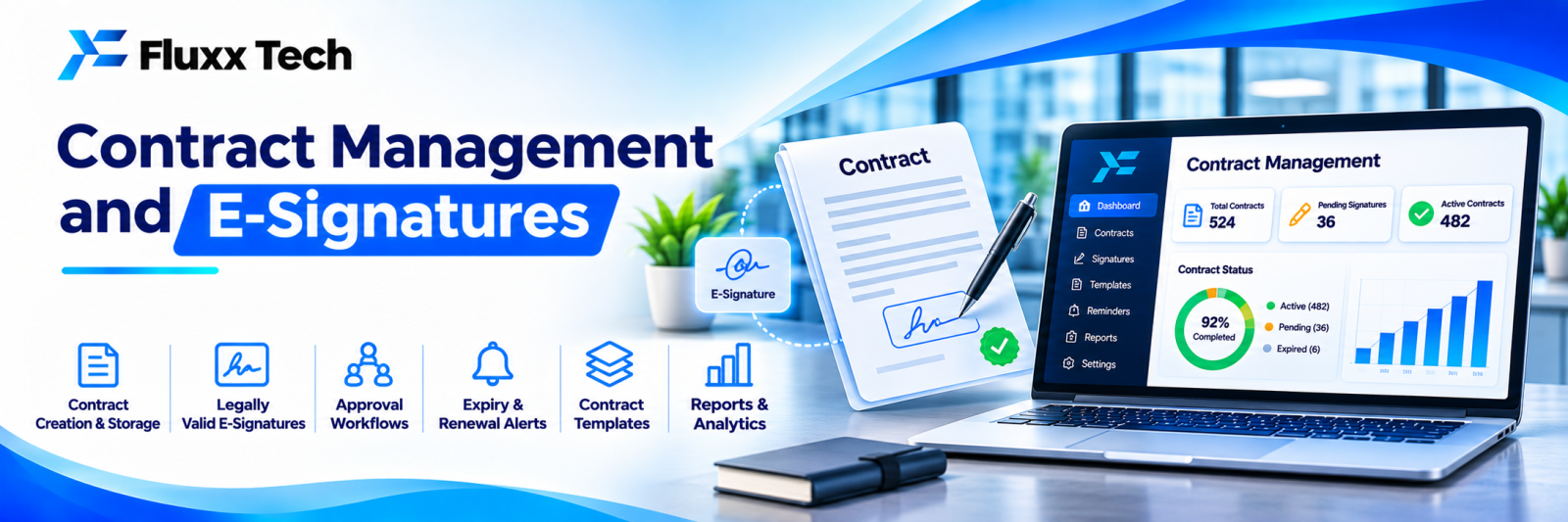
Function | What it does |
Central repository | Every contract, searchable, with the signed copy |
Metadata | Parties, value, start, end, notice period, renewal type |
Templates | Standard agreements with approved clauses |
Clause library | Pre-approved wording, so nobody drafts from scratch |
Approval workflow | Legal, finance and management sign-off before signing |
Version control | Draft history and what changed |
E-signature | Sign and return without printing |
Alerts | Renewal, expiry and notice-period deadlines |
Obligation tracking | Deliverables and milestones both sides committed to |
Audit trail | Who did what, when |
Renewal alerts are the main return
Most of the value is here. For every contract, record:
• End date
• Auto-renewal: yes or no
• Notice period required to terminate
• Notice deadline, which is the date that actually matters
Then alert at 120, 90, 60 and 30 days before the notice deadline, not the end date. By the time the end date arrives on an auto-renewing contract, you have already renewed it by default.
Assign an owner to each alert. An alert with no owner is ignored.
E-signatures in India
Electronic signatures have legal recognition in India under the Information Technology Act, and the framework includes specific types of electronic signature with different legal standing. Some documents are excluded from electronic execution, and stamp duty requirements still apply to many instruments and vary by state.
Practically:
• For routine commercial agreements, e-signature is widely used
• For documents requiring registration, stamping, or those excluded under the law, take legal advice before signing electronically
• Keep the audit trail: signer identity, IP, timestamp, document hash
• Store the signed copy with the evidence trail, not just the PDF
Confirm with your lawyer which of your documents can be executed electronically, what form of signature is appropriate, and how stamp duty applies in your state. This article is not legal advice.
Templates and the clause library
For contracts you issue repeatedly — client agreements, NDAs, vendor terms, employment letters — build templates with your lawyer once:
• Standard version requiring no legal review
• Variable fields filled from the deal data
• A clause library of pre-approved alternatives for common negotiation points
• A rule: any wording outside the library goes to legal
This cuts turnaround from days to minutes for the routine majority, and focuses legal time on the contracts that need it.
Approval workflow
Decide who approves what before signing:
Contract type | Approval needed |
Standard template, below [value] | Department head |
Standard template, above [value] | Management |
Non-standard wording | Legal, then management |
Anything with indemnity or liability changes | Legal, always |
Multi-year commitments | Management and finance |
The system enforces it; the policy defines it.
Obligation tracking
A contract is a list of promises. Extract the ones with dates and money:
• Deliverables and their deadlines
• Payment milestones
• Service levels you committed to
• Reporting obligations
• Insurance or compliance certificates to be maintained
• Price escalation clauses with effective dates
Many businesses fail to invoice a milestone because nobody tracked it. That is money lost on a contract you already won.
Access control
Contracts contain commercially sensitive terms.
• Role-based access; not everyone sees every contract
• Restrict who can download or export
• Audit log of views and downloads
• Secure storage with backups
• Careful handling of contracts containing personal data
Rollout
1. Gather every active contract; this is the hard part
2. Record the key metadata: parties, value, dates, notice period, owner
3. Switch on renewal alerts immediately; the return starts here
4. Build templates for your three most common agreements
5. Add approval workflow
6. Add e-signature, after legal confirms what may be signed electronically
7. Add obligation tracking for high-value contracts
Frequently asked questions
Do we need software, or will a folder and a spreadsheet do? Below perhaps 30 active contracts, a disciplined spreadsheet with calendar reminders can work. The discipline is the hard part.
Are e-signatures legally valid in India? Electronic signatures have statutory recognition, with conditions and exclusions. Take legal advice for your document types.
What is the single biggest benefit? Not missing notice periods on auto-renewing contracts.