Fluxx Tech
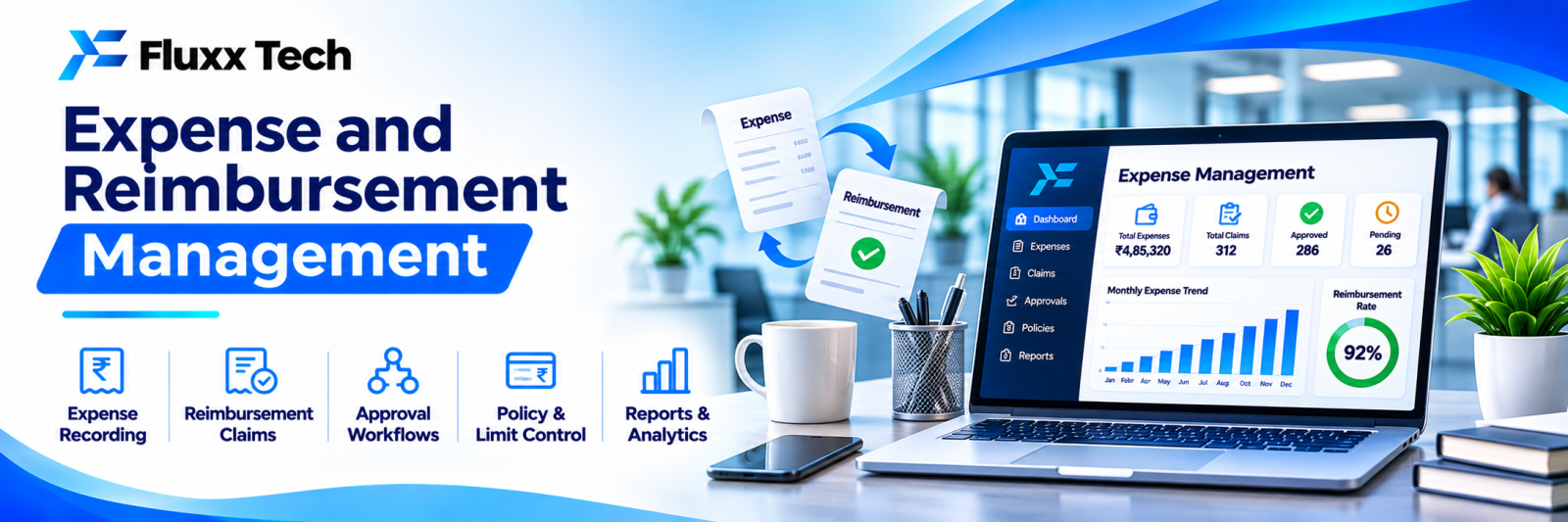
Expense claims are a small-money, high-irritation process. Employees spend their own money and wait weeks to get it back. Finance chases missing bills. Managers approve things they cannot verify. Nobody is happy, and nobody wants to own it.
Software fixes the process. A clear policy fixes the arguments.
Write the policy first
Software without a policy just digitises confusion. Decide and document:
Item | Define |
Categories | Travel, accommodation, food, fuel, client entertainment, telephone, training |
Limits | Per category, per grade, per day |
Receipt requirement | Above what amount is a bill mandatory |
Mileage rate | Per km for personal vehicle use |
Advance policy | Who can take one, how it is settled |
Submission deadline | Within how many days of spending |
Approval chain | Manager, then finance; different above a threshold |
Payment cycle | When reimbursements are paid |
Non-reimbursable | What is never claimable |
Publish it. Most expense disputes are policy ambiguity, not dishonesty.
The flow
Employee spends
↓
Submits claim with photo of the bill, from the phone
↓
Policy check: within limit, within deadline, receipt attached
↓
Manager approves or queries
↓
Finance verifies and processes
↓
Payment, usually with payroll or a separate cycle
↓
Accounting entry and GST input captured
Submission must be easy
If claiming is harder than forgetting, employees stop claiming small amounts and resent it, or they batch three months of crumpled bills into one impossible claim.
• Mobile app, photograph the bill at the moment of payment
• Auto-read the amount and date from the receipt, where OCR works
• Category selected from a list
• Draft saved immediately
• Works offline, for people travelling. See our offline-first apps guide
• Status visible to the employee: submitted, approved, paid
Policy enforcement in software
• Limits applied automatically; a claim above the limit requires a higher approval
• Receipt mandatory above the threshold, enforced
• Duplicate detection: the same bill submitted twice
• Date range validation against the deadline
• Project or cost centre tagging where you need it
• Warning, not silent rejection; tell the employee why
Advances
• Request with purpose and amount
• Approval
• Disbursement recorded
• Settlement against actual expenses
• Balance recovered or paid
• Outstanding advances report, by employee and age
Unsettled advances are where this process leaks. A monthly ageing list fixes it.
Mileage and travel
• Mileage claimed per kilometre at your published rate
• Start and end locations, with distance
• GPS-assisted capture where your policy and privacy stance allow it
• Travel requests approved before booking
• Travel desk or self-booking, with policy limits
• Per diem, where you operate one
Decide your stance on GPS tracking explicitly. It is effective and it is intrusive; employees should know exactly what is tracked and when.
GST input credit
Business expenses often carry GST that may be claimable.
• Capture the vendor GSTIN and tax amounts on the claim
• Separate claimable and non-claimable categories
• Export in a format your accounting process uses
Eligibility rules for input credit are specific and change; confirm treatment with your CA rather than assuming.
Integration
• Payroll, so reimbursements go out with salary or in a defined cycle
• Accounting or Tally, so entries are not retyped. See our Tally integration guide
• Project costing, so client-billable expenses attach to the project
• Corporate cards, where used, with statement reconciliation
Controls against misuse
• Duplicate receipt detection
• Round-number pattern flags
• Same vendor, same amount, repeatedly
• Claims submitted long after the expense date
• Approval by someone other than the beneficiary, always
• Random sample audit each month
• An audit trail of every edit
Most expense fraud is small, repeated and boring. Pattern reports catch it; investigations rarely find it.
Reports
Report | Use |
Spend by category and department | Budget control |
Spend per employee | Outliers |
Pending approvals, with age | Why reimbursements are late |
Average time from claim to payment | Employee experience |
Policy exceptions approved | Whether the policy is realistic |
Advances outstanding | Recovery |
Client-billable expenses | Recovery from clients |
Average time from claim to payment is the number employees care about. Keeping it short costs little and improves goodwill disproportionately.
Frequently asked questions
Is this worth it for a 20-person company? If employees travel or spend regularly, yes. Below that, a disciplined spreadsheet and a clear policy may be enough.
Should we use corporate cards instead? They reduce out-of-pocket spending but still need receipt capture, approval and reconciliation.
What causes most disputes? An unclear or unpublished policy. Write it first.