Fluxx Tech
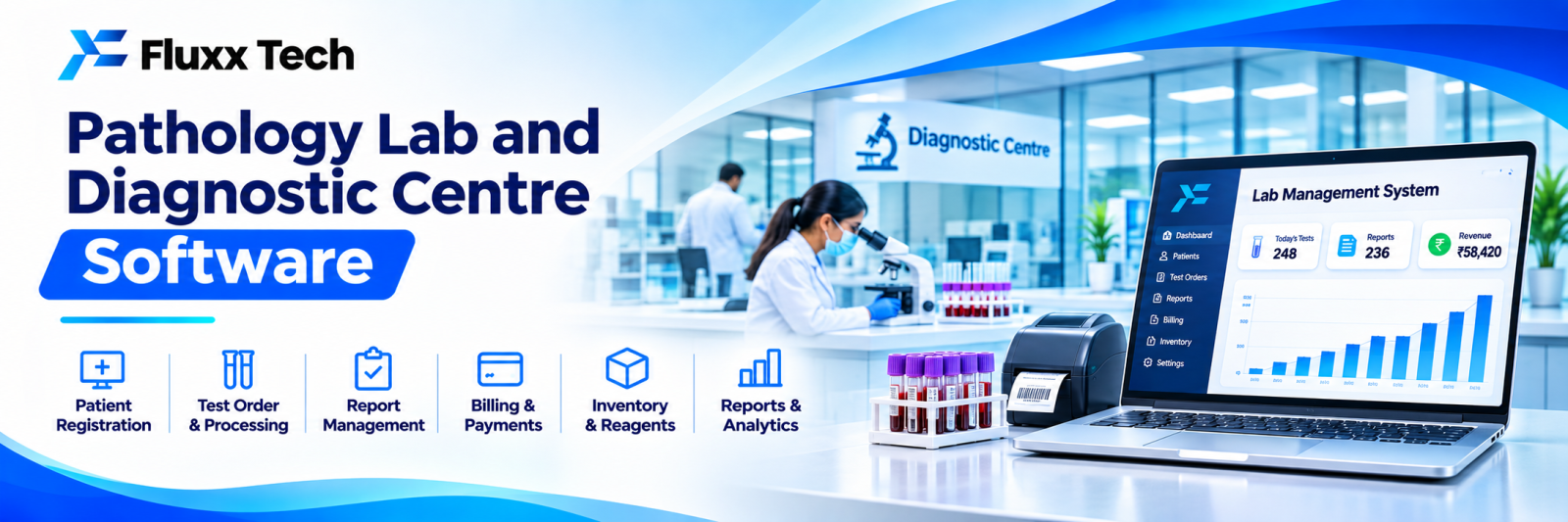
A diagnostic lab’s output is a report that a doctor will act on. Everything in the workflow exists to make sure the right result reaches the right patient, quickly, with no mix-up.
Software for a lab is less about billing and more about sample traceability.
The workflow
Patient registration
↓
Test selection, pricing, billing
↓
Sample collection, barcoded
↓
Sample tracking: received, processing, pending
↓
Results: analyser interface or manual entry
↓
Validation by a qualified person
↓
Report generation and authorisation
↓
Delivery: WhatsApp, email, portal, print
↓
Referral and doctor reporting
Core modules
Module | What it handles |
Registration | Patient master, demographics, referring doctor |
Test master | Tests, panels, profiles, pricing, sample type, TAT |
Billing | Cash, credit, corporate, insurance, discounts, concession approval |
Barcoding | Unique sample IDs, container-wise |
Sample tracking | Collected, received, in process, rejected, completed |
Results | Analyser interface, or manual entry with validation rules |
Reference ranges | By age, gender, and method |
Report generation | Your format, with signatures and credentials |
Delivery | WhatsApp, email, patient portal, SMS link |
Home collection | Scheduling, phlebotomist assignment, route |
Referral management | Doctor-wise reporting and commission, where lawful |
Inventory | Reagents, kits, consumables, expiry |
Quality control | QC runs, Levey-Jennings charts, corrective action |
MIS | Volume, revenue, TAT, rejection rates |
Barcoding is non-negotiable
Sample mix-ups are the worst failure a lab can have. Barcodes make them very unlikely:
• Unique ID generated at registration
• Label printed and applied at collection, in front of the patient
• Scanned at every stage: receipt, processing, result entry
• Reconciliation of samples received against samples registered
• Rejected samples recorded with the reason
Scan, do not type. Every manual transcription is a chance for the wrong result to reach the wrong patient.
Analyser integration
Connecting analysers to the software removes manual result entry, which is both slow and error-prone.
• Check which of your machines support an interface and in which protocol
• Unidirectional (results come in) is simpler; bidirectional (worklist goes out) is better
• Middleware may be required for older analysers
• Results still require validation by a qualified person before release
Confirm interface capability for each machine before committing to a software choice; this is the most common source of surprise during implementation.
Validation and authorisation
• Auto-flagging of results outside reference range
• Critical value alerts, with a defined escalation: who is informed, how fast, and recorded
• Delta checks against the patient’s previous result
• Only an authorised person can release a report
• Amendments tracked with reason and audit trail
• The authorising person’s name and credentials on the report
Critical value notification is both a quality requirement and a patient safety one. Define the list and the process with your pathologist.
Report delivery
• WhatsApp with a secure link, which is what most Indian patients prefer
• Email with a password-protected PDF
• Patient portal login
• Printed copy at the centre
• Doctor-wise delivery for referring physicians
Be careful: a report sent to the wrong number is a serious privacy breach. Verify the number at registration and confirm it at delivery.
Home collection
• Booking by phone, WhatsApp or app
• Phlebotomist assignment and route planning
• Collection confirmation with time stamp
• Sample transport tracking, including temperature-sensitive samples
• Payment collection at home
Compliance and privacy
Diagnostic labs are regulated, and obligations cover registration, qualified personnel, record retention, report formats and quality standards. NABL accreditation, where you hold it, adds documentation and QC requirements.
Health data is sensitive personal data under the DPDP framework.
• Restrict access by role; a receptionist does not need to see results
• Audit trail on every view and amendment
• Encrypt data in transit and at rest
• Set retention per statutory requirement, confirmed with your adviser
• Never share results with anyone other than the patient or an authorised person
• Train staff on confidentiality
Confirm your obligations with your legal adviser and the relevant authority. This article is not legal or regulatory advice.
Multi-centre and collection points
• Central lab with collection centres: sample routing and tracking between them
• Franchise collection points with their own pricing and settlement
• Consolidated and centre-wise MIS
• One patient master across centres
Reports management actually uses
Report | Decision |
Tests per day by category | Capacity and staffing |
Turnaround time by test | Service quality |
Sample rejection rate and reasons | Process and training |
Revenue by test, centre and doctor | Commercial focus |
Pending reports | Daily operations |
Reagent consumption vs tests done | Wastage |
Credit outstanding from corporates and doctors | Cash flow |
Frequently asked questions
Can it connect to our existing analysers? Often, depending on the machine’s interface support. Check each one before finalising software.
Can patients get reports on WhatsApp? Yes, commonly with a secure link. Verify the number carefully to avoid misdelivery.
Is this only for large labs? No. Barcoding and report delivery help a single-centre lab immediately.