Fluxx Tech
Hiring in most small companies runs on a shared inbox and a WhatsApp group. Resumes arrive, somebody forwards the good ones, interviews are arranged by phone, and three weeks later nobody remembers who was told what. Candidates go silent because nobody got back to them, which quietly damages your employer reputation.
An applicant tracking system (ATS) turns hiring into a pipeline you can see.
What it handles
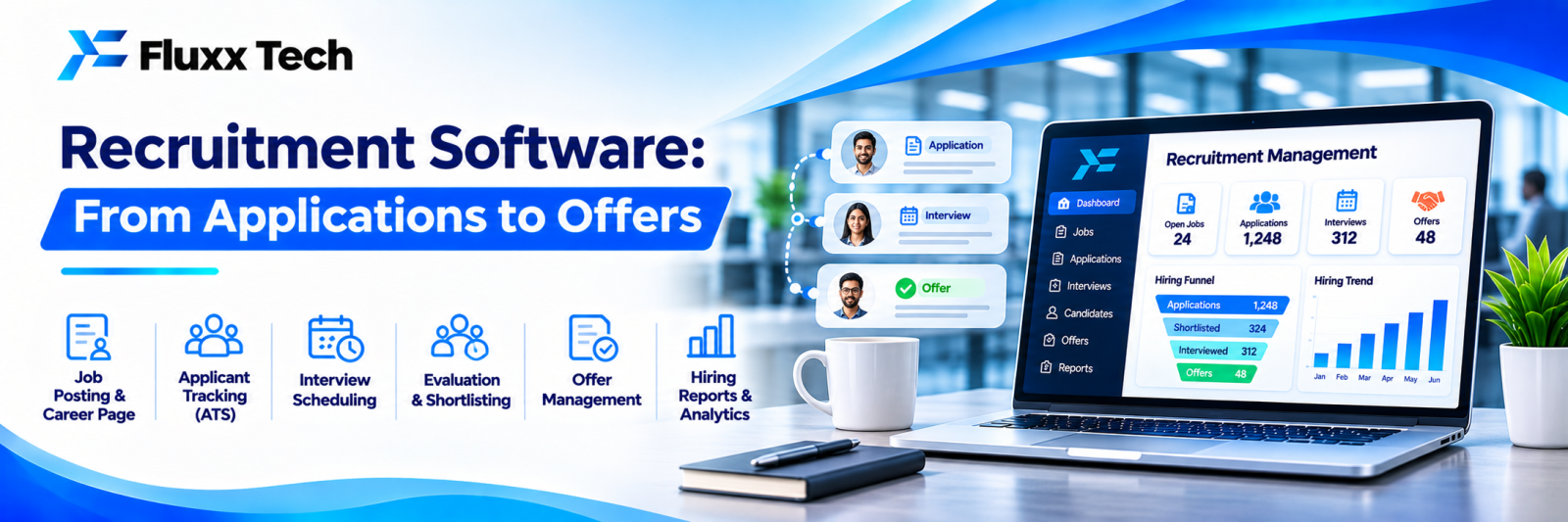
Stage | Function |
Requisition | Role approved, with budget and headcount |
Job posting | To your careers page and job boards, from one place |
Application capture | From boards, email, referrals, walk-ins |
Resume parsing | Name, contact, skills, experience extracted automatically |
Screening | Filters and knockout questions |
Pipeline | Applied → screened → interview → offer → joined |
Interview scheduling | Calendar coordination with panel and candidate |
Scorecards | Structured feedback per interviewer |
Offer management | Approval, letter generation, acceptance |
Onboarding handover | Candidate data passed to HR |
Reports | Time to hire, source quality, drop-off |
Your careers page matters
Most companies post on job boards and have no careers page, which means they pay for every application.
A proper careers page:
• One page per open role, with a real job description
• Clear location, experience required and type
• A short section on the team and what the work involves
• Salary range, where you are willing to publish it; it increases quality and reduces time wasted
• A simple application form, not “email your CV to…”
• Photos of the actual workplace
• Indexable, so the roles can rank for “[role] jobs in Coimbatore”
Job pages can rank. A “React developer jobs in Coimbatore” page that ranks brings free, direct applications for years.
Resume parsing and screening
• Resumes parsed into structured fields, so you can search by skill and experience
• Duplicate detection: the same candidate applying for three roles
• Knockout questions: notice period, location willingness, minimum experience
• Tagging for future roles
Be careful with automated filtering. Rigid keyword filters reject good candidates who phrase things differently. Use filters to sort, not to auto-reject, unless the criterion is genuinely absolute.
Pipeline discipline
The main benefit is simply knowing where everyone is.
• Every candidate in exactly one stage
• An owner for each candidate
• Age in stage visible; candidates sitting for ten days are your problem, not theirs
• A reason recorded for every rejection
• Nobody left without a response
That last rule is worth enforcing. Candidates who are ghosted tell people. In a city-sized talent market, that reputation costs you future hires.
Interview scheduling
• Panel availability visible
• Candidate offered slots to choose from
• Calendar invites to everyone automatically
• Reminders to candidate and panel
• Video interview link included
• Rescheduling handled without ten phone calls
Scheduling is where hiring time quietly disappears. Automating it is one of the clearest wins.
Structured scorecards
Unstructured interviews produce inconsistent hiring. Give interviewers a form:
• The specific competencies for this role
• A rating per competency
• Evidence required, not just a score
• An overall recommendation
• Submitted before discussing with other panel members, so opinions are not anchored
Keep scorecards in the system. They are also your record if a hiring decision is ever questioned.
Offers
• Offer approval workflow, with compensation limits
• Letter generated from a template with the approved terms
• Sent and accepted digitally. See our e-signature guide
• Acceptance tracked
• Follow-up during notice period, because offer-drop is common in India
• Handover to HR for onboarding
Candidate engagement between offer and joining is where many hires are lost. Keep in touch: a message from the manager, documents sent in advance, a joining-day plan shared. Silence during the notice period is how candidates get re-recruited by someone else.
Data protection
You are holding personal data about people who do not work for you.
• Collect only what is needed for the hiring decision
• Tell candidates what you collect, why, and how long you keep it
• Get consent before keeping a resume in a talent pool for future roles
• Restrict access to hiring team members
• Delete after your stated retention period
• Be careful with identity documents; do not collect them before you need them
Confirm your obligations under the DPDP framework with a legal adviser. This article is not legal advice.
Fair hiring
Avoid collecting or using information irrelevant to the job: caste, religion, marital status, pregnancy plans. Beyond the legal risk, structured, job-relevant hiring produces better outcomes.
Where you use any automated scoring, understand what it is actually filtering on and check it is not excluding whole groups for irrelevant reasons.
Metrics worth tracking
Metric | What it tells you |
Time to hire, by role | Process speed |
Time in each stage | Where the bottleneck is |
Source of hire | Which channels actually work |
Cost per hire by source | Where to spend |
Application to interview ratio | Job description and screening quality |
Interview to offer ratio | Interview quality |
Offer acceptance rate | Compensation and candidate experience |
Offer drop rate | Engagement during notice period |
Early attrition, under 6 months | Hiring quality, the real test |
Source of hire usually surprises people: referrals and the careers page often outperform paid job boards on both cost and retention.
Frequently asked questions
Is an ATS worth it for a company hiring 10 people a year? Probably not a full product. A structured spreadsheet plus a good careers page and a response discipline covers it. Above 20–30 hires a year, software pays.
Should we publish salary ranges? It improves application quality and saves time on both sides. Many Indian companies still do not; those that do usually find it helps.
What is the most common hiring failure? Slowness, followed by silence. Good candidates accept the first good offer.