 Fluxx Tech
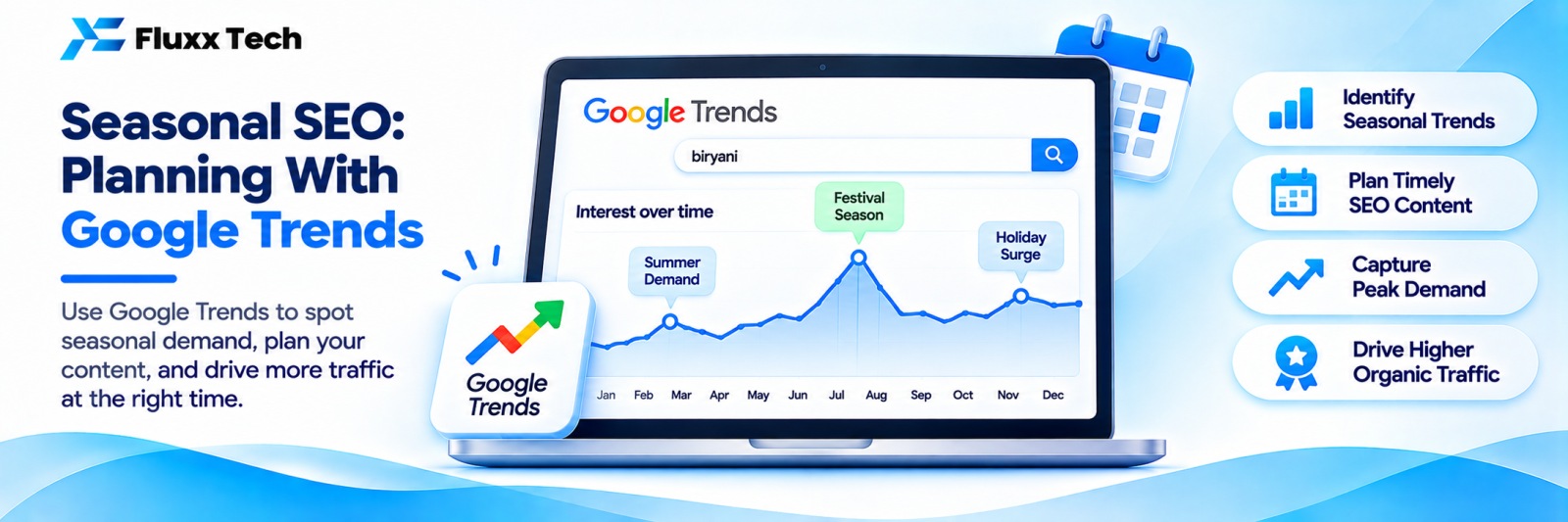
Search demand is not flat. Wedding-related searches spike before the muhurtham seasons, air conditioner searches climb from March, gift searches peak before Diwali, and admission searches concentrate into a few weeks.
If you publish your Diwali page in late October, you have missed it. Google needs time to crawl, index and build confidence in a page before it ranks.
Using Google Trends properly
Google Trends shows relative interest over time, not absolute volume. That is fine; you care about the shape, not the number.
Settings that matter:
• Region: India, and state-level where relevant. Tamil Nadu’s seasonality is not Delhi’s.
• Time range: past 5 years to see the repeating pattern, not just last year’s noise
• Compare terms to see which phrasing wins and when
• Related queries → Rising to catch new phrasings before competitors
What to look for:
1. The month demand starts climbing
2. The peak week
3. How fast it falls
4. Whether the pattern repeats every year
5. Whether a term is growing or declining year on year, separate from its seasonality
Publish early
Work backwards from the peak:
Content type | Publish before peak |
New page for a competitive seasonal term | 3–4 months |
New page, low competition | 6–8 weeks |
Refresh of an existing page that already ranks | 4–6 weeks |
Social and ads | 1–3 weeks |
Last-minute offers | Days |
A brand new page published two weeks before peak will not rank. The same page published in July, then refreshed in September, often will.
Indian seasonality worth planning for
This varies enormously by business; check your own data in Search Console and Trends before committing.
Period | Common demand |
Jan | Pongal, new year planning, admissions begin |
Feb–Mar | Exams, financial year end, tax, wedding season |
Mar–May | Summer: AC, cooling, water, travel, summer camps |
Apr | New financial year, business software and compliance |
May–Jun | School admissions, uniforms, books, college applications |
Jun–Sep | Monsoon: repairs, waterproofing, health |
Aug–Sep | Onam, Ganesh Chaturthi, festive buying begins |
Sep–Nov | Festive peak: Navratri, Diwali, gifting, electronics, jewellery, vehicles |
Nov–Feb | Wedding season in much of India |
Dec | Year-end offers, holidays, planning for next year |
Add your own industry’s cycle: harvest for agri businesses, exhibition calendars for manufacturers, academic cycles for education.
Reuse the page, do not recreate it
The biggest seasonal SEO mistake: creating /diwali-offers-2026/ every year, then /diwali-offers-2027/, and losing all the accumulated authority each time.
Better: keep one permanent URL, /diwali-offers/, and update it each year.
• URL stays constant and keeps its links and history
• Update the H1, content, offers and images annually
• Mention the year in the title tag and content for freshness
• Keep it live all year, with a note about when the next offer runs
• Link to it from relevant content throughout the year
If you already have year-specific URLs, consolidate them: pick one as the permanent URL and 301 the others to it.
What to do in the off-season
A seasonal page sitting dormant loses ground. Between peaks:
• Keep the page live, do not delete or noindex it
• Add evergreen content that makes it useful year-round: buying guides, comparisons, care tips
• Build internal links to it from new blog posts
• Refresh it two to three months before the next peak
• Earn a link or two while competitors are not paying attention
Off-season is the cheapest time to build the authority you will need at peak.
Plan twelve months at a time
Step | When |
Pull last 3 years of Search Console data by month | Once, at planning time |
Identify your own demand peaks per product or service | Same |
Check Trends for each seasonal term | Same |
Mark peak weeks on a calendar | Same |
Work backwards to publish dates | Same |
Schedule refresh dates for existing seasonal pages | Same |
Review after each season: what ranked, what did not | Each season |
Your own Search Console data beats Trends for your specific business, because it reflects your actual audience. Use Trends for terms you do not yet rank for.
Measure after each season
• Clicks during the season versus last year
• Position for the main seasonal terms at peak
• When traffic started rising, and whether you were ranked by then
• Revenue from seasonal pages
• What competitors did differently
Write it down immediately after the season, while it is fresh. That note is next year’s plan.
Frequently asked questions
Does Google Trends show real search volume? No, relative interest. Use a keyword tool for volume and Trends for timing.
Should I delete last year’s seasonal page? No. Update it and keep the same URL, or 301 it into a permanent one.
How far ahead should I start for Diwali? For competitive terms, publish or refresh by July or August. Two weeks before is far too late.