 Fluxx Tech
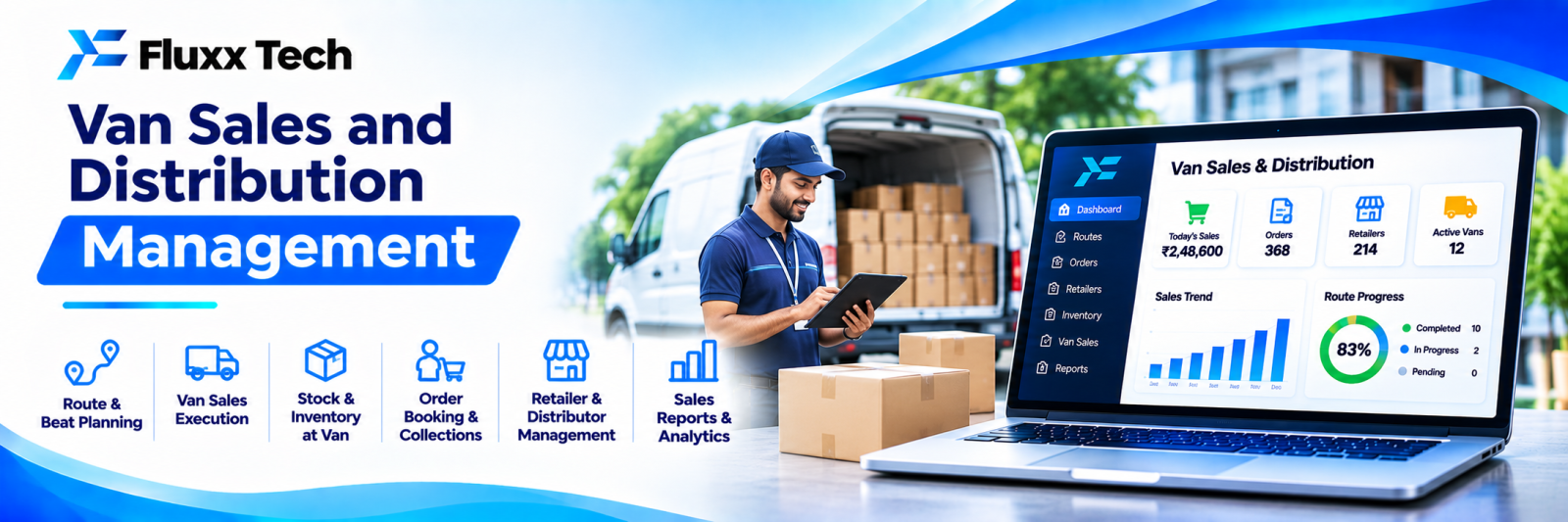
A distributor’s business runs on vans going out with stock each morning and coming back with cash, unsold goods and a handful of handwritten bills. What happened in between — which shops were visited, what was offered, what was refused — is known only to the salesman.
Van sales software makes the route visible and the stock accountable.
Two models
Van sales (cash van): stock goes out on the vehicle, is sold and invoiced at the shop, and cash or UPI is collected immediately. Common in FMCG, dairy, bakery, beverages.
Pre-sales: the salesman takes orders at the shop, delivery follows later from the warehouse. Common for larger order sizes and credit customers.
Many distributors run both. The software must handle whichever you use, and often both on the same route.
Core modules
Module | What it handles |
Beat and route planning | Which outlets, which day, which salesman |
Van loading | Stock issued to the vehicle, with a load sheet |
Outlet master | Shops with location, type, credit terms, history |
Order and invoice | On the spot, printed or digital |
Scheme and discount | Trade offers applied by rule, not by memory |
Collection | Cash, UPI, cheque, against invoice |
Returns and damages | Recorded at the shop, with reason |
Van reconciliation | Loaded minus sold minus returned equals balance |
Retailer coverage | Visited, productive, skipped |
Competitor and stock check | What the shop is stocking |
Reports | Sales, coverage, collections, variance |
Beat planning
• Outlets assigned to beats, beats assigned to days
• Each salesman’s daily route list
• Planned versus actual visits
• Geo-tagged outlets, so visits can be verified
• New outlet addition with photograph and details
Coverage metrics are the point: outlets visited, outlets that bought (productive calls), and lines sold per call. A route where the salesman visits 40 shops and sells to 12 is a different problem from one where he visits 18.
The mobile app
Used standing in a crowded shop, often on a cheap phone with poor signal.
Requirements:
• Fast: an order entered in under a minute
• Works offline, syncing later. Markets have dead zones, and this is non-negotiable. See our offline-first apps guide
• Shows last order history for that shop, which drives upselling
• Shows scheme eligibility automatically
• Prints or sends the invoice on WhatsApp
• Records collection against invoices, including partial payments
• Handles returns and damages with a photo
If the app is slower than a bill book, the salesman will go back to the bill book.
Van stock reconciliation
The core financial control, done every evening:
Opening van stock
+ Loaded during the day
− Sold (invoiced)
− Returns taken back to warehouse
− Damages recorded
= Closing van stock
Any variance is flagged, attributed to the salesman and vehicle, and investigated. Done daily and consistently, this closes the main leakage route in distribution.
Schemes and trade offers
FMCG distribution is full of schemes: buy 10 get 1, slab discounts, combo offers, retailer incentives.
• Schemes defined centrally with validity dates
• Applied automatically at invoicing, so nothing depends on the salesman remembering
• Scheme cost tracked, and claimed back from the principal company where applicable
• Expired schemes cannot be applied
Unclaimed scheme reimbursement is money distributors routinely lose because the paperwork was incomplete.
Collections and credit
• Outstanding visible per outlet, on the app, before the salesman walks in
• Credit limit enforced; over-limit requires approval
• Collection recorded against specific invoices
• Cheque details captured
• Daily cash deposit reconciliation
• Ageing report by outlet and by beat
Integration
• Accounting or Tally, for invoices, purchases and collections. See our Tally integration guide
• Warehouse or inventory, for stock
• Principal company systems, where they require sales data uploads
• WhatsApp, for invoices to retailers and daily reports to the owner
Reports the owner reads
Report | Decision |
Daily sales by salesman, beat, product | Performance |
Coverage: planned vs visited vs productive | Route discipline |
Lines per call and value per call | Upselling |
Van variance | Leakage |
Collection against target | Cash flow |
Outlet-wise sales trend | Which shops are declining |
New outlets added | Market expansion |
Returns and damages by salesman | Handling and ordering quality |
Outlet-wise declining trend is the one most distributors never see. A shop that used to buy weekly and now buys monthly has usually switched to a competitor, and nobody noticed.
Rollout
1. Clean the outlet master: real shops, correct names, geo-tagged
2. Define beats and assign them properly
3. Start with order entry and invoicing only
4. Add van loading and daily reconciliation
5. Add collections and outstanding
6. Add schemes
7. Add coverage and competitor reporting
8. Review variance weekly with the team
Expect resistance from salesmen who prefer the bill book. Daily reconciliation discipline is what makes the system stick.
Frequently asked questions
Will salesmen use the app? Only if it is fast, works offline and in their language. Test with your actual team on their actual phones.
Does it need GPS tracking? Geo-tagging visits is common and useful. Be clear with the team about what is tracked and why.
Can it handle both van sales and pre-sales? It should, since most distributors run both on different routes or customer types.