Fluxx Tech
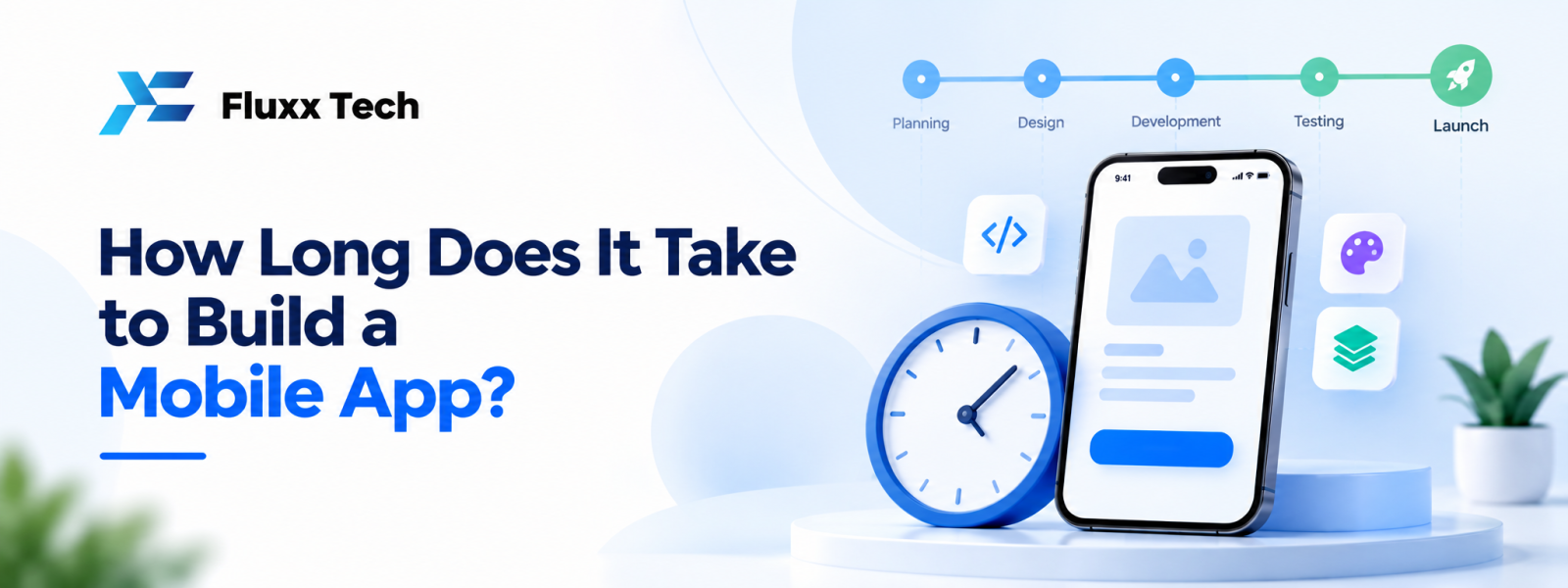
If you are planning a mobile application for your business, you probably want to know when it will be ready. Understanding how long to build a mobile app helps you plan your budget, prepare your team and coordinate marketing activities before launch. The timeline depends on features, design, platform, integrations and testing requirements. A basic business application has different needs from a delivery platform with customer accounts, online payments, delivery partners and an administrative dashboard. Breaking development into clear stages makes the work easier to understand and manage.
How long does mobile app development usually take?
Use scope, not guesses
A simple app may take several weeks, while a complex application may take several months or longer. These are broad planning descriptions, not delivery promises. A realistic estimate requires reviewing the features, team capacity, dependencies and approval process.
Compare application types
A basic information app has different requirements from a booking app. E-commerce apps may require product search, checkout, payment integration and order management. Delivery platforms can add driver workflows, tracking and multiple dashboards. Each added workflow creates design, development and testing work.
Plan for uncertainty
An estimate should state its assumptions and identify what could change the schedule. Avoid treating an early conversation as a guaranteed launch date.
App development timeline: the main stages
Discovery and requirements
The team identifies the business problem, user types, workflows, required features, integrations and constraints. Clear requirements reduce ambiguity. For example, an order cancellation feature may involve inventory changes, refunds, notifications and reports, not just a button.
Project planning
The team prioritises features, selects an implementation approach, defines milestones and identifies dependencies. Agree on review responsibilities and how scope changes will be handled.
UI/UX design
User flows, wireframes, visual screens and prototypes help confirm how people will use the app. Design time depends on screen count, interaction complexity and review rounds. Consolidated feedback helps reduce rework.
Mobile and backend development
Developers build the interface, business logic, APIs, data storage and integrations. Mobile and backend tasks may overlap where dependencies allow. Platform choices affect implementation, but both Android and iOS releases need appropriate checks.
Testing and quality assurance
Testing checks user journeys, forms, permissions, payments, notifications, device compatibility, network errors and performance. Defects discovered during testing need time for correction and retesting.
Deployment and release
Release preparation can include app signing, store listings, screenshots, descriptions and submission. Store review and third-party approvals are outside the developer's complete control, so they should be treated as schedule dependencies.
Post-launch support
After launch, the team may monitor errors, resolve defects and prioritise improvements. Compatibility changes and new business requirements can create further work.
What can delay a mobile app project?
Changing requirements
Adding features after development starts can affect design, architecture and testing. Evaluate new requests before changing the agreed scope.
Unclear requirements
When expected behaviour is not defined, developers may make assumptions that later need to be revised. Document important rules and approve workflows early.
Delayed feedback
Design and development reviews depend on decisions from business stakeholders. Assign a decision-maker and agree on reasonable review periods.
Third-party dependencies
Payment services, APIs, account access and existing systems can delay work. Identify these dependencies early and arrange test access.
Insufficient testing time
Reducing testing to meet an arbitrary date can increase release risk. Include testing and defect resolution in the original plan.
How to improve the development schedule
Start with an MVP
A minimum viable product focuses on essential features needed to test a business idea. A service business might initially launch with booking and reminders, then consider loyalty features later. An MVP must still be fit for its intended use and properly tested.
Prepare content and assets
Product images, descriptions, store listing materials and business details can become launch blockers if they are prepared late. Assign owners and deadlines.
Keep feedback organised
Use a shared tracker for design comments, defects, decisions and pending tasks. This helps the team avoid conflicting instructions.
Communicate regularly
Progress reviews should cover completed work, current priorities, upcoming milestones and decisions needed from the business.
Estimate your project timeline before starting
Define scope and platforms
List features, user roles, integrations and target platforms. Make sure the estimate covers the intended first release.
Confirm responsibilities
Identify who supplies content, credentials, test accounts and business decisions. Dependencies should have clear owners.
Agree on milestones
Break the work into reviewable deliverables rather than relying on a single date. Ask what acceptance means for each milestone.
Allow for uncertainty
Set aside reasonable flexibility for unexpected defects or external dependencies. Any buffer should be based on project risk, not used to hide an unclear plan.
Frequently Asked Questions
How long does a basic mobile app take?
It may take several weeks depending on the scope, integrations, design and testing. Ask for an estimate after requirements are reviewed.
Does building Android and iOS apps take twice as long?
Not necessarily. Shared-code approaches can reduce duplicated work, but each platform still needs testing and release preparation.
Can an MVP be developed faster?
Often, because it includes fewer features. The timeline still depends on technical complexity and quality requirements.
Does testing increase the timeline?
Yes, but testing helps identify defects before launch. Include time for fixes and retesting.
Can a developer guarantee an exact launch date?
A planned date can be agreed based on defined assumptions, but scope changes, defects, external services and store reviews may affect the release.
Conclusion
Understanding how long to build a mobile app requires more than counting coding days. Planning, design, backend work, integrations, testing and deployment all contribute to the schedule. Define requirements, prioritise features, agree on milestones and manage dependencies early.