Fluxx Tech
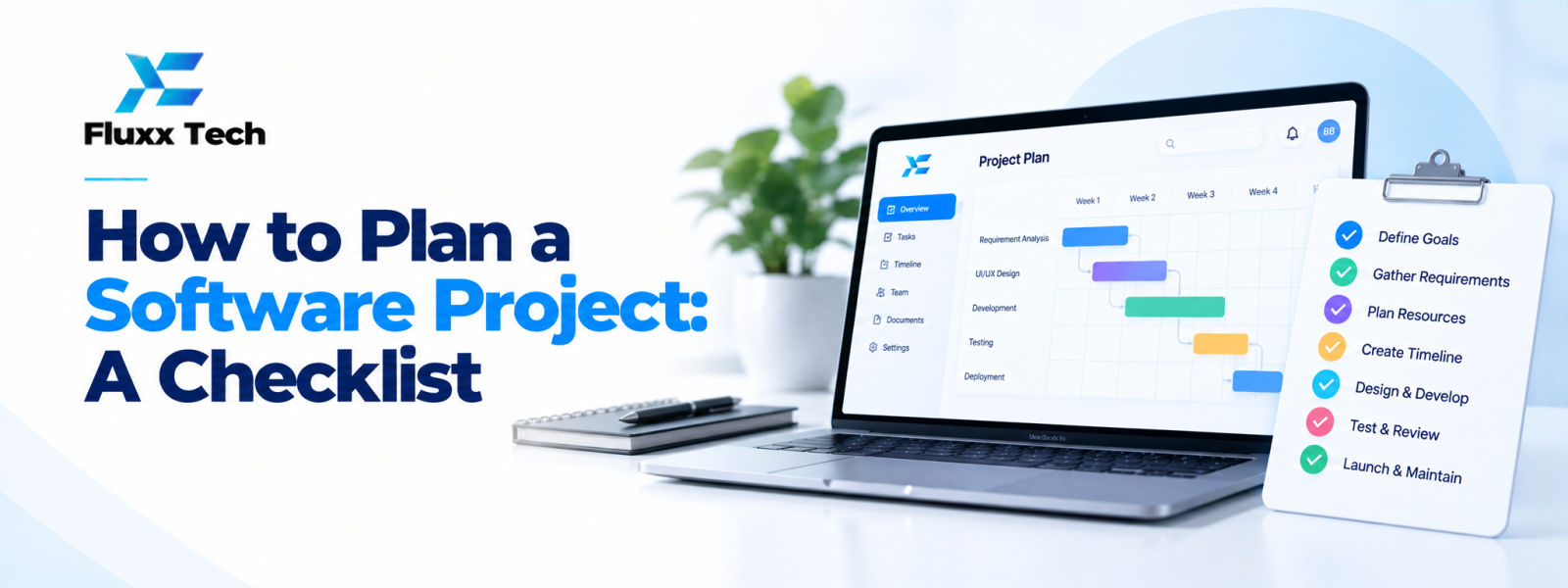
Software project planning helps a business turn an idea into a deliverable product with a clear scope, realistic expectations and measurable outcomes. Whether you are building a customer portal, an internal workflow tool or a mobile app, planning reduces avoidable confusion between business owners, designers and developers. It cannot remove every uncertainty, but it creates a shared reference for decisions and makes changes easier to evaluate.
Define the business goal
Start by explaining why the project is needed. Describe the business problem, who experiences it and what should improve after launch. 'Build an app' is an activity, not an outcome. 'Allow customers to place and track orders without calling the office' is a clearer goal that can guide feature decisions.
Identify the primary users and stakeholders. Include the people who will use the system daily, the people responsible for approving it and anyone who depends on its data. Agree on how success will be measured before selecting features.
Set scope and priorities
Create a list of required capabilities and separate must-have features from items that can wait. A useful first release solves the main user problem without attempting to cover every future possibility. Define what is explicitly out of scope so the team can identify requests that would expand the project.
Consider an MVP when it is appropriate: a focused first version that tests the most important assumptions. The MVP should still meet basic expectations for security, reliability and usability; it should not be treated as permission to ignore essential quality.
Prepare a software requirements document
A software requirements document records what the system should do and the constraints it must respect. Describe user roles, key workflows, inputs and outputs, business rules, notifications, reports and integrations. Add examples or simple diagrams for complicated processes.
Include non-functional requirements such as expected performance, availability, accessibility, data protection, backup and recovery, browser or device support and audit needs. Requirements should be specific enough to test. Instead of 'the page should be fast', define a performance target that makes sense for the application and its users.
Review the document with business stakeholders and the development team. Resolve conflicting expectations early and record assumptions that still need confirmation.
Map the user journey and technical approach
Sketch the main journey from the user's first action to task completion. Identify unusual cases, failed payments, missing information, cancelled requests and permission restrictions. Early wireframes can help stakeholders agree on the workflow before detailed design and implementation.
Choose an architecture that fits the project's scale, data sensitivity, expected integrations and maintenance capacity. Decide whether to use existing platforms, third-party services or custom components. Avoid adding complex infrastructure without a clear need, but do not ignore reliability and security requirements.
Estimate budget, people and timeline
Ask the team to estimate work by milestone rather than relying on a single unexplained delivery date. Include discovery, design, development, testing, content or data migration, deployment, training and post-launch support. Identify dependencies such as access to payment providers, customer data or external approvals.
Budget for ongoing hosting, licences, monitoring, maintenance, security updates and future enhancements. Keep a contingency for uncertainty and make clear what the estimate assumes. A quote based on incomplete requirements should be treated as provisional.
Create a project roadmap and governance plan
Break the work into milestones with a deliverable, owner and acceptance criteria for each. A roadmap might include discovery, requirements approval, prototype review, development increments, user acceptance testing, launch preparation and post-launch review.
Agree on how often progress will be reviewed, where decisions are recorded and who can approve scope or budget changes. Define how urgent defects will be escalated and how stakeholders will give feedback. One clear decision-maker can help prevent contradictory instructions.
Plan testing, security and launch
Testing should cover normal user journeys, validation errors, permissions, integrations, different devices or browsers and recovery from failures. Business users should complete acceptance tests against agreed requirements. Keep defects visible and decide which severity levels must be resolved before release.
Review access control, secrets management, data handling, backups, logging and third-party dependencies. Prepare a launch checklist covering production configuration, DNS or app-store steps where relevant, monitoring, rollback options, support ownership and user communication. Do not make the first real-world use the first meaningful test.
After launch: support and improve
Assign someone to receive feedback, monitor errors and coordinate fixes. Check the success measures defined at the start and compare them with the baseline. Review what users struggle with, which features are adopted and where the original assumptions were wrong.
Maintain a prioritised backlog and plan updates based on impact, risk and available resources. A project is not fully planned if nobody owns it after launch.
Conclusion
In conclusion, successful technology decisions begin with a clear understanding of business goals, current challenges and the outcomes you need to achieve. Assess the available options, define priorities and plan implementation in manageable stages. Review risks, costs and results regularly so the solution continues to support the business as it grows. A practical roadmap and the right technical guidance can help teams make informed decisions instead of investing in technology without a clear purpose.
Frequently Asked Questions
What is the most important part of software project planning?
Clear goals and requirements are foundational because they help the team choose scope, estimate effort and test whether the finished system solves the intended problem.
Can requirements change after development starts?
Yes. Record the change, estimate its impact on cost, timeline, risk and existing features, then approve or defer it through an agreed process.
Who should approve the software requirements document?
The business owner or authorised product stakeholder should approve the business requirements, with technical review from the delivery team and input from key users.