Fluxx Tech
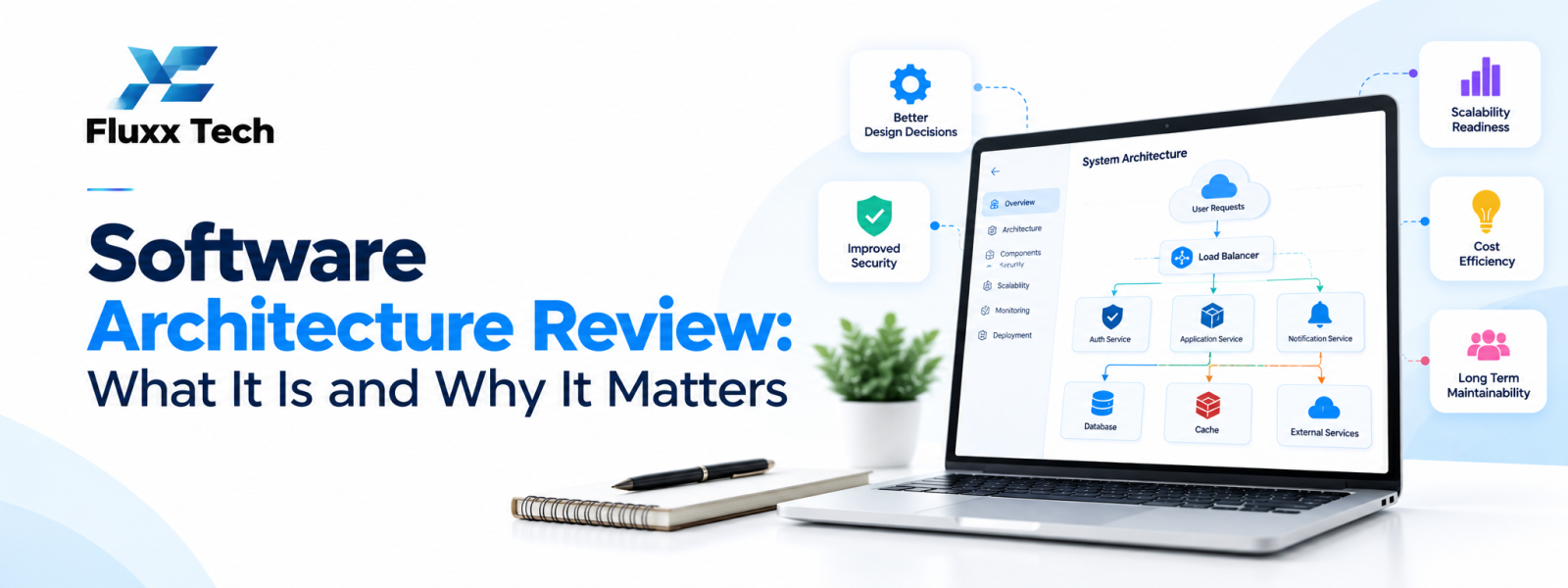
A software architecture review examines how an application is structured and whether that structure supports its business, technical and operational needs. It looks beyond individual code defects to consider components, data flows, integrations, deployment, security and the ability to change the system safely. A review can be useful before scaling a product, modernising a legacy application, onboarding a new development team or investing in a major feature.
What a software architecture review covers
The review starts with the system's purpose, users, expected load, business criticality and constraints. It examines the main components, how they communicate, where data is stored, how dependencies are managed and how the application is deployed and monitored.
It may also assess maintainability, performance, resilience, access control, backup and recovery, observability and the complexity of future changes. The exact depth should match the system's risk and the decisions the business needs to make.
Why architecture matters to business outcomes
Architecture influences how reliably the product works, how quickly teams can deliver improvements and how much effort is required to operate it. Tight coupling can make a small change affect several unrelated features. Unclear data ownership can lead to inconsistent records. Missing monitoring can make incidents difficult to diagnose.
Good architecture is not about choosing the newest framework or making every system highly distributed. It is about making trade-offs appropriate to the product, team and expected growth. A simple design that is easy to maintain may be better than a complex architecture that the organisation cannot operate.
When to conduct a review
Consider a review when response times deteriorate as usage grows, releases become risky, defects frequently return, infrastructure costs rise unexpectedly or integrations are difficult to maintain. A review is also useful before a merger, cloud migration, large refactor or significant security-sensitive feature.
New projects can benefit from a lightweight review before implementation choices become expensive to reverse. Existing systems may need a deeper review when business operations depend on them and failures would have serious consequences.
How the review is performed
First, collect available architecture diagrams, repository information, deployment details, incident history, requirements and known pain points. Interview developers, operations staff and business stakeholders to understand the gap between the documented design and the system in practice.
Next, map critical user journeys and data flows. Identify important dependencies, trust boundaries, failure points and operational responsibilities. Use code inspection, configuration review, logs or performance evidence where authorised and appropriate. Avoid drawing conclusions from diagrams alone if they may be outdated.
Finally, assess findings against business requirements and rank them by impact, likelihood and remediation effort. The result should distinguish confirmed problems from assumptions that require further testing.
Areas to examine
Scalability: Can the system handle expected usage patterns? Identify bottlenecks based on evidence rather than assuming every component needs to scale independently.
Reliability: What happens when a dependency fails? Review timeouts, retries, queues, backup restoration and recovery procedures.
Security: Examine identity, permissions, secrets, sensitive data flows, dependency updates and logging practices. A high-level architecture review is not a substitute for a specialised penetration test where one is required.
Maintainability: Check module boundaries, duplicated logic, testing strategy, documentation and how safely changes can be released.
Operations: Review monitoring, alerting, deployment automation, environment consistency and ownership of incidents.
Understand the review report
A useful report explains the current architecture in accessible language, highlights the highest-risk issues and links each recommendation to a business consequence. It should identify quick wins, structural improvements and questions requiring more evidence.
Recommendations should include priority, expected benefit, dependencies and rough effort ranges where possible. A long list of technical observations without sequencing does not help leadership decide what to fund first.
Create a remediation roadmap
Address urgent risks first, especially those involving data loss, uncontrolled access or serious reliability problems. Then tackle recurring operational pain and architectural constraints that slow delivery. Group related changes into manageable increments and define a way to measure whether each change helped.
Some findings may be accepted temporarily because the cost of remediation exceeds the current risk. Record the rationale, owner and review date instead of allowing the decision to disappear.
Common review mistakes
Treating a review as a search for a single perfect architecture can distract from the business context. Recommending a rewrite without comparing migration risk can be costly. Ignoring team skills and operational capacity may produce a design that looks good on paper but fails in practice.
A strong software architecture review provides evidence, explains trade-offs and gives the organisation a realistic route to a more dependable system.
Conclusion
In conclusion, successful technology decisions begin with a clear understanding of business goals, current challenges and the outcomes you need to achieve. Assess the available options, define priorities and plan implementation in manageable stages. Review risks, costs and results regularly so the solution continues to support the business as it grows. A practical roadmap and the right technical guidance can help teams make informed decisions instead of investing in technology without a clear purpose.
Frequently Asked Questions
Is a software architecture review the same as a code review?
No. Code review focuses on particular changes or implementation details. Architecture review considers the system's structure, interactions and long-term qualities, though it may inspect code to validate findings.
How often should architecture be reviewed?
Review it before major changes and when growth, incidents, costs or maintenance problems indicate that assumptions may no longer hold.
Does a review guarantee that software is secure?
No. It can identify architectural security concerns, but security assurance may also require threat modelling, configuration checks, dependency analysis and specialised testing.