Fluxx Tech
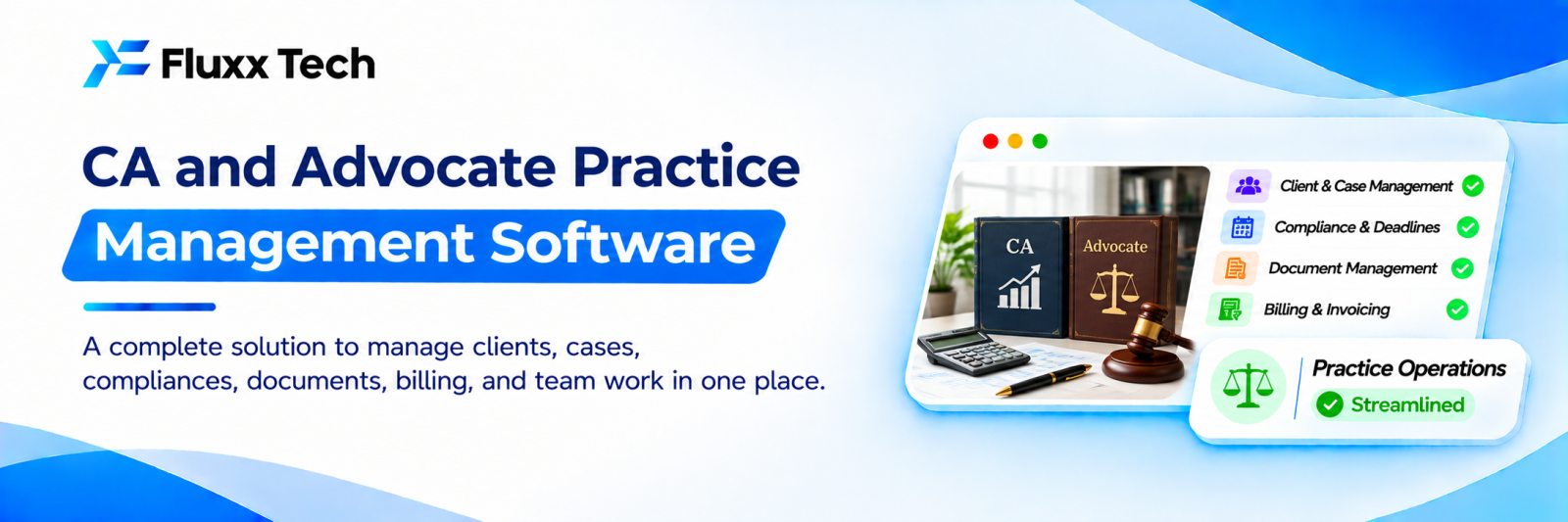
A professional practice sells time and judgement against deadlines that are set by someone else. Miss a filing date or a court date and the consequence falls on the client, which means it falls on you.
The two things practice software must do well are never lose a deadline and never lose a document.
Client and matter structure
Organise around the matter, not just the client:
Client: ABC Industries Pvt Ltd
├── Matter: GST compliance FY 2026-27
├── Matter: Income tax assessment AY 2025-26
├── Matter: ROC annual filing 2026
└── Matter: Trademark opposition
Each matter needs: type, responsible partner, assigned staff, status, opening date, fee arrangement, and its own documents and deadlines.
For a law practice, matters are cases, with court, case number, opposing party and stage.
The compliance calendar
For a CA practice this is the core of the system.
• Statutory due dates by compliance type, applied across all clients
• Client-wise applicability: which clients need which filings
• Automatic task generation ahead of each due date
• Assignment to staff
• Status: not started, documents pending, in progress, filed
• Escalation as the date approaches
• Record of what was filed, when, with acknowledgement number
Due dates change. Extensions are announced, forms are revised, and requirements shift. The calendar must be maintained by someone, and the software should make updating a date across all affected clients a single action.
Confirm every due date against the official source before relying on it. This article is not tax or legal advice.
Document collection: the real bottleneck
Most delays are not the professional’s work; they are waiting for the client to send something.
• Checklist per matter type: what is needed from the client
• Request sent on WhatsApp and email, with the list
• Client uploads or replies with documents
• Received, pending and overdue tracked per item
• Automatic reminders to the client
• A visible list of matters blocked on client documents
The last item is what lets a partner see on a Monday that eleven filings are stuck waiting on clients, and act on it.
See our document collection in chat guide.
Court dates and hearings, for law practices
• Case with court, bench, case number, stage
• Next hearing date, recorded as soon as known
• Cause list checking and updating
• Adjournment history
• Brief and case papers linked
• Counsel assigned
• Client informed of each date and outcome
Missing a hearing date is the professional equivalent of a missed filing. Multiple reminders, to multiple people, are warranted.
Time recording and billing
Fee model | Handling |
Fixed fee per matter | Simple; track against effort to see whether it is profitable |
Hourly | Time recorded per matter, per person |
Retainer | Monthly fee against agreed scope, with overflow tracked |
Per filing or per appearance | Transaction-based |
Contingent, where permitted | Per the applicable professional rules |
Even fixed-fee practices benefit from recording time, because it reveals which clients consume far more effort than their fee justifies. That is usually two or three clients, and almost every practice has them.
• Time entries against matters
• Expenses: government fees, filing charges, travel, stamp duty, recorded as reimbursable
• Invoice generation from time and expenses
• Advance and retainer adjustment
• Receivables ageing
Professional conduct rules govern advertising, fee arrangements and client solicitation for both CAs and advocates. Confirm what your institute or bar council permits before publishing fee information or marketing material.
Workload and capacity
• Open matters by staff member
• Tasks due this week by person
• Capacity visible before accepting new work
• Bottlenecks: one person holding up several matters
During filing season, this view is what prevents the firm from accepting work it cannot deliver.
Confidentiality and access control
Professional practices hold highly sensitive information: financials, disputes, personal data, strategy.
• Role-based access; staff see only their matters
• Partner-level visibility across the practice
• Audit log of document access and downloads
• Restricted export
• Encryption at rest and in transit
• Clear policy on personal devices
• Access removed immediately when staff leave
• Conflict-of-interest check before accepting a new matter
Conflict checking deserves its own step: a searchable record of all clients and opposing parties, checked before onboarding.
Professional secrecy obligations apply in addition to data protection law. Confirm both with your institute and a legal adviser.
Client communication
• A record of every advice given, in writing
• Matter status visible to the client, where you offer that
• Deadline reminders to the client for their actions
• Annual compliance calendar shared with each client
Written confirmation of advice protects both sides. A practice that advises by phone and records nothing is exposed.
Reports
Report | Decision |
Upcoming due dates, next 30 days | Operations |
Matters blocked on client documents | Chasing |
Overdue filings or missed dates | Risk |
Realisation: fee billed versus time spent | Pricing |
Client profitability | Which clients to keep |
Receivables ageing | Cash |
Matters per staff member | Capacity |
New matters by source | Business development |
Client profitability is the uncomfortable report. Most practices discover that a few clients produce most of the work and little of the fee.
Frequently asked questions
Is this different from a CRM? Yes. A CRM manages prospects; practice software manages matters, deadlines, documents and billing.
Can it handle both CA and legal work? A firm doing both needs matter types for each, with different fields and calendars.
What is the biggest risk it removes? Missed statutory dates, and documents that cannot be found when they are needed.