Fluxx Tech
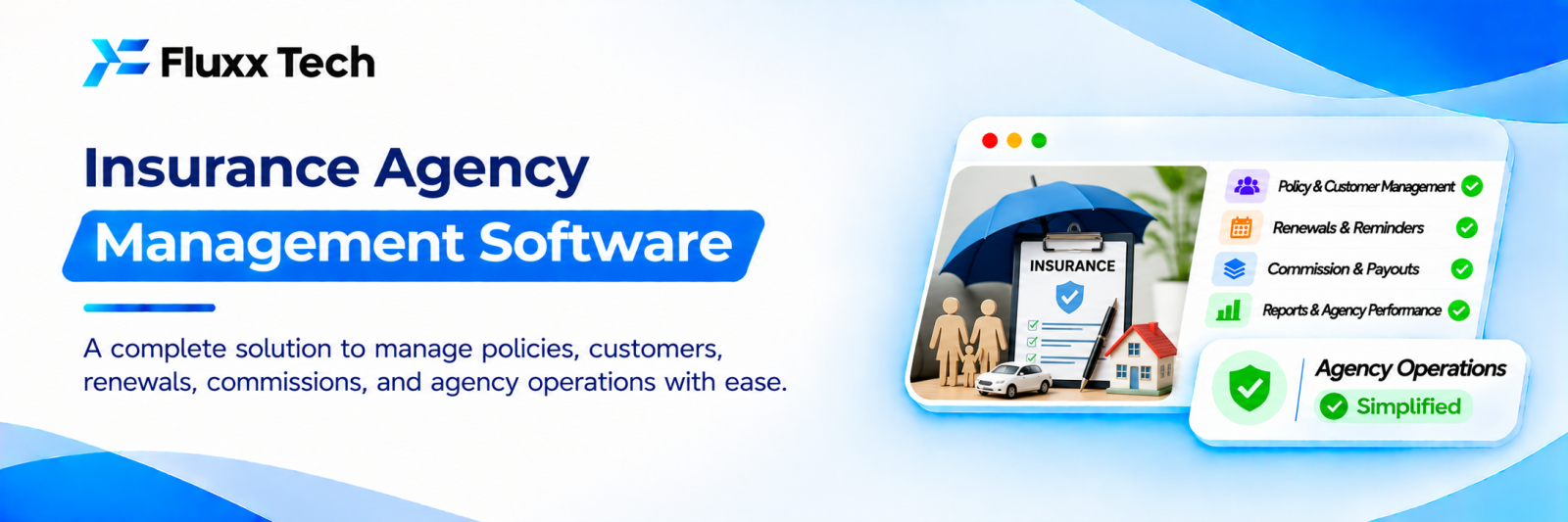
An insurance agency’s income is renewals. A policy sold once pays for years, provided somebody remembers it is due and reaches the client before the lapse date, and before a competitor does.
Agents who track renewals properly keep most of their book. Agents who rely on memory and a diary lose a slice of it every year without ever knowing which policies they lost.
Policy records
• Client record with family or group linkage
• Policy: insurer, product, policy number, type
• Sum assured or sum insured
• Premium amount and frequency
• Inception date, renewal date, maturity date
• Nominee details
• Riders and add-ons
• Premium payment mode
• Document copies: policy schedule, proposal, KYC
One client often holds several policies across insurers. The system should show the whole relationship on one screen: motor, health, term, endowment, and who in the family holds what.
Renewal management: the core
• Renewal dates visible 90, 60, 30, 15 and 7 days ahead
• Automatic reminders to the client on WhatsApp
• Reminder to the agent to call
• Status: contacted, payment pending, renewed, lapsed, lost to another agent
• Grace period tracking
• Lapsed policy revival follow-up
Motor insurance is the most competitive renewal, with aggregators contacting the customer directly before the date. An agent who calls two weeks ahead with a quote keeps the business; one who calls after expiry usually does not.
Record the reason when a policy is not renewed. After fifty entries the pattern is clear: price, service, claim experience, or simply never contacted.
Commission reconciliation
Agents are routinely underpaid without noticing, because nobody checks.
• Expected commission per policy, by product and insurer
• Commission statements received from each insurer
• Reconciliation: expected versus received
• Discrepancies flagged for follow-up
• Clawback on cancelled or lapsed policies
• Renewal commission in later years, which is where it is most often missed
Reconciling first-year commission is common. Reconciling the second and third year renewal commission is rare, and that is exactly where gaps accumulate.
Multi-insurer handling
Most agents and brokers represent several companies.
• Insurer-wise policy counts and premium
• Product comparison for a client’s requirement
• Each insurer’s portal reference and login arrangement
• Insurer-wise commission rates
• Insurer-wise claim experience, which should influence what you recommend
Note that what you may recommend and how you may be remunerated is governed by your licence category and IRDAI regulations. Agents, corporate agents and brokers have different permissions, and the rules change.
Confirm your obligations with IRDAI guidance and your principal insurers. This article is not regulatory or financial advice.
Claims support
Claims are where an agent proves their value and earns referrals.
• Claim intimation recorded with date and reference
• Document checklist per claim type
• Documents collected from the client
• Status tracking with the insurer
• Surveyor appointment and visit, for motor and property
• Settlement amount and date
• Client communication log
• Claim closed, with outcome
A claim handled well produces referrals for years. A claim handled badly loses the whole family’s policies.
Lead and prospect management
• Lead source: referral, walk-in, online, existing client
• Requirement captured: type, sum assured, budget
• Quotations given, from which insurers
• Follow-up schedule
• Conversion or loss, with reason
• Cross-sell opportunities: a motor client with no health cover
Cross-sell lists are the easiest revenue in an agency. Clients with only one policy, listed by what they are missing, is a report that should be worked monthly.
Compliance and record-keeping
• Licence and renewal dates for the agency and each agent
• Training and certification requirements
• KYC documents per client, with retention per requirement
• Proposal forms and disclosures
• Records as required by your licence category
Personal and financial data of clients is sensitive. Restrict access, secure documents, and confirm retention periods with a legal adviser.
Client communication
• Renewal reminders
• Policy document delivery
• Annual portfolio statement: everything they hold, with renewal dates
• Claim updates
• Birthday and milestone messages, used sparingly. See our milestone messaging guide
The annual portfolio statement is a strong retention tool. A client who receives a clear summary of their family’s cover each year sees the value of having an agent.
Business-initiated WhatsApp messages need opt-in and approved templates; confirm current rules.
Reports
Report | Decision |
Renewals due, next 90 days | The daily work |
Renewal rate, by product and insurer | Retention performance |
Lapse reasons | What to fix |
Commission expected vs received | Money owed to you |
Premium under management | Business size |
Policies per client | Cross-sell opportunity |
Claim settlement ratio by insurer | Recommendation quality |
New business by source | Where clients come from |
Frequently asked questions
Can one system handle life, health and general insurance? It should, since most clients hold all three and the renewal discipline is the same.
Does it connect to insurer portals? Rarely automatically. Most agencies maintain their own records and reconcile against insurer statements.
What is the biggest gain? Renewal retention, followed by commission reconciliation. Both are money already earned that is being lost.