Fluxx Tech
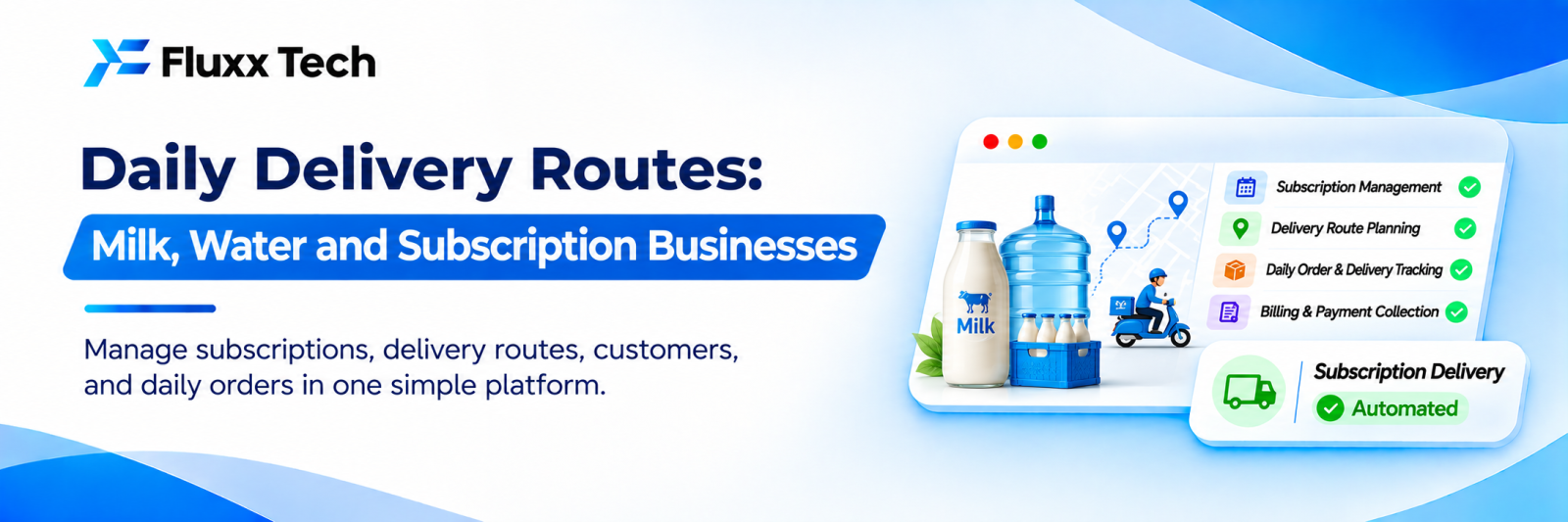
Milk, water cans, newspapers, tiffin, flowers, vegetables: businesses built on delivering the same thing to the same houses every morning. Low value per delivery, high frequency, and monthly billing that depends entirely on an accurate record of what was delivered.
The whole business turns on one question: what exactly was delivered to each customer this month? Get that wrong and you either lose money or lose the customer.
Subscriptions, not orders
The core data is a standing instruction:
• Customer, address with landmark, phone
• Product and quantity per day
• Delivery days: daily, alternate, weekdays only, specific days
• Start date
• Route and sequence position
• Delivery time preference
• Rate, which may be customer-specific
• Special instructions: “ring bell”, “leave at gate”, “dog”
Then the system generates each day’s delivery list automatically. No one should be writing tomorrow’s list by hand.
Changes are constant
The feature that decides whether customers stay:
Change | Handling |
Vacation pause | From date to date, resumed automatically |
Quantity change | Temporary for one day, or permanent |
Extra on a given day | Guests coming |
Skip tomorrow | One-off |
Product change | Toned to full cream, 20L to 10L |
Address change | Mid-month, affecting route |
Stop permanently | With reason recorded |
Customers should be able to request these on WhatsApp, and the change should reflect in tomorrow’s list automatically. The most common complaint in this business is being charged for milk delivered during a week the customer was away.
A simple keyword flow works:
Reply PAUSE with dates, SKIP for tomorrow, EXTRA for an extra unit, or STOP to cancel.
Route management
• Routes defined with an ordered sequence of houses
• Delivery person assigned per route
• Route sheet generated each morning, in sequence
• New customers slotted into the nearest route position
• Route rebalancing when one grows too large
• Substitute delivery person able to follow the sequence without knowing the area
That last point is the test. If a replacement cannot complete the route from the sheet, the route only exists in one person’s head.
Delivery recording
• Delivered, not delivered, partial, with reason
• Recorded on the delivery person’s phone, not from memory at the end of the day
• Works offline; many deliveries happen at 5 am with poor signal. See our offline-first apps guide
• Photograph as proof, where disputes are common
• Time stamp
Daily recording is what makes monthly billing defensible. Reconstructing a month from memory guarantees disputes.
Returnable containers
For water cans, milk crates and bottles, the empties are an asset.
• Cans issued and returned, per customer
• Running balance of cans with each customer
• Deposit held against cans
• Can deposit refund on closure
• Damaged or lost cans charged per policy
• Total cans in circulation versus cans owned
Can balances drift quietly. A monthly reconciliation per customer prevents a large unexplained shortfall at year end.
Monthly billing
• Bill generated from actual recorded deliveries
• Clear day-wise statement showing exactly what was delivered
• Pauses and skips visible, which pre-empts disputes
• Extras itemised
• Previous balance carried forward
• Sent on WhatsApp on a fixed date, with a payment link
The day-wise statement is important. A bill that just says “₹1,840 for October” invites argument; one that lists each day does not.
See our payment reminders guide.
Collection
• Online payment link, which most customers now prefer
• Cash collected by the delivery person, recorded immediately
• Collection reconciliation per delivery person, daily
• Outstanding per customer, visible to the delivery person before the next delivery
• Reminder sequence for overdue accounts
• Rule for stopping delivery after a defined overdue period
Cash collected by delivery staff needs same-day reconciliation. A weekly reconciliation on a cash-heavy route is an invitation to leakage.
Procurement planning
Tomorrow’s delivery list is tomorrow’s requirement:
• Total quantity needed per product, per route
• Adjusted for pauses and extras
• Compared with supply available
• Wastage recorded if you over-procure
For milk and perishables, this planning directly controls spoilage.
Customer acquisition and churn
• New customer onboarding: address, start date, first delivery confirmation
• Trial period, if offered
• Churn reason recorded on every stop
• Win-back for customers who stopped. See our win-back guide
Track net customer growth per route, not just new additions. A route adding six and losing eight is shrinking.
Reports
Report | Decision |
Daily delivery list by route | Operations |
Delivered vs planned | Service reliability |
Not-delivered reasons | Process problems |
Active customers by route, net growth | Business health |
Collection versus billing | Cash |
Outstanding ageing | Risk |
Can balance per customer | Asset control |
Churn rate and reasons | Retention |
Frequently asked questions
Do delivery staff need smartphones? Basic ones are enough. The app must be simple, fast and work offline at 5 am.
How do we handle customers who pay late? Outstanding visible before delivery, automated reminders, and a clear written policy on when delivery stops.
What causes most disputes? Billing for days the customer had paused. Daily recorded delivery and a day-wise statement fix it.