 Fluxx Tech
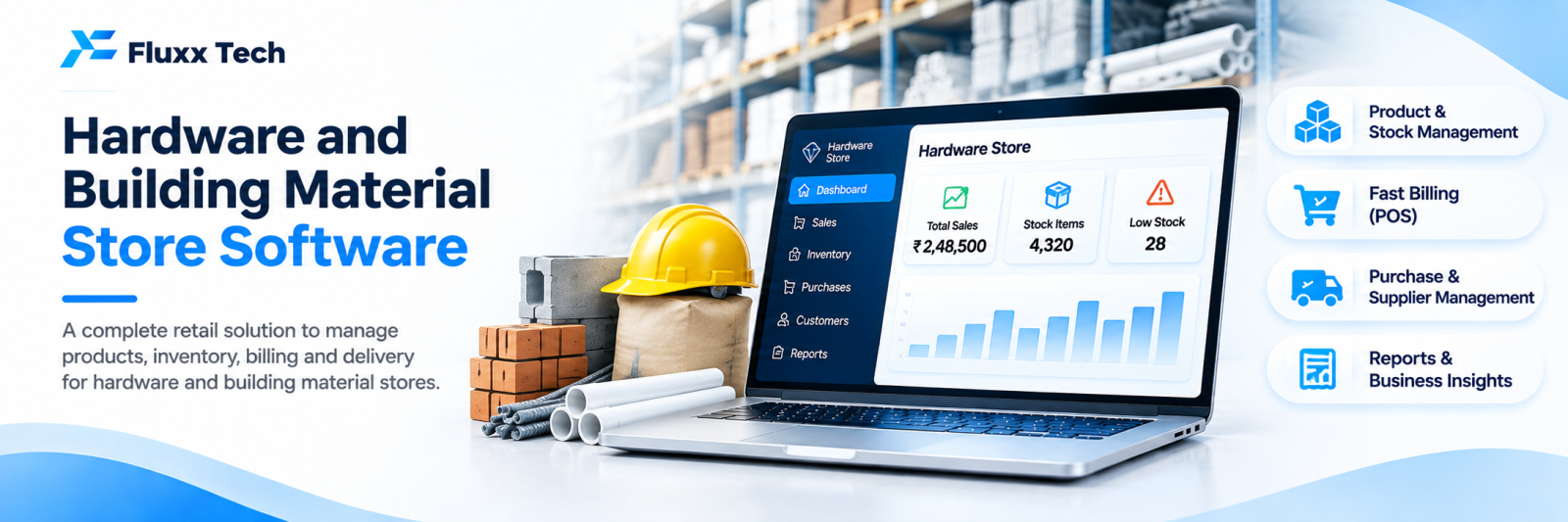
A hardware shop sells cement by the bag, wire by the metre, paint by the litre, pipes by the length and screws by the kilo or the piece. Half the customers are contractors buying on credit for a site, and the rate they pay is not the rate on the board.
This is why generic retail billing software does not survive a week in a hardware store.
The unit problem
The single biggest requirement:
Item | Sold as | Also as |
Cement | Bag | – |
Steel rods | Piece | Kg, bundle, tonne |
Wire | Metre | Coil, roll |
Pipes | Length | Metre, bundle |
Paint | Litre | 4L, 10L, 20L |
Screws, nails | Piece | Kg, box, packet |
Tiles | Piece | Box, square feet |
Sand, aggregates | Unit | Load, tonne |
Your software must hold multiple units per item with conversion factors, allow billing in any of them, and keep stock correct whichever unit was used. Selling a 20-litre bucket should reduce litre stock correctly.
Tiles in square feet deserves specific mention: customers buy area, stock is in boxes, and the conversion depends on tile size. Get this wrong and every tile sale is a manual calculation.
Pricing is not one price
• MRP for walk-in retail customers
• Contractor rates, often customer-specific
• Project or bulk rates for a quantity threshold
• Negotiated rates for regular customers
• Rate contracts with builders
The system should apply the right rate automatically based on the customer, and flag any bill priced below your floor. Letting each counter staff member remember which contractor gets which rate guarantees leakage.
Credit management is the core risk
Hardware stores run on credit, and that is where the money gets stuck.
• Credit limit per customer, enforced at billing
• Outstanding visible to the counter before the bill is made
• Ageing: 30, 60, 90 days and above
• Over-limit requires a manager’s approval, recorded
• Site-wise accounts for a contractor working on several projects
• Payment reminders on WhatsApp with a payment link
Site-wise sub-accounts matter: a contractor may be clear on one site and heavily overdue on another, and the shop needs to see both.
See our payment reminders guide.
Site delivery
• Delivery note separate from the bill
• Vehicle and driver assigned
• Partial deliveries against one order
• Material returned from site, which is common with cement and steel
• Delivery charges, where applicable
• Proof of delivery: signature or photo
Returns from site are a frequent source of stock error. Give them a defined entry, not a verbal adjustment.
Estimates and quotations
Contractors ask for a material estimate before the job.
• Build a quotation from the item master with current rates
• Convert an accepted quotation into an order, then into bills as material is lifted
• Track what has been lifted against the quotation
• Revise with version control
See our quotation software guide.
Stock
• Godown and shop stock separately, if you hold both
• Damaged and broken stock recorded, especially for tiles and sanitaryware
• Minimum level alerts for fast-moving items
• Batch or lot where it matters: cement date of manufacture, paint batch for shade matching
• Physical verification with multi-unit reconciliation
Paint shade batches matter commercially: a customer returning for a top-up expects the same shade, and that means recording the batch sold.
Purchase and supplier
• Purchase orders to distributors
• Receipt against the PO, with short and damaged quantities flagged
• Supplier rate history, so you can see when your buying price moved
• Scheme and discount tracking from manufacturers, which is often significant and often unclaimed
• Supplier outstanding and payment scheduling
Manufacturer schemes in building materials are substantial and frequently unclaimed because nobody tracked the qualifying quantity. The system should.
GST
Hardware items fall under different GST rates, and getting the rate right per item is essential.
• Item-wise GST rate in the master
• Correct treatment for composite supplies and delivery charges
• E-invoicing if your turnover requires it. See our e-invoicing guide
• E-way bills for material movement above the threshold
Confirm rate classifications and e-way bill thresholds with your CA; these change.
Reports the owner needs
Report | Decision |
Daily sales and collection | Cash position |
Receivables ageing by customer and site | The main risk |
Item-wise margin | What actually earns |
Slow and dead stock | Capital stuck |
Supplier scheme eligibility | Money to claim |
Rate variance: billed vs standard | Leakage |
Delivery pending | Service |
Frequently asked questions
Can it handle selling in two different units? It must. Multiple units with conversion is the core requirement for this trade.
Will it work with our existing Tally? Yes, with integration, so billing entries flow to accounts without retyping.
What is the biggest benefit? Credit control. Knowing a contractor’s outstanding before making the next bill is where the money is saved.