Fluxx Tech
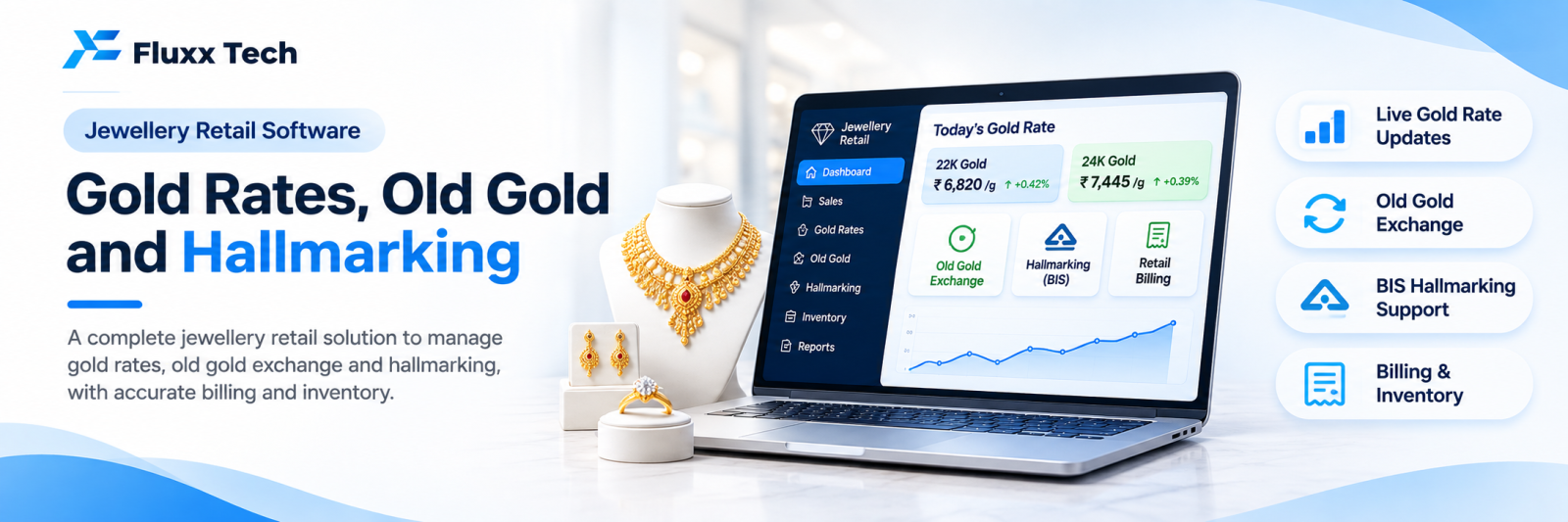
Jewellery retail is unlike any other shop. The price of your main product changes daily. Stock is measured in grams, not pieces. Half your customers bring old gold to exchange. And a large part of your inventory is sitting with karigars, not in the showroom.
Generic billing software cannot do this. Every jewellery business that tries ends up keeping a parallel register.
What makes jewellery billing different
Requirement | Why generic software fails |
Daily rate updates | Price is not fixed on the item |
Weight-based pricing | Gross, net, stone weight, wastage |
Making charges | Per gram, per piece, or percentage |
Purity and karat | 22K, 18K, 916, with conversion |
Old gold exchange | Deduct from the new purchase, at assessed value |
Hallmarking | HUID tracking per piece |
Karigar jobs | Metal issued, ornament received, wastage settled |
Schemes | Monthly savings plans with maturity rules |
Stock in grams | Not unit counts |
Approval / tried-at-home | Items out of the shop, not sold |
Rate management
• One place to set the day’s rate, per metal and per purity
• Rate applied automatically to every bill
• Rate history stored, so an old bill can be explained
• Different rates for sale and for old gold purchase
• Rate locked on a booking, if you offer that
A bill that cannot be reconstructed because nobody recorded that day’s rate is a problem at audit and in any customer dispute.
Billing that handles the real cases
A single bill may include:
• A new ornament: gross weight, stone weight, net weight, wastage, making charges
• Old gold given in exchange: weight, purity after testing, deduction value
• Advance adjusted
• Scheme maturity adjusted
• GST on the correct value
• Balance payable
Each of these must be shown clearly on the bill. Customers compare the arithmetic, and so do tax authorities.
Old gold exchange
The step most likely to cause an argument:
• Record the item received, with weight before and after testing
• Purity assessment result and who did it
• Photograph of the item received
• Value credited, and the rate used
• Where the old gold went: melted, resold, sent for refining
Keep it auditable. “She said it was 22K” is not a record.
Hallmarking and HUID
Hallmarking requirements for gold jewellery in India are set by BIS and have expanded over time, including the unique HUID system. What is mandatory, for which items and which categories of seller, has changed more than once.
Practically, your software should be able to:
• Record the HUID against each piece
• Track which stock is hallmarked and which is not
• Produce the records your registration requires
• Link hallmarking charges to the item
Confirm current BIS requirements for your category and registration with your jewellers’ association and a legal adviser before relying on any software claim. This article is not legal or regulatory advice.
Karigar (goldsmith) management
A significant part of a jeweller’s working capital sits outside the shop.
• Metal issued to a karigar, by weight and purity
• Expected ornament and expected wastage
• Receipt of the finished piece, with actual weight
• Wastage settled against the agreed percentage
• Labour charges payable
• Pending metal with each karigar, at any moment
That last report is the one most jewellers cannot produce accurately today, and it is usually a large number.
Schemes and savings plans
Monthly savings schemes are standard in Indian jewellery retail and are regulated in ways that vary.
• Customer enrolment with plan terms
• Monthly instalment collection and receipts
• Reminders for missed instalments
• Maturity calculation per the scheme rules
• Redemption against a purchase
• Outstanding liability reporting, which matters for your accounts
Scheme rules and any applicable regulatory treatment should be confirmed with your CA and legal adviser; the terms you publish are a commitment.
Stock
• Stock in grams by purity and category, not just piece count
• Item-wise tracking for tagged pieces
• Approval/issue register: items taken out for a customer to see, or sent to an exhibition
• Melting and remaking entries
• Physical verification with weight reconciliation
• Valuation at the current rate
The approval register is where pieces go missing in practice. Anything leaving the showroom needs a record and a return date.
Reports that matter
Report | Why |
Daily sales by metal, purity and category | Performance |
Old gold purchased | A separate business line |
Metal with karigars | Working capital outside the shop |
Making charge income | Your real margin |
Scheme liability | What you owe customers |
Stock valuation at today’s rate | Position |
Approval items pending return | Risk |
Security and privacy
Customer records in jewellery retail include high-value purchase history and sometimes identity documents collected for large transactions.
• Restrict who can see customer purchase history
• Store identity documents securely, only where required, and only as long as required
• Audit trail on every bill edit and cancellation
• Confirm KYC and reporting obligations for high-value transactions with your CA
Frequently asked questions
Can generic retail software handle jewellery? Rarely. Weight-based stock, daily rates, old gold and karigar tracking usually need jewellery-specific or custom software.
Does it handle hallmarking requirements? It can record HUID and hallmark status. Whether that satisfies your obligations depends on current BIS rules; confirm with your association.
What is the biggest gain? Knowing exactly how much metal is with karigars, and being able to reconstruct any bill.