Fluxx Tech
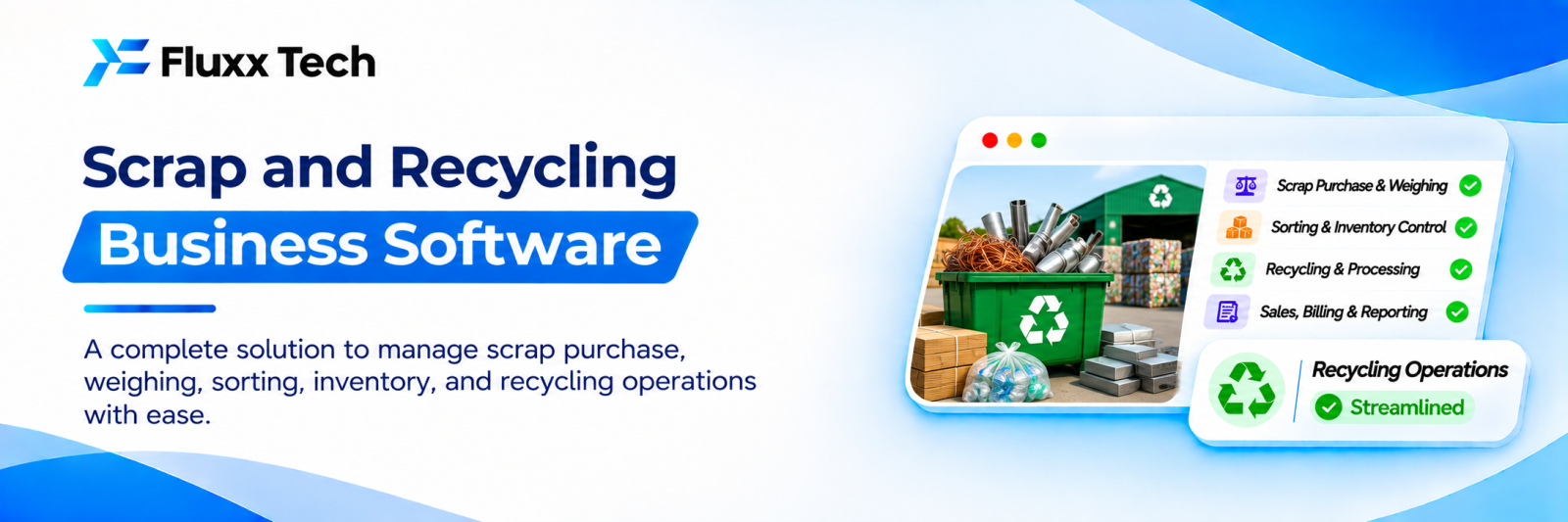
Scrap trading is a weight-and-rate business with daily price movement, cash-heavy vendor payments, and material that changes category between buying and selling. Margin per lot is often thin, and the business is won on volume, segregation and disciplined weighing.
The common failure is simple: nobody can say what a specific lot cost, what it became after segregation, and what it finally sold for.
Purchase
• Vendor record: individual collector, small dealer, industrial supplier, institution
• Vehicle in, weighbridge gross weight
• Material category and grade assessed
• Deductions: moisture, dirt, attached non-metal, impurities
• Net weight after deduction
• Rate applied, from today’s rate card
• Amount payable, and payment mode
• Vehicle out, tare weight
Record the deduction percentage and who assessed it. Deduction disputes are the most frequent argument in this trade, and a consistent record settles them.
Rate management
Scrap rates move daily and vary by grade.
• Rate card per material and grade, dated
• Separate purchase and sale rates
• Rate history retained, so any old transaction can be explained
• Rate change authority: who may change rates, and it should be logged
• Vendor-specific rates for regular suppliers
A margin that disappears when the market moves between buying and selling is the main risk in this business. Recording purchase rate against sale rate per lot is how you see it.
Material categories and grading
Scrap is not one product:
Category | Grades |
Ferrous | Heavy melting, light, turnings, cast |
Aluminium | Sheet, utensil, alloy, extrusion |
Copper | Bright, heavy, armature, wire |
Brass | Honey, mixed, radiator |
Paper | Kraft, newsprint, mixed, carton |
Plastic | PET, HDPE, PP, mixed |
E-waste | Boards, cables, components, CRT |
Battery | Lead acid, lithium |
Each grade has a different rate. A system that treats “metal” as one item cannot produce useful margin reporting.
Segregation and processing
Material bought as mixed becomes several products after sorting.
Mixed lot in (1000 kg)
↓ segregation
Copper 120 kg + Aluminium 300 kg + Iron 450 kg + Waste 130 kg
Record:
• Input lot and weight
• Outputs by category and weight
• Process loss
• Yield percentage per category
• Labour or processing cost
Yield per lot type tells you which sources are worth buying from. Two vendors selling “mixed scrap” at the same rate can have very different yields.
Processing operations — baling, shredding, stripping, dismantling — should record input, output and cost.
Sales
• Buyer record: smelter, mill, recycler, exporter
• Sale lot with material, grade, weight
• Weighbridge at dispatch
• Rate and value
• Transport arrangement
• Buyer’s weight versus your weight, with difference recorded
• Payment terms and receipt
Weight difference at the buyer’s end is a recurring loss. Track it per buyer; a buyer whose weighment is consistently lower than yours is a commercial issue to raise, with data.
Payments and cash discipline
Much of the vendor side is cash, which needs tight control.
• Daily cash issued to the purchase counter
• Payments recorded per transaction, with vendor acknowledgement
• Daily reconciliation: cash issued minus paid equals balance
• Vendor-wise payment history
• Advance payments to regular collectors, tracked against supply
Confirm applicable limits and documentation requirements for cash transactions with your CA; rules on cash payments and reporting apply and change.
Compliance
Scrap and recycling businesses face obligations that vary by material and state: trade licences, pollution control board consent, e-waste and battery handling rules, GST including reverse charge situations, and documentation for movement of goods.
E-waste and battery recycling in particular have specific authorisation and record-keeping requirements under India’s rules, which have been revised.
Confirm your obligations with your pollution control board, your CA and a legal adviser. This article is not legal or regulatory advice.
The software’s role is to produce whatever registers and records you are required to maintain, reliably.
Weighbridge integration
The financially critical point. Connecting the weighbridge removes manual entry at the place where errors cost the most.
• Automatic gross and tare capture
• Vehicle number recorded
• Photograph at weighing
• Weighment slip printed and attached to the transaction
Reports
Report | Decision |
Purchase and sale by material and grade | Volume mix |
Margin per lot | The core number |
Yield by vendor and lot type | Who is worth buying from |
Rate variance: billed vs rate card | Leakage |
Weight difference at buyer end | Buyer-side loss |
Stock by material and grade, with ageing | Capital and price exposure |
Cash reconciliation | Control |
Deduction percentage by assessor | Consistency |
That last row is worth watching. Large variation between assessors on similar material is either inconsistency or something worse.
Frequently asked questions
Is software worth it for a small scrap yard? If you buy from more than a handful of vendors daily, rate and deduction discipline alone justify it.
Can it handle cash-heavy operations? Yes, with daily cash reconciliation. Confirm cash transaction limits with your CA.
What is the biggest hidden loss? Weight differences at the buyer’s end, and poor yield from badly selected purchases. Both are only visible with lot-level records.