Fluxx Tech
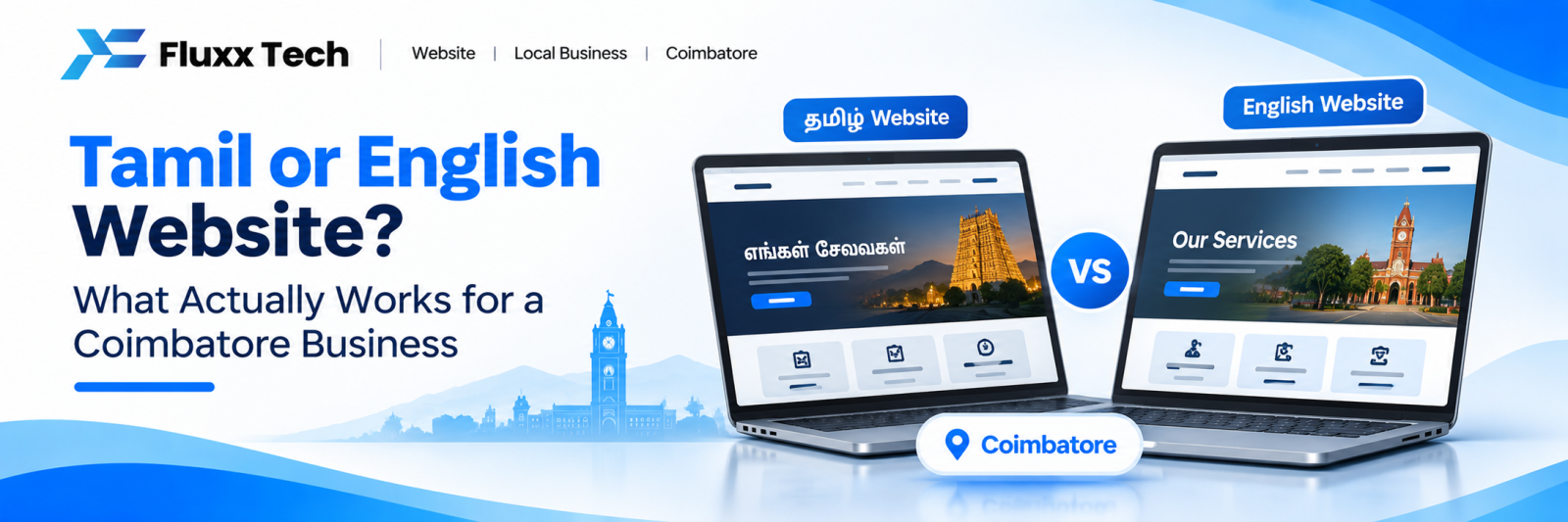
“Should the website be in Tamil?” comes up in almost every first meeting with a local business, and the honest answer is that it depends entirely on who is going to read it and what they type into Google.
Getting it wrong in either direction is expensive. A Tamil-only site cuts you off from buyers outside the state. An English-only site can feel distant to the customer standing in front of your shop.
This article works through the decision properly.
Start with how your customers actually search
Here is the thing most people get wrong: a great many Tamil speakers search in English, or in Tamil typed with English letters.
Three patterns exist:
Pattern | Example | Common among |
English | best dentist in coimbatore | Most urban searchers, all ages |
Tanglish (Tamil in English letters) | coimbatore la best dentist | Very common in conversation and voice search |
Tamil script | கோயம்புத்தூர் பல் மருத்துவர் | A minority of typed searches, growing with voice |
The practical consequence: even customers who speak only Tamil at home often type in English. Google also understands the intent behind Tamil-script queries well enough to return English pages.
So Tamil content is not primarily an SEO decision. It is a trust and comprehension decision.
When Tamil content genuinely helps
Your customer reads Tamil more comfortably than English. Agricultural equipment, local services, traditional trades, government-scheme-related services, healthcare aimed at older patients.
The decision is emotional or high-trust. Healthcare, legal matters, education, financial products. People want to read the important parts in the language they think in.
Your competitors are all in English. A Tamil page becomes a genuine differentiator rather than a box ticked.
You run WhatsApp or ad campaigns in Tamil. The landing page should match the ad. Sending someone from a Tamil ad to an English page breaks the flow.
When English is enough
You sell B2B, to businesses outside Tamil Nadu, or export. A textile exporter’s buyers in Tiruppur, Delhi or Dubai read English.
Your customers are younger and urban. They search in English even when they speak Tamil.
You work in a technical field where the vocabulary is English anyway — software, engineering components, IT services.
You cannot maintain two versions properly. A half-updated Tamil section with old prices and a dead phone number is worse than no Tamil at all.
The three approaches, compared
Approach | What it means | Good for | Watch out for |
English only | One site, English | B2B, export, technical, urban B2C | May feel distant to local walk-in customers |
Full bilingual | Every page in both, language switcher | Healthcare, education, services with mixed audience | Double the content work, forever |
English base + key Tamil pages | Site in English, with Tamil versions of the pages that matter | Most local businesses | Needs discipline about which pages qualify |
The third option is what suits most Coimbatore businesses. You keep one site to maintain, and you translate the few pages where language genuinely changes whether someone enquires — usually the homepage, the main service page, and the contact page.
If you build bilingual, build it properly
A badly built bilingual site creates SEO problems that take months to undo.
Give each language its own URL. Either a subfolder (/ta/) or separate pages. Do not swap text with JavaScript on the same URL — Google will only ever index one version.
Add hreflang tags. These tell Google that /services and /ta/services are the same page in different languages, so it shows the right one and does not treat them as duplicates.
Translate, do not machine-convert. Google Translate output reads as machine output to any native speaker, and it damages trust more than English would have. Pay a person.
Keep the switcher visible on every page, in the header, labelled in both languages — “தமிழ்” and “English”.
Check the font. Tamil script needs a proper web font such as Noto Sans Tamil, loaded correctly, at a slightly larger size than English to stay readable.
Translate the invisible parts too. Page titles, meta descriptions, image alt text, form labels, error messages, button text. A Tamil page with an English “Submit” button and an English title tag is half-done.
What never gets translated
Keep these identical across both versions:
• Business name
• Address
• Phone number
• Email address
These are what Google uses to confirm you are one business. Writing the address in Tamil on one page and English on another creates exactly the inconsistency that hurts local ranking.
The maintenance question
Before committing to bilingual, answer this: who will update the Tamil version when the English one changes?
If the answer is “we will manage”, it will not get done. Within a year the Tamil pages will show last year’s offers and an old number, and customers will trust you less, not more.
If nobody owns it, build the English site well and add Tamil later when you have someone to maintain it.
A practical sequence
1. Build the English site properly first — fast, clear, easy to contact
2. Look at Search Console after three months. Are Tamil-script queries appearing?
3. Talk to your front desk. Which language do walk-in customers and callers use?
4. If Tamil matters, translate the three pages that decide enquiries
5. Add hreflang and a visible switcher
6. Review every six months and keep them in step
Social media and ads are a separate decision
Your website can be English while your Instagram captions are Tanglish and your WhatsApp replies are Tamil. That is not inconsistent — it is matching the medium.
Social media in Coimbatore runs heavily on Tanglish. It reads as natural and local. On a website it can read as careless, because a website is a formal document. Different rules for different places.
Frequently asked questions
Will a Tamil website rank better for Coimbatore searches? Not by itself. Local ranking comes from your Google Business Profile, reviews, relevance and proximity. Tamil content helps when your customers read Tamil, by improving trust and time on page — not by being Tamil.
Can I just add a Google Translate widget? It is better than nothing but it is visibly machine-translated, Google does not index the translated version, and medical or legal content can be rendered badly enough to be misleading.
What about Tanglish on the website? Generally no. Tanglish works in captions, WhatsApp and ads, where it sounds like a person talking. On a website it reads as informal. Use proper Tamil script or proper English.
Should my Google Business Profile be in Tamil? Google Business Profile has one name, address and description. Keep your business name exactly as it appears everywhere else. The description can mention that you serve customers in Tamil.
My customers are mostly local but speak English. Do I need Tamil? Probably not for the website. Spend the budget on speed, clear contact options and reviews instead — those will produce more enquiries than a translation would.