Fluxx Tech
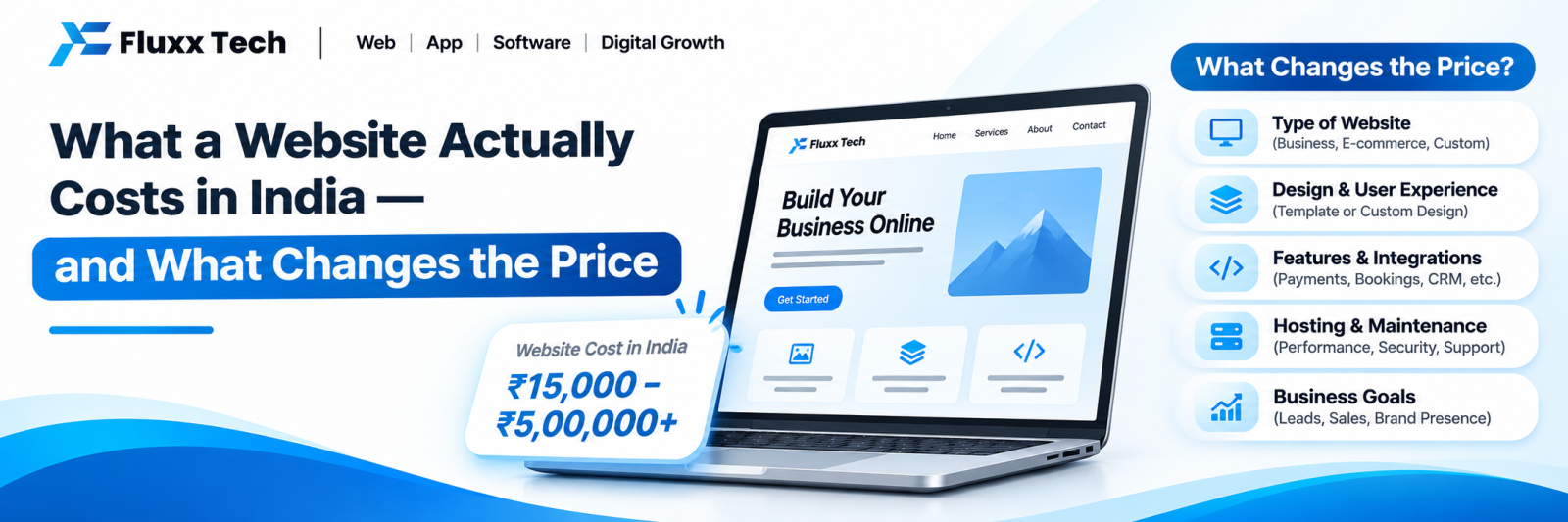
Ask three developers to quote for the same website and you can easily get ₹25,000, ₹90,000 and ₹3,00,000.
The natural assumption is that someone is overcharging. Usually nobody is. They are quoting three different websites against the same one-paragraph brief.
This article explains what actually moves the price, what the market ranges look like, and how to compare two quotations so the comparison means something.
Why the same brief produces wildly different quotes
A brief like “I need a website for my business, about 8 pages” leaves almost everything undecided:
• Who designs it, and is the design custom or from a template?
• Who writes the content?
• Does it need payment, enquiry routing, inventory, a CRM connection?
• Is it a static site or does the client update it themselves?
• Who owns the code afterwards?
• Is there support after launch, and for how long?
Each quote fills those blanks differently, silently. The number you receive is the output of assumptions you never saw.
Market ranges in India
These are approximate market ranges, not a price list. Your quote depends on scope, complexity and who is doing the work.
Type of website | Approximate market range |
Basic informational site, template design, 5–8 pages | ₹15,000 – ₹50,000 |
Business website, custom design, 10–20 pages | ₹50,000 – ₹1,50,000 |
Ecommerce store, standard platform | ₹60,000 – ₹2,50,000 |
Ecommerce with custom features and integrations | ₹2,50,000 – ₹6,00,000+ |
Web application or portal with user accounts | ₹3,00,000 upwards |
Landing page, single page | ₹8,000 – ₹30,000 |
Annual running costs sit outside these figures: domain, hosting, SSL, maintenance and any licensed plugins or themes.
A caution on the bottom of each range. Very low quotes are usually template-based, with content you write yourself, no optimisation, and no ongoing support. That can be exactly right for a new business with no budget. It becomes expensive when the site has to be rebuilt in a year.
The six things that actually move the price
1. Number of pages — and how different they are
Twenty pages that share one layout cost far less than eight pages that each need their own. A homepage, a service page template and a contact page is three designs. A homepage, five different service layouts, a portfolio grid and a careers page is eight.
Ask for the quote to state the number of unique page designs, not just the page count.
2. Custom design or template
| Template | Custom |
Cost | Lower | Higher |
Time | Days | Weeks |
Looks like competitors | Possibly | No |
Changes later | Limited by the template | Open |
A good template, properly adapted, is a perfectly reasonable choice for many businesses. The problem is a quote that says “custom design” and delivers a template with your logo on it. Ask to see the design before development starts.
3. Ecommerce
Selling online changes the project substantially: product pages, variants, cart, checkout, payment gateway, shipping rules, tax configuration, order management, and an admin your team can actually use.
The cost scales with product count, variant complexity and how many of your existing systems it has to talk to.
4. Integrations
Each connection to another system is work, and each one is a place where things can break later.
• Payment gateway — Razorpay, PayU, Stripe
• WhatsApp Business API for enquiries and order updates
• CRM or lead management
• Inventory or billing software
• Email marketing
• Analytics and conversion tracking
• Booking or appointment systems
A quote that does not list integrations has probably not priced them.
5. Who writes the content
This is the single most commonly hidden item.
A cheap quote almost always assumes you will supply all the text, images and product descriptions. That sounds manageable until you are three weeks past the deadline because nobody has written the About page.
Professional content writing, product photography and image sourcing are real line items. If a quote does not mention them, they are yours.
6. Who owns the code
Ask this explicitly, in writing.
Some arrangements leave the code with the developer and the client with a licence to use it. If you later want a different developer, you may find you cannot take the site with you.
What you want stated:
• Source code ownership transfers to you on final payment
• You get the repository or full file access
• Domain and hosting registered in your business name
• All third-party accounts in your name
What should be in a quotation
A number with no scope is not a quotation. Ask for this structure:
Section | What it should state |
Pages | Count, and how many unique designs |
Design | Custom or template; how many concepts; how many revisions |
Content | Who writes it, who sources images |
Features | Every function, listed |
Integrations | Every system it connects to |
Mobile | Responsive across phone, tablet, desktop |
SEO basics | Titles, meta descriptions, sitemap, schema, speed |
Browser testing | Which browsers and devices |
Timeline | Phase by phase, with what you must supply and when |
Revisions | How many, at which stages |
Training | Will your team be shown how to update it |
Support | What is covered after launch, for how long |
Ownership | Code, domain, hosting, accounts |
Payment terms | Milestones |
Out of scope | What would be charged extra |
That last row matters more than people expect. A quotation that never says what is excluded will produce a dispute later.
Comparing two quotes
Put both into the same table before looking at either number.
| Quote A | Quote B |
Total |
|
|
Unique page designs |
|
|
Custom or template |
|
|
Content written by |
|
|
Images sourced by |
|
|
Ecommerce included |
|
|
Integrations listed |
|
|
SEO basics included |
|
|
Revisions allowed |
|
|
Timeline |
|
|
Training included |
|
|
Support period |
|
|
Source code ownership |
|
|
Accounts in whose name |
|
|
Very often the cheaper quote turns out to exclude content, integrations and ownership — which means the gap was never really about price.
What is not included in a website quote
Budget for these separately:
Item | Typical frequency |
Domain renewal | Yearly |
Hosting | Monthly or yearly |
SSL certificate | Often included with hosting |
Maintenance and updates | Monthly or as needed |
Content updates after launch | Ongoing |
SEO and marketing | Ongoing, separate from the build |
Premium plugins or licences | Yearly |
A website is not a one-time purchase. A site nobody maintains becomes slow, insecure and out of date within about two years.
Where businesses waste money
Paying for pages nobody reads. A twenty-page site where four pages get all the traffic. Start smaller and add pages once you know what people search for.
Rebuilding instead of fixing. Many slow or dated sites can be repaired for a fraction of a rebuild. Get a second opinion before replacing something that works.
Paying for design and skipping content. A beautiful site with placeholder text and stock photos converts worse than a plain site with real information.
Skipping conversion basics. A tappable phone number in the header, a WhatsApp button, and a form that actually arrives. These cost almost nothing and decide whether the site produces enquiries.
Not budgeting for after launch. The site goes live and nothing is set aside to maintain or market it.
How to decide what to spend
Work backwards from what the site has to do.
If the site is a brochure — people who already know you check your address and services — a modest, fast, clear site is enough.
If the site has to bring enquiries — people find you through search and judge you against competitors — then content, speed and search optimisation matter more than visual polish, and the budget should reflect that.
If the site is the business — ecommerce, bookings, a portal — it is infrastructure, not marketing material, and should be budgeted as such.
Most businesses are in the middle case and spend as though they are in the first.
Frequently asked questions
How long does a website take to build? A small informational site typically takes two to four weeks. A business site with custom design takes four to eight. Ecommerce takes longer. The usual cause of delay is content, not development.
Is WordPress cheaper than a custom build? Usually, for standard requirements, because much of the groundwork already exists. Custom becomes worthwhile when the requirement does not fit an existing platform.
Should I pay the full amount upfront? No. Milestone payments are standard — typically an advance, a payment at design approval, and the balance at launch.
What if I need changes after launch? Agree this before you start. Most quotes include a short free period for fixes, after which changes are billed. Get that stated in writing.
Can I update the website myself? Ask specifically. A site built on a CMS with training is very different from one where every text change requires the developer.
Why do some agencies not publish prices? Because the price depends entirely on scope, and a published figure for a website that has not been scoped is a guess. What a business should publish is how pricing is determined — and then quote properly once the requirement is known.