Fluxx Tech
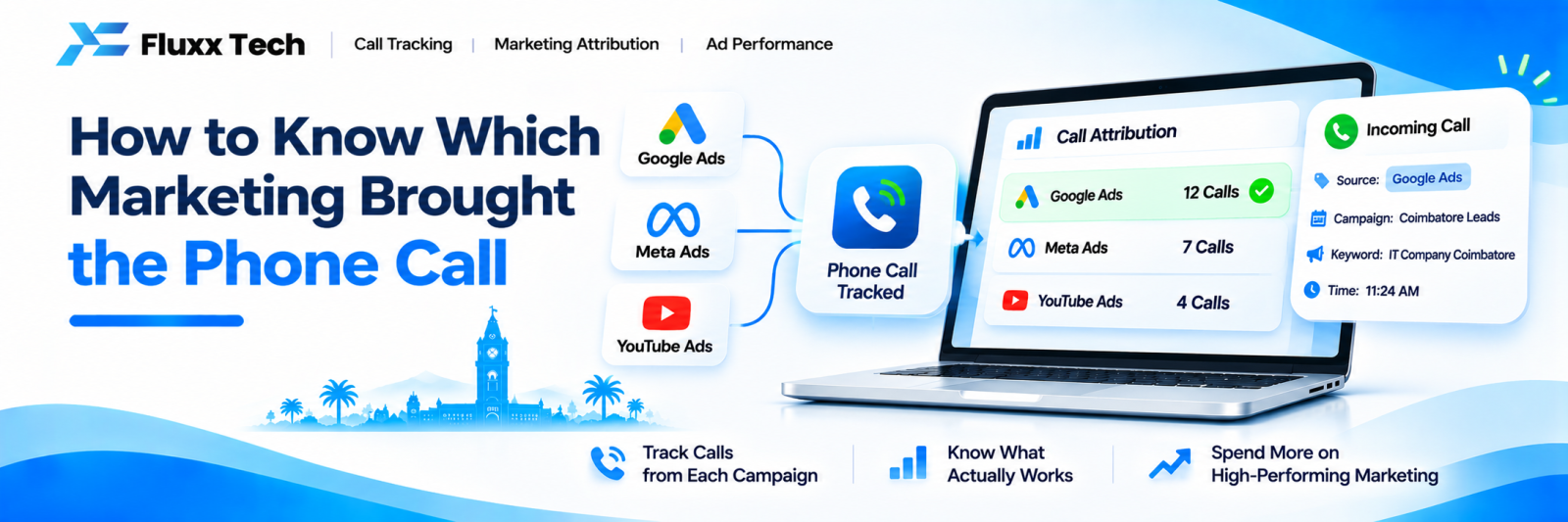
Here is the problem almost every Indian local business has with marketing measurement.
Analytics shows website visits. Ads show clicks. Search Console shows impressions. And the actual enquiries arrive as phone calls and WhatsApp messages, where none of those tools can see them.
So the owner is left with two numbers that do not connect: money spent, and a phone that rings. Which spend caused which ring is a mystery, and so the budget gets allocated on instinct.
This is solvable, and most of the solutions are simple.
Method 1: Just ask
The cheapest and most underrated method.
Every enquiry gets one question: “How did you find us?”
Log the answer. A notebook works. A shared sheet works better.
Date | Name | Enquiry | How they found us | Converted |
18 Nov | Suresh | AC service | Yes | |
18 Nov | Priya | Quote | No | |
19 Nov | Karthik | Website redesign | Referral | Pending |
Make it work properly
• Ask every single time, not when you remember
• Train whoever answers the phone to ask it naturally, after the enquiry is handled
• Keep the categories simple: Google, Instagram, Facebook, JustDial, referral, walk-in, repeat
• When someone says “online”, follow up with “Google or Instagram?”
Its limits: people misremember. Someone who saw an Instagram post, then searched your name on Google, will say Google. Treat it as directional, not precise.
But even imperfect data beats none. If three months of logging shows forty enquiries from Google and two from Instagram, that tells you something real about where the budget belongs.
Method 2: Click tracking on your buttons
This captures intent even when the call itself is invisible.
When someone taps your phone number or WhatsApp button on the website, that tap can be recorded as a conversion event in Google Analytics 4.
What you need
• Your phone number as a proper tel: link, and WhatsApp as a wa.me link
• GA4 set up with those clicks tracked as events
• Those events marked as key events (conversions)
What it gives you
• How many people intended to call, from which page
• Which traffic source those people came from
• Which pages produce contact attempts and which do not
What it does not give you: whether the call connected, how long it lasted, or whether it became a customer. It measures intent, not outcome. Still, knowing that your service page produces four times the call taps of your homepage is genuinely useful.
Method 3: Separate numbers per channel
Straightforward, no technology required.
Use a different phone number in different places:
Channel | Number |
Website | Number A |
Google Business Profile | Number B |
JustDial and directories | Number C |
Printed material and hoardings | Number D |
Every call to number C came from a directory. No ambiguity.
Practical notes
• Do not overdo it. Three or four numbers is manageable; ten is chaos.
• Google Business Profile is an exception — keep your main number there, consistent with every other listing, because NAP consistency matters for local ranking. Google provides call history on the profile anyway.
• All numbers must be answered equally well. A number that goes unanswered produces a lost customer and a misleading data point.
Method 4: WhatsApp link parameters
If a meaningful share of your enquiries arrive on WhatsApp — and for most Indian local businesses they do — this is the highest-value method.
A wa.me link can carry a pre-filled message. Use a different one in each place:
Where the link is | Pre-filled message |
Website service page | “Hi, I’m enquiring about AC service” |
Instagram bio | “Hi, I saw your Instagram page” |
Google Business Profile | “Hi, I found you on Google” |
Meta ad | “Hi, I’d like to know about the offer” |
The customer sends it without editing. You now know the source from the first message, with no tools, no setup cost, and no guessing.
This is the single easiest high-value tracking change most businesses can make this week.
Method 5: UTM tags on links you control
For any link you place somewhere — Instagram bio, a WhatsApp broadcast, an email, a QR code — add UTM parameters so analytics can attribute the visit.
https://fluxxtech.com/?utm_source=instagram&utm_medium=bio&utm_campaign=profile
Parameter | What it records |
utm_source | Where it came from — instagram, whatsapp, justdial |
utm_medium | The type — bio, broadcast, qr, email |
utm_campaign | Which campaign — diwali2026, newsite |
Use Google’s Campaign URL Builder to generate them. Keep your naming consistent — “Instagram” and “instagram” are counted separately.
Never put UTM tags on internal links between pages of your own site. It breaks attribution and makes every internal click look like a new visit from an external source.
Method 6: QR codes with their own destination
For print — visiting cards, boards, vehicle branding, packaging, exhibition stands — give each QR code its own tagged URL.
A QR on your shop board pointing to yoursite.com/?utm_source=shopboard tells you whether anyone ever scans it. Usually the answer is sobering, and that is useful to know before printing more.
Putting it together
You do not need all six. A workable setup for a local business:
1. Ask every caller and log it — covers everything, including offline
2. Different WhatsApp pre-filled messages per channel — free, immediate
3. Click tracking on call and WhatsApp buttons — tells you which pages work
4. UTM tags on every link you place yourself
5. One separate number for directories, since those are easy to isolate
That covers most of what you need to decide where next month’s budget goes.
Reading the data without fooling yourself
The first touch and the last touch are different things. Someone may discover you on Instagram, follow you for two months, then search your name on Google and call. Analytics credits Google. Instagram did the work. This is why asking “how did you find us” matters alongside the tools.
Do not judge on a week. Local enquiry volumes are small enough that a single busy week means nothing. Look at months.
Count enquiries, not traffic. A channel sending 2,000 visits and two enquiries is worse than one sending 200 visits and fifteen.
Track what happens after the enquiry. Fifty enquiries that produce two customers is a different problem from five enquiries that produce three. Log the outcome, not just the arrival.
A monthly review worth doing
Once a month, fill in this table:
Channel | Spend | Enquiries | Customers | Cost per customer |
Google Ads |
|
|
|
|
Meta Ads |
|
|
|
|
Organic search |
|
|
|
|
Google Business Profile |
|
|
|
|
JustDial / directories |
|
|
|
|
Instagram organic |
|
|
|
|
Referrals |
|
|
|
|
Three months of this will change how you spend, more than any dashboard.
Frequently asked questions
Is call tracking software worth buying? Dedicated call-tracking services exist and do work, but for most small local businesses the manual methods above capture enough. Consider paid tools when spend is large enough that a percentage improvement justifies the cost.
Will using different phone numbers hurt my SEO? Not if your Google Business Profile and all directory listings carry the same primary number. The variation should be on your own website and print material, not on citation sites.
Can I see who called from my Google Business Profile? The profile shows call volume and timing in its performance data. It does not give you numbers, but it tells you how many calls the listing produced.
How do I track walk-in customers? Ask them. It is the only way, and it is the most honest data you will get.
Someone says “I just found you online”. What then? Ask one follow-up: “Was that on Google, or on Instagram?” Most people can answer that.