Fluxx Tech
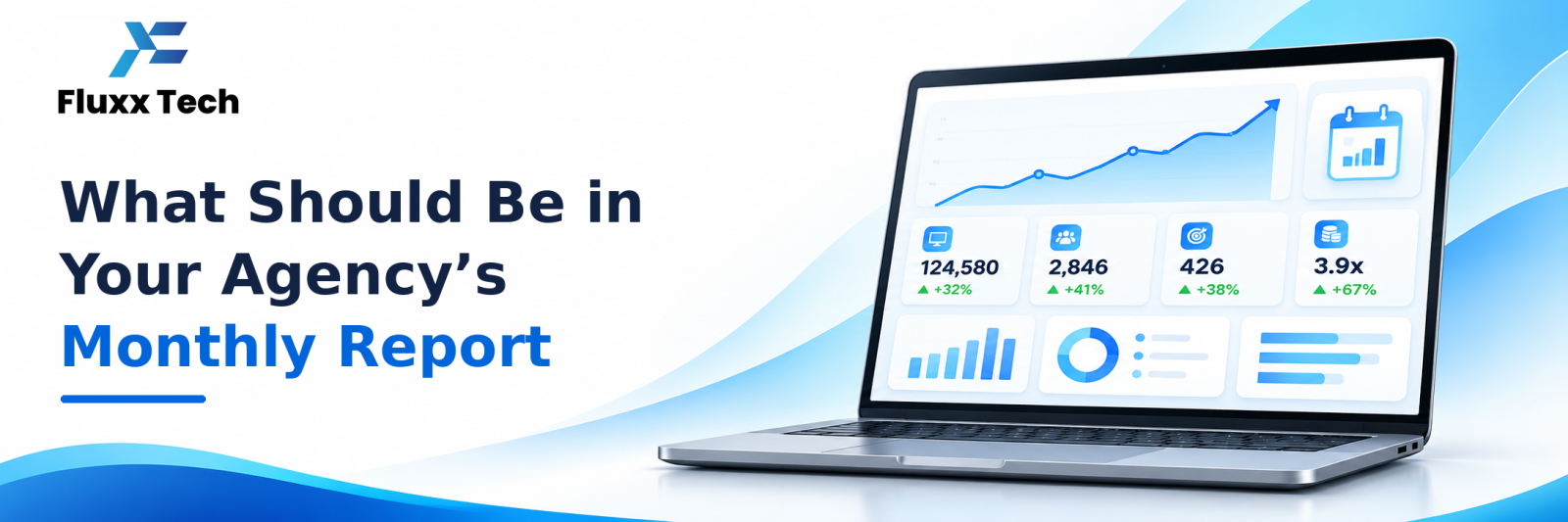
Every month a PDF arrives. It has charts. The numbers are mostly green. You skim it, file it, and pay the invoice.
Then three months later someone asks what the agency has actually achieved, and you realise you cannot answer.
The problem is rarely that the agency is doing nothing. The problem is that most agency reports are built to look reassuring rather than to be read. This article covers what a report should contain, what is filler, and how to ask for a better one.
The test a report has to pass
One question: can you tell what was done last month, and what it produced?
If the report answers both, it is a report. If it only shows numbers going up, it is a dashboard. Dashboards are not useless, but they are not accountability.
A dashboard tells you the temperature. A report tells you who turned the heating on.
The seven things that belong in it
1. Work completed, with specifics
This is the section most reports do not have, and the most important one.
Not “optimised website content”. Instead:
Date | What was done | Where |
4 Nov | New service page published | /services/web-development |
9 Nov | Title and meta rewritten, 6 pages | List attached |
14 Nov | Blog published | /blog/website-speed-indian-networks |
18 Nov | Internal links added from 12 posts | List attached |
21 Nov | Image compression across the site | Site-wide |
With URLs. You should be able to click and see the work.
2. Keyword positions — up and down
A list of your target keywords, this month’s position, last month’s position, and the change.
Keyword | Last month | This month | Change |
digital marketing companies in coimbatore | 12.4 | 10.7 | ▲ 1.7 |
seo company in coimbatore | 24 | 19 | ▲ 5 |
web development company in coimbatore | 31 | 34 | ▼ 3 |
Both directions. A report where every keyword improved every month is not a report, it is a selection. Ask for the full tracked list, not the highlights.
3. Search Console numbers
Impressions, clicks, average click-through rate, average position — this month against last month.
These come from your own Search Console, so you can verify them. That is exactly why they belong in the report.
Read them together, not separately:
Pattern | What it means |
Impressions up, clicks up | Working |
Impressions up, clicks flat | Ranking for the wrong things, or weak titles |
Both flat | Little is happening |
Both down | Something changed — needs explaining |
4. Indexing status
How many pages Google has indexed, and whether that number moved.
If four articles were published and the indexed count did not change, something is wrong — either they were not published, or Google has chosen not to index them. Both need an answer.
5. Enquiries from organic search
The number that actually matters, and the one most often missing.
• Calls traced to the website or Google Business Profile
• Form submissions
• WhatsApp messages
• Where possible, how many became customers
If the agency says this cannot be measured, the honest response is that measurement has not been set up. It can be — call clicks, WhatsApp clicks and form submissions can all be tracked as conversions.
6. Google Business Profile activity
For a local business this is half the work, so it belongs in the report:
• Profile views, searches, calls, direction requests
• Posts published
• Photos added
• Reviews received and replied to
• Questions answered
7. Next month’s plan
Specific. “Continue SEO activities” is not a plan.
December: publish /services/ecommerce-development and /services/mobile-app-development, add internal links from 15 existing posts to the main Coimbatore page, rewrite titles on the 10 pages with highest impressions and lowest CTR, request indexing on all new pages.
You should be able to hold them to it next month.
What is padding
In the report | Why it is filler |
“Engagement increased” | Engagement with what? By how much? Compared to when? |
Impressions alone, with no clicks | Appearing is not visiting |
Social media followers | Rarely connected to revenue |
Screenshots of tools with no interpretation | Data is not analysis |
Bounce rate as a headline metric | Easily misread; depends heavily on page type |
A keyword list where everything improved | Selection, not reporting |
Charts with no axis labels | Unverifiable by design |
Long explanations of algorithm updates | Usually context for why nothing moved |
None of these are lies. They are simply not accountability.
How to read the report in ten minutes
Minute 1–2. Go to the work section. Can you name five specific things done last month? If not, stop and ask.
Minute 3–4. Look at keyword positions. Count how many moved up, how many down. If nothing moved either way for three months, ask what is expected to change that.
Minute 5–6. Check Search Console numbers against your own account. They should match.
Minute 7–8. Find the enquiry number. If there isn’t one, that is this month’s question.
Minute 9–10. Read next month’s plan. Is it specific enough that you could check it next month?
A template you can send
If your report is not giving you this, send the structure you want. Most agencies will adapt.
Monthly report — [Month]
1. Work completed Date · what was done · URL
2. Keyword positions Keyword · last month · this month · change (full tracked list)
3. Search Console Impressions · clicks · CTR · average position, vs previous month
4. Indexing Pages indexed, change from last month, anything not indexed and why
5. Enquiries from organic search Calls · forms · WhatsApp · any that became customers
6. Google Business Profile Views · calls · direction requests · posts · photos · reviews
7. Next month Specific deliverables with dates
Red flags in a monthly report
• It arrives late, or only when you ask for it
• It is the same document with the numbers changed
• There is no work section
• You cannot verify any number independently
• Every metric improves, every month
• There is no mention of anything that did not work
• Nobody offers to walk you through it
That last one matters. A monthly call of fifteen minutes, where someone explains what happened and what is next, is worth more than a forty-page PDF.
What a good report changes
When the report contains work and enquiries rather than impressions and engagement, three things follow.
You can tell whether the spend is justified. You can hold the agency to a plan. And the agency starts doing work that produces enquiries, because that is what is being measured.
Measurement shapes behaviour. If a report is judged on impressions, you will get impressions.
Frequently asked questions
How long should a monthly report be? Two to four pages. Length is often used to hide the absence of substance.
Should I expect results every month? No. SEO is slow, and some months are foundation work with no visible movement. What you should expect every month is a clear account of what was done.
My agency says enquiries cannot be tracked. Is that true? Form submissions, call-button clicks and WhatsApp clicks can all be tracked as conversions in Google Analytics. Offline walk-ins cannot, which is why “how did you find us?” is worth asking every caller.
What if the report shows everything improving but the phone isn’t ringing? Then you are ranking for searches with no buying intent, or your site is not converting the visitors it gets. Both are fixable, and both start with reading the actual search queries in Search Console.
Can I ask for the report in a different format? Yes. It is your report. Send the template above.
Should there be a monthly call? Ideally yes, even a short one. Most misunderstandings between a business and its agency come from a report nobody explained.